
About George Wetherill
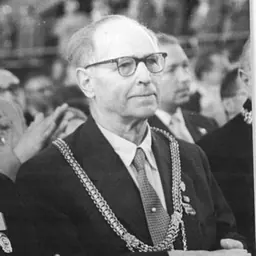
Lived 1925 – 2006 (aged 80). George Wetherill was an American physicist, astronomer, nuclear physicist, university teacher, director and geologist, known for Meteoritics, Nebular hypothesis and Radioactive Dating.
George Wetherill (August 12, 1925 – July 19, 2006) was an American physicist and geologist. He was the director emeritus of the department of terrestrial magnetism at the Carnegie Institution of Washington.
In 2000, Wetherill received the J. Lawrence Smith Medal from the National Academy of Sciences "For his unique contributions to the cosmochronology of the planets and meteorites and to the orbital dynamics and formation of solar system bodies."
Career and achievements Department of Terrestrial Magnetism (1953–1960) After receiving his Ph.D., Wetherill became a staff member at Carnegie's Department of Terrestrial Magnetism (DTM) in Washington, D.C. There, he joined an interdepartmental group who were working to date rocks using geochemical methods that measured natural radioactive decay. This involved determining the concentration and isotopic composition of inert gases such as argon, as well as the isotopes of strontium and lead.
University of California, Los Angeles Wetherill left DTM in 1960 to become a professor of geophysics and geology at the University of California, Los Angeles. There, he served as chairman of the interdepartmental curriculum in geochemistry (1964-1968), and as chairman of the Department of Planetary and Space Sciences (1968-1972).
Department of Terrestrial Magnetism (1975–1991) In 1975, Wetherill returned to Carnegie's Department of Terrestrial Magnetism as director. He remained director until 1991, when he became a staff member. At DTM, he began extending his research efforts into questions concerning the origin of the terrestrial planets--Mercury, Venus, Earth, and Mars. He was stimulated by earlier studies by Victor Safronov (O. Yu. Schmidt Institute, Moscow), who showed that as a swarm of planetesimals coagulated into large bodies the swarm could evolve to produce a few terrestrial planets. Wetherill developed a technique to calculate numerically the orbital evolution and accumulation of planetesimal swarms, and he used the technique to reach specific predictions of the physical and orbital properties of terrestrial planets. His results agreed well with present observations.
In addition to showing how the inner solar system formed, Wetherill's work provided the basis for a model of a giant-impact origin for the Moon and the core of Mercury. It also led to explanations for the isotopic abundances of present-day planetary atmospheres.
Wetherill has shown that Jupiter plays an important role in the evolution of the Solar System; by ejecting comets from the Solar System, it offers a protective presence to the inner planets.
Community engagement Wetherill provided leadership in the scientific community by serving on advisory committees for NASA, the National Academy of Sciences, and the National Science Foundation. For 15 years, he was editor of the Annual Review of Earth and Planetary Sciences.
He served as president of the Meteoritical Society, the Geochemical Society, the Planetology Section of the American Geophysical Union, the International Association of Geochemistry and Cosmochemistry, and was a member of the American Philosophical Society.
Wetherill died at his home in Washington, D.C., on July 19, 2006, aged 80, after a long illness.
Awards 1974, Member, National Academy of Sciences 1977, National Medal of Science, National Science Foundation 1984, G. K. Gilbert Award, Geological Society of America 1986, G. P. Kuiper Prize of the Division of Planetary Sciences of the American Astronomical Society 1991, Harry H. Hess Medal of the American Geophysical Union 1997, National Medal of Science awarded by President Clinton 2000, J. Lawrence Smith Medal, National Academy of Sciences 2003, Henry Norris Russell Lectureship, American Astronomical Society
Don’t just read it —
keep it.
Full-length biographies made to live with: read them, listen on the way to work, watch them tonight.
- E-book
- Audio
- Video
Instant download · yours to keep · every purchase keeps this site free
Important facts
more
G.W. Wetherill, George W Wetherill, G W WetherillPeople in George Wetherill's life
Named in this biography and alive at the same time



Related people
Same field, nearest in time



Contemporaries
People whose lives overlapped George Wetherill's



Frequently asked questions
Who was George Wetherill?
American physicist (1925–2006)
When was George Wetherill born?
George Wetherill was born on 12 August 1925 in Philadelphia.
When did George Wetherill die?
George Wetherill died on 19 July 2006 in Washington, D.C..
What was George Wetherill's occupation?
George Wetherill was a physicist, astronomer, nuclear physicist, university teacher, director and geologist.
What was George Wetherill known for?
George Wetherill was known for Meteoritics, Nebular hypothesis and Radioactive Dating.
What nationality was George Wetherill?
George Wetherill was American.
Sources & further reading
Cite this page
APA: Biography.guide. (2026). George Wetherill. https://biography.guide/george-wetherill/
MLA: "George Wetherill." Biography.guide, https://biography.guide/george-wetherill/.
Chicago: "George Wetherill." Biography.guide. https://biography.guide/george-wetherill/.
Data last updated: 2026-09-20 · Spot an error? Report a correction.
Page generated 2026-09-27 05:05 UTC