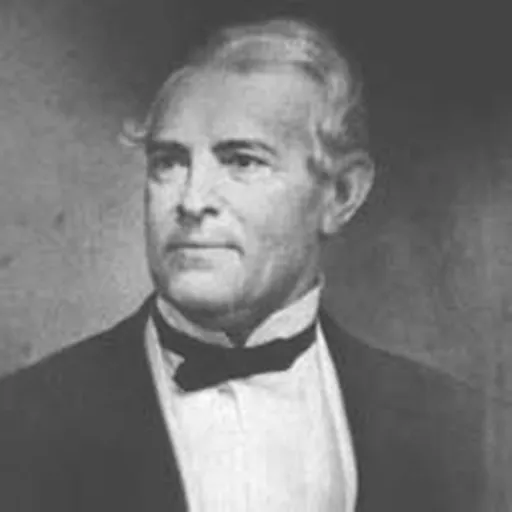
About George Trenholm
Lived 1807 – 1876 (aged 69). George Trenholm was an American politician, businessperson and ship-owner.
George Alfred Trenholm (February 25, 1807 – December 9, 1876) was a South Carolina businessman, financier, politician, and slaveholding planter who owned several plantations and strongly supported the Confederate States of America. He was appointed as its Secretary of the Treasury during the final year of the American Civil War.
His merchant firm was estimated to have made $9 million by blockade running with its 60 ships during the war. Although he was imprisoned briefly after the war and suffered economic setbacks, Trenholm prospered. In the postwar years, Trenholm was a prominent philanthropist, aiding black and white South Carolinians. He also served on railroad and bank boards. He was elected to state office again in 1874 and died in office.
He was one of the few Confederate cabinet members who returned to political office in the United States after the Civil War.
Early and family life George Alfred Trenholm was born on February 25, 1807, in Charleston, South Carolina to Elizabeth Irene (de Greffin) Trenholm and her merchant husband, William Trenholm. His maternal grandfather, Comte de Greffin, was a major plantation owner in Saint Domingue (before the slave revolution; it is now Haiti). His paternal grandfather, William Trenholm (1737-1822), was born in Yorkshire, England, but he lived and worked in Charleston most of his adult life. He was forced to leave during the American Revolutionary War due to his Loyalist sympathies and business associations. He lived in New York, the Netherlands, and Santo Domingo, but returned to Charleston in 1785, shortly after the war's end, and lived there for another 37 years. He introduced his son William (1772-1824) into the family business. When his father died, George Trenholm left school and went into business.
Career At 16, George Trenholm had begun working for a major cotton broker, John Fraser and Company in Charleston. He rose to become a partner, and by 1853, when he was 46, he led the company. Fraser died in 1854, and it became Fraser and Trenholm. By 1860 Trenholm became one of the wealthiest men in the Southern United States, owning real estate worth $90,000 and personal property (including enslaved people) valued at about $35,000 . His financial investments included steamships, hotels, wharves, cotton and plantations. Trenholm's family enslaved about 39 persons as domestic staff Trenholm was also director of the Bank of Charleston and a South Carolina railroad.
A member of the Democratic Party, Trenholm was elected to the South Carolina legislature in 1852 and served until 1856. After President Abraham Lincoln's election in 1860, Trenholm strongly supported the secession of the Confederacy, which South Carolina led among the top six of the major slave states.
Former offices of Fraser, Trenholm & Co. in Rumford Place, Liverpool (photographed in 2019).Trenholm's wealth increased as his 60 commercial ships ran the U.S. Navy blockade. The ships carried cotton, tobacco, and turpentine to England and brought back coal, iron, salt, guns, and ammunition. Josiah Gorgas, the Confederate chief of ordnance, estimated that by March 1863, Trenholm's company had made $9 million (equivalent to $ million in ) by blockade running. His company - now called Fraser, Trenholm and Company - became the Confederate government's overseas banker. The office in Liverpool arranged cotton sales and financed its own fleet. The U.S. consul in Liverpool, Thomas Dudley, estimated Trenholm's fleet imported $4.5 million of cotton into Great Britain. However, Confederate President Jefferson Davis vetoed Trenholm's suggestion that the Confederacy buy decommissioned British East India Company ships for $10 million.
Trenholm and his Liverpool-based partner Charles K. Prioleau (son of a Charleston lawyer) worked with fellow American James Dunwoody Bulloch as Confederate foreign agents in Britain to manage their arrangements, especially shipping munitions home. Britain depended on the South's cotton exports. Continuing cotton exports to Britain helped the Confederacy financially and shaped British public opinion toward the Confederate cause.
Trenholm served again in the South Carolina legislature from 1860 to 1863.
In January 1864, Trenholm's daughter Emily married William Miles Hazzard, a Confederate scout. Trenholm deeded the Annandale and Beneventum plantations to Hazzard shortly after the war's end, trying to protect them from potential confiscation by the United States government.
Confederate Treasury Secretary Christopher Memminger, a fellow Charlestonian and friend, used Trenholm as an unofficial adviser for almost four years. When Memminger resigned on July 1, 1864 (due to public outcry after he issued millions of Confederate bank notes at one-third the value of the old ones), and moved back to Flat Rock, North Carolina, Trenholm succeeded him. He was formally appointed on July 18, 1864. Trenholm was a more charismatic figure than his predecessor. Together with his constant published updates, he had better press relations and contact with the Confederate Congress. Trenholm had a "never give up the ship" personality but could do little to stop the financial havoc as the rebel government grew insolvent and printing money caused inflation. Trenholm advocated direct taxation, reducing the circulation of paper currency, further public subscriptions for war bonds, and purchasing blockade runners (rather than continuing to rely on private shippers), but the Confederate Congress refused to pass those measures. The last published account of it reported $86,000 in specie hidden in the false bottom of a carriage and entrusted to James A. Semple, a Naval paymaster and son-in-law of ex-President John Tyler. He was supposed to take it to Liverpool to pay Confederate accounts. Secretary of State Judah Benjamin used a $1,500 gold warrant signed by Trenholm to secure his passage on a boat to Britain.
Days later, Trenholm was transported by ambulance to another train carrying the Confederate government into North Carolina, where they learned President Abraham Lincoln had been assassinated on April 14. Eventually, the Confederate government, including Trenholm, reached Fort Mill, South Carolina. Upon hearing of General Robert E. Lee's surrender at Appomattox Court House, Virginia on April 9, the local commander in Charlotte, North Carolina, General John Echols, had offered his troops the choice of surrendering or continuing to fight. Half his cavalry and almost all infantry left for home. Only 1,000 men followed General Echols to meet with President Jefferson Davis and the remaining Confederate cabinet members in Fort Mill. Trenholm asked President Davis to accept his resignation, citing his ill health, and Davis accepted with his thanks on April 27, 1865.
Imprisonment and parole Trenholm had six rice plantations to manage in Georgetown County, South Carolina, having bought many in 1863 before assuming his public role. He traveled from Abbeville to South Carolina College in Columbia, South Carolina for the wedding on June 1, 1865 of his son Frank to Mary Elizabeth Burroughs in the house of the college president. Trenholm, his wife, and daughters moved into their newly purchased estate, now named DeGreffin, near Columbia, South Carolina. U.S. Army troops had burned it in a raid. They left the Abbeville house to William and his family.
Around June 12, a U.S. officer asked Trenholm to come to them in Charleston to answer questions. Escorted by his future son-in-law James M. Morgan (or by his son William, under alternate accounts) and carrying a bag of gold pieces, Trenholm drove to Orangeburg, South Carolina. He took the train to Charleston, where he was arrested at the depot and escorted to jail by United States Colored Troops on June 13. The U.S. government accused him of making off with millions in Confederate assets. He was soon joined in jail by Theodore Dehon Wagner, the manager of Trenholm, Fraser & Co.
Trenholm was briefly imprisoned at Hilton Head, South Carolina, but General Quincy Gillmore, who knew him and of his kindnesses toward U.S. prisoners during the war and recognizing his physical disability, issued him a written parole on June 25 to allow him to return to his home and the corporate limits of Columbia, South Carolina. In July, Gillmore was relieved of his command, and Trenholm was arrested again on July 12. He was allowed guests, including many former high Confederate officials. Fellow prisoners included James A. Seddon, David Yulee, R.M.T. Hunter, former Florida governor A.K. Allison, Charles Clark of Mississippi, A.G. Magrath, and assistant Secretary of War, James A. Campbell—all of whom were allowed liberty around the island after giving their parole of honor on August 21.
North Carolina erected a historical highway marker near his estate Solitude, where he and Memminger spent summers during his final years.
Gone with the Wind Popular legend suggests that Trenholm and his exploits inspired Margaret Mitchell's character of Rhett Butler in her novel Gone with the Wind.
Don’t just read it —
keep it.
Full-length biographies made to live with: read them, listen on the way to work, watch them tonight.
- E-book
- Audio
- Video
Instant download · yours to keep · every purchase keeps this site free
Important facts
People in George Trenholm's life
Named in this biography and alive at the same time

Related people
Same field, nearest in time



Contemporaries
People whose lives overlapped George Trenholm's






Frequently asked questions
Who was George Trenholm?
American politician (1807-1876)
When was George Trenholm born?
George Trenholm was born on 25 February 1807 in Charleston.
When did George Trenholm die?
George Trenholm died on 9 December 1876 in Charleston.
What was George Trenholm's occupation?
George Trenholm was a politician, businessperson and ship-owner.
What nationality was George Trenholm?
George Trenholm was American.
Sources & further reading
Cite this page
APA: Biography.guide. (2026). George Trenholm. https://biography.guide/george-trenholm/
MLA: "George Trenholm." Biography.guide, https://biography.guide/george-trenholm/.
Chicago: "George Trenholm." Biography.guide. https://biography.guide/george-trenholm/.
Data last updated: 2026-09-20 · Spot an error? Report a correction.
Page generated 2026-09-27 05:09 UTC