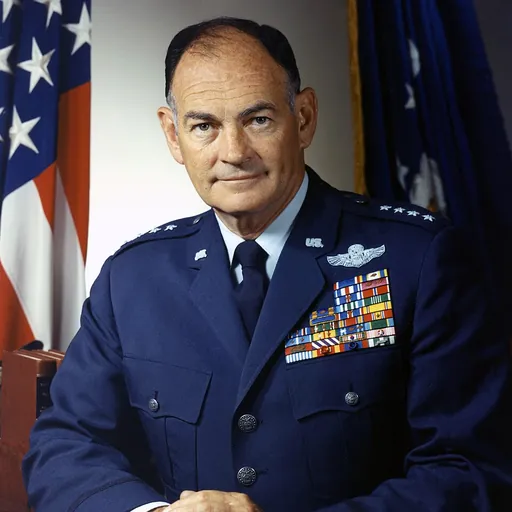
About George Scratchley Brown
Lived 1918 – 1978 (aged 60). George Scratchley Brown was an American military officer.
George Scratchley Brown (17 August 1918 – 5 December 1978) was a United States Air Force general who served as the eighth chairman of the Joint Chiefs of Staff. In this capacity, he served as the senior military adviser to the president of the United States, the National Security Council and the secretary of defense. Through the commanders of the unified and specified commands, he was also responsible for executing the decisions of the National Command Authorities regarding worldwide readiness and employment of combat forces of the United States Army, Navy, Air Force and Marine Corps.
Early life George Scratchley Brown was born in Montclair, New Jersey, on 17 August 1918, the son of Thoburn Kaye Brown, an Army officer who had graduated with the West Point class of 1913, and his wife Frances Katherine née Scratchley. As an Army brat, Brown lived in a succession of different towns and military bases. He was an Eagle Scout, and played on the American football varsity team as a freshman at Fort Brown, Texas. He later was a fullback during his junior and senior years at Immaculata High School in Fort Leavenworth, Kansas, and was an all-league in the Catholic high school interstate league.
Both Brown and his younger brother Tim set their sights on attending West Point, but their father advised taking a year of college first. Therefore, after graduating from high school in 1936, Brown enrolled in engineering at the University of Missouri where he joined Sigma Alpha Epsilon. A fine horseman, he played polo. He also enlisted in the 128th Field Artillery Battalion of the Missouri National Guard, rising to the rank of corporal. His father was able to secure a congressional appointment to the United States Military Academy from Kansas for him, and Brown entered on 1 July 1937.
At West Point, Brown was roommates with John Norton, future US Army lieutenant general. Brown once again played polo, and was captain of the team in his senior year, when the West Point team lost in the final to Princeton University. In that year he was also cadet captain and regimental adjutant. He would have liked to have joined the cavalry on graduation like his father, but his standing as 342nd in his class was too low for an appointment to the cavalry. Instead, he was commissioned as a second lieutenant in the infantry on graduation on 11 June 1941. However, he volunteered for Air Corps training. At West Point he met Alice (Skip) Colhoun. An Army brat like himself, Alice met Brown at a party her father had thrown for the sons of the graduates of the class of 1913. Brown and Alice dated for over a year, and were married in 1942. Their marriage produced three children, two boys and a girl.
World War II
Brown commenced his basic flight training in Fairchild PT-19s at Pine Bluff, Arkansas on 20 August 1941. He then went to Randolph Field, Texas, for the second phase of his training. The third and final phase was completed at Kelly Field, Texas, where he received his pilot's wings on 7 March 1942. He officially transferred to the Air Corps on 4 April 1942, and was promoted to first lieutenant on 18 June 1942. His first assignment after flight training was at Barksdale Field, Louisiana, where, as a member of the 344th Bombardment Squadron of the 93d Bombardment Group, he flew the Consolidated B-24 Liberator. Moving with the organization to Fort Myers, Florida, he flew both antisubmarine patrol and conventional bomber training aircraft. thumb
In August 1942, he flew with the 93d Bombardment Group to England, where it became the first B-24 group to join the Eighth Air Force. He served in various positions with the group, including commander of the 329th Bombardment Squadron, group operations officer and group executive officer. As Seventh Air Force commander, he was responsible for all Air Force combat air strike, air support and air defense operations in Southeast Asia. In his MACV position, he advised on all matters pertaining to tactical air support and coordinated the Republic of Vietnam and United States air operations in the MACV area of responsibility. According to Goodpaster, Brown and MACV commander General Creighton Abrams "were like two brothers". General George F. Keegan felt that:
Brown's tour of Vietnam ended in September 1970, and he became Commander, Air Force Systems Command, with headquarters at Andrews Air Force Base, Maryland. Brown was successful in building his character and leadership, mostly during his time as a general officer, and his tenure at several high-ranking positions had made him the favored choice for higher position within the military for quite some time. According to Brown biography book "Destined for Stars" written by Edgar F. Puryear Jr. several high-ranking people within the military and government officials had predicted that Brown someday would achieve a higher position within the military, such as Brown predecessor General John D. Ryan who informed Brown that he was his favorite choice to succeed him as Air Force Chief of Staff after Ryan assumed the Air Force Chief of Staff position in August 1969. Air Force Chief of Staff General George S. Brown piloting a Lockheed VC-140B JetStar.
During his tenure as Air Force Chief of Staff, Brown also wanted to create a new and different relationship with his fellow Air Force personnel, unlike his predecessor, in asking them not to hesitate to suggest new ideas for the Air Force. One of Brown's primary focus in reshaping and modernize the Air Force, is that not only focusing on the aircraft, weapons and material, but also with its own personnel and people within the Air Force especially the morale and spiritual welfare. Brown's comments at Duke and subsequent reprimand by President Gerald Ford were reported on the front page of The Washington Post on 13 and 14 November 1974. There was speculation that Brown would be asked to resign, or at least not be nominated for a second two-year term; but he was re-nominated and went on to serve under the new president, Jimmy Carter.
In April 1976 during an interview with Ranan Lurie, a cartoonist for Newsweek, Brown was asked to comment on his opinion of the British Armed Forces, Brown replied, "They're no longer a world power. All they've got are generals, admirals and bands." Reaction in Britain was mixed. Some, like Lord Allenby condemned Brown's remarks, while others, like Lord Monckton acknowledged the truth of the remarks.
Evacuation of Saigon
One of the most important events during Brown's tenure as Chairman of the Joint Chiefs of Staff was the evacuation of Saigon after North Vietnamese troops defeated South Vietnamese troops in battles fought during the 1975 Spring Offensive, occupied many South Vietnamese cities and marched towards Saigon, the capital city of South Vietnam.
Dates of rank Source:
Awards and decorations Chairman of The Joint Chiefs of Staff General George S. Brown with the other members of The Joint Chiefs of Staff at The Pentagon in 1977.
Distinguished Service Cross citation
Brown, George S. Major, U.S. Army Air Forces Headquarters, 93d Bombardment Wing (H), Ninth Air Force (Attached) Date of Action: August 1, 1943
Other honors and recognition 1974, Golden Plate Award of the American Academy of Achievement 1985, The National Aviation Hall of Fame
Gallery
Don’t just read it —
keep it.
Full-length biographies made to live with: read them, listen on the way to work, watch them tonight.
- E-book
- Audio
- Video
Instant download · yours to keep · every purchase keeps this site free
Important facts
People in George Scratchley Brown's life
Named in this biography and alive at the same time




Related people
Same field, nearest in time

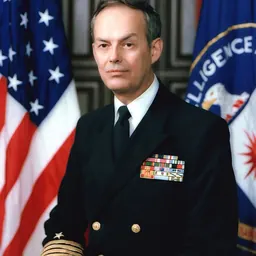

Contemporaries
People whose lives overlapped George Scratchley Brown's


Frequently asked questions
Who was George Scratchley Brown?
US Air Force general (1918-1978)
When was George Scratchley Brown born?
George Scratchley Brown was born on 17 August 1918 in Montclair.
When did George Scratchley Brown die?
George Scratchley Brown died on 5 December 1978 in Washington, D.C..
What was George Scratchley Brown's occupation?
George Scratchley Brown was a military officer.
What nationality was George Scratchley Brown?
George Scratchley Brown was American.
Sources & further reading
· Wikipedia: George Scratchley Brown
· DBpedia: George Scratchley Brown
Cite this page
APA: Biography.guide. (2026). George Scratchley Brown. https://biography.guide/george-scratchley-brown/
MLA: "George Scratchley Brown." Biography.guide, https://biography.guide/george-scratchley-brown/.
Chicago: "George Scratchley Brown." Biography.guide. https://biography.guide/george-scratchley-brown/.
Data last updated: 2026-09-20 · Spot an error? Report a correction.
Page generated 2026-09-27 05:09 UTC