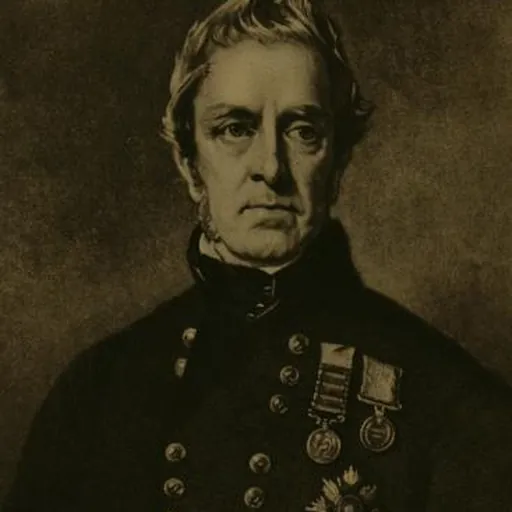
About George Pollock
Lived 1786 – 1872 (aged 86). George Pollock was a British military personnel and constable of the Tower.
Field Marshal Sir George Pollock, 1st Baronet, (4 June 1786 – 6 October 1872) was a British Indian Army officer. He first saw action at the Battle of Deeg and at the Siege of Bhurtpore during the Second Anglo-Maratha War before taking part in the Anglo-Nepalese War. He also commanded the British artillery at the Battle of Prome and at Bagan during the First Anglo-Burmese War. Following a disastrous retreat from Kabul in January 1842 during the First Anglo-Afghan War, the retreating forces became stranded at the small British garrison at Jalalabad and Pollock was appointed Commander of the Force sent to relieve the garrison: he advanced through the Khyber Pass and relieved the garrison in April 1842. He then set about an unauthorised but ultimately successful mission to rescue the British hostages who had been left behind in Kabul prior to the retreat. In 1844 the Pollock Medal was created to commemorate Pollock's achievements: this medal was to be awarded to the "best cadet of the season" at the Addiscombe Military Seminary.
Life Early life and education Pollock was son of David Pollock, of Charing Cross, saddler to King George III, and Sarah Pollock (née Parsons); his elder brother was the lawyer and politician Sir Frederick Pollock, 1st Baronet. The Pollock family were a branch of that family of Balgray, Dumfriesshire; David Pollock's father was a burgess of Berwick-upon-Tweed, and his grandfather a yeoman of Durham. His business as a saddler was given the official custom of the royal family. Sir John Pollock, 4th Baronet, great-great-grandson of David Pollock, stated in Time's Chariot (1950) that David was, 'perhaps without knowing it', Pollock of Balgray, the senior line of the family (Pollock of Pollock or Pollock of that ilk) having died out.
Military career Nepal and India Educated at the Royal Military Academy, Woolwich, Pollock was commissioned as a lieutenant-fireworker in the Bengal Artillery on 14 December 1803. Promoted to lieutenant on 19 April 1804, he saw action at the Battle of Deeg in November 1804 and at the Siege of Bhurtpore in Spring 1805 during the Second Anglo-Maratha War. He became assistant adjutant-general of artillery in 1820 and being promoted to lieutenant colonel on 1 May 1824. He was promoted further to brevet colonel on 1 December 1829 and then posted to Cawnpor to command an artillery battalion in 1830. and briefly held a divisional command at Danapur with the rank of brigadier-general before transferring to the more senior command at the Agra district with the rank of major-general on 28 June 1838.
Afghanistan
In 1838, Lord Auckland, the Governor-General of India decided to invade Afghanistan to proclaim a pro-British former ruler as king of Afghanistan so instigating the First Anglo-Afghan War. The initial campaign was a success but at the end of 1841, faced with ever-increasing hostility from the Afghans, the military and political leaders decided to withdraw the 5,000 British and Indian troops and 12,000 camp followers, wives and children from Kabul and to return to India. The retreat, which took place in January 1842, was a disaster and eventually led to a massacre because of inefficient leadership, the cold and the ferocious tribes. There was now almost nothing between the retreating forces and India except for the small British garrison at Jalalabad. Legend has it that only one (Dr. Brydon) survived; In fact, he was not the only European to survive the retreat; about 115 British officers, soldiers, wives and children were captured or taken as hostages and survived to be subsequently released. Against this background Pollock was appointed Commander of the Force sent to relieve Jalalabad: he advanced through the Khyber Pass and relieved the garrison at Jalalabad in April 1842. He destroyed the Great Bazaar in Kabul before withdrawing to India in October 1842. he became British Resident at Lucknow in December 1843 and military member of the Council of India in September 1844.
Later life Death Remnants of an Army by Elizabeth Butler depicts Dr. Brydon arriving at Jalalabad After returning to England in 1846, Pollock benefited from an annuity of £1,000 per annum from the East India Company and lived at Clapham Common. He was promoted to lieutenant general on 11 November 1851 and became a member of the Court of Directors of the East India Company in 1854. he was appointed Knight Commander of the Order of the Star of India on 19 August 1861 and advanced to Knight Grand Commander of the Order of the Star of India on 24 May 1866. he became Constable of the Tower in November 1871, before being made a baronet on 20 March 1872. In retirement he also served as honorary colonel of the 1st Surrey (or South London) Rifle Volunteer Battalion. He died at Walmer in Kent on 6 October 1872 and was buried in the north aisle at Westminster Abbey.
Family In 1810 Pollock married Frances Webbe Barclay; they had four sons and one daughter. After his first wife's death, he married Henrietta Wollaston in 1852.
Don’t just read it —
keep it.
Full-length biographies made to live with: read them, listen on the way to work, watch them tonight.
- E-book
- Audio
- Video
Instant download · yours to keep · every purchase keeps this site free
Important facts
People in George Pollock's life
Named in this biography and alive at the same time

Related people
Same field, nearest in time


Contemporaries
People whose lives overlapped George Pollock's


Frequently asked questions
Who was George Pollock?
British Indian Army officer
When was George Pollock born?
George Pollock was born on 4 June 1786 in Piccadilly.
When did George Pollock die?
George Pollock died on 6 October 1872 in Walmer.
What was George Pollock's occupation?
George Pollock was a military personnel and constable of the Tower.
What nationality was George Pollock?
George Pollock was British.
Sources & further reading
· DBpedia: Sir George Pollock, 1st Baronet
Cite this page
APA: Biography.guide. (2026). George Pollock. https://biography.guide/george-pollock-military-personnel/
MLA: "George Pollock." Biography.guide, https://biography.guide/george-pollock-military-personnel/.
Chicago: "George Pollock." Biography.guide. https://biography.guide/george-pollock-military-personnel/.
Data last updated: 2026-09-23 · Spot an error? Report a correction.
Portrait: Wikimedia Commons · author & licence
Page generated 2026-09-27 05:06 UTC