
About George Moir
Lived 1800 – 1870. George Moir was a photographer.
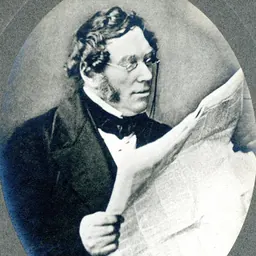
George Moir FRSE (1800–1870) was a Scottish advocate and author, amateur artist and early photographer.
Life The son of George Moir, a vintner running "The Old Ship Inn", he was born in Aberdeen, and educated in the city. Moving to Edinburgh, he entered a lawyer's office and qualified as an advocate in 1825.
In 1824, when Moir was working on an article for the Edinburgh Review, a friend suggested that he might seek information from Sir William Hamilton. They met in the Advocates' Library, and formed a lifelong friendship. On 2 July 1825 Moir was admitted advocate. In 1826 Hamilton proposed Moir as a Fellow of the Royal Society of Edinburgh - he resigned from the Society in 1837. In 1830 he married his wife, Flora Towers (d.1858), and this was presumably their family home. He was an early photographer and member of the Edinburgh Calotype Club.
He continued in practice at the Scottish bar, and in 1855 was appointed sheriff of Ross and Cromarty, a post which in 1859 he exchanged for the shrievalty of Stirlingshire. In 1864 the Faculty of Advocates chose Moir as Professor of Scots law at the University of Edinburgh, however due to bad health he resigned in less than a year. Edinburgh, on 19 October 1870.
He is buried in the churchyard of St John's Episcopal Church, at the west end of Princes Street.
Works Originally a Whig in his politics, Moir later sided with the Tories, and became a regular contributor to Blackwood's Magazine. His works are:
Schiller's Piccolomini and Wallenstein, translated, with a critical preface, Edinburgh, 1827; dedicated to Hamilton. Schiller's Thirty Years' War, translated, with biographical notice, 2 vols. Edinburgh, 1828. The Appellate Jurisdiction of Scotch Appeals, Edinburgh, 1851. Magic and Witchcraft, London, 1852.
Extracts from Moir's lectures were incorporated by William Guthrie in the 14th edition of John Erskine's Principles of the Law of Scotland, 1870. Moir also contributed articles on poetry and modern romance to the Encyclopædia Britannica which, with William Spalding's article on rhetoric, were published as Treatises on Poetry, Modern Romance and Rhetoric (1839).
Magia e Stregoneria, Lulu Press, Raleigh (NC), 2018, Italian version of Magic and Witchcraft (1852), translated by Rev. Marco Lupi Speranza.
Don’t just read it —
keep it.
Full-length biographies made to live with: read them, listen on the way to work, watch them tonight.
- E-book
- Audio
- Video
Instant download · yours to keep · every purchase keeps this site free
Important facts
People in George Moir's life
Named in this biography and alive at the same time

Related people
Same field, nearest in time



Contemporaries
People whose lives overlapped George Moir's






Frequently asked questions
Who was George Moir?
Scottish advocate and author; (1800-1870)
When was George Moir born?
George Moir was born in 1800 in Aberdeen.
When did George Moir die?
George Moir died in 1870.
What was George Moir's occupation?
George Moir was a photographer.
Sources & further reading
Cite this page
APA: Biography.guide. (2026). George Moir. https://biography.guide/george-moir/
MLA: "George Moir." Biography.guide, https://biography.guide/george-moir/.
Chicago: "George Moir." Biography.guide. https://biography.guide/george-moir/.
Data last updated: 2026-09-20 · Spot an error? Report a correction.
Page generated 2026-09-27 04:57 UTC