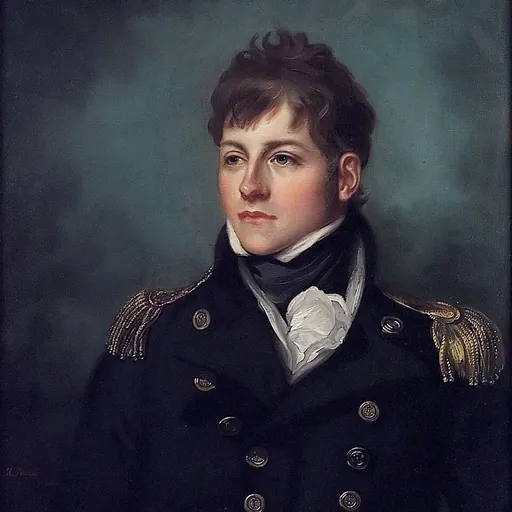
George Miller Bligh
Royal Navy officer during the French Revolutionary Wars and the Napoleonic Wars
About George Miller Bligh
Lived 1780 – 1834 (aged 53–54). George Miller Bligh was a British privateer.
Captain George Miller Bligh (1780–1834) was an officer of the Royal Navy, who saw service during the French Revolutionary and Napoleonic Wars, eventually rising to the rank of Captain. He was present aboard at the Battle of Trafalgar, and was badly wounded during the action. He was taken below and was present in the cockpit at the death of Vice-Admiral Horatio Nelson.
Family and early life Bligh was born in 1780, the only son of Richard Rodney Bligh, who was later to become an Admiral, and his first wife Ann Worsley. The younger Bligh followed his father into the navy, joining his father's ship as a midshipman in 1794. Shortly after this a French squadron captured Alexander in an action on 6 November 1794. Bligh became a prisoner of war at Brest, spending six months there until he was able to escape and return to England. He returned to serving aboard the Brunswick after this, before being transferred aboard Nelson's flagship HMS Victory in 1804. Victorys signal Lieutenant John Pasco was also wounded in the battle, while Lieutenant William Ram was killed. Bligh was carried below to be seen by the surgeon William Beatty. He was in the cockpit during the last hours of the mortally wounded Nelson's life, and was depicted in Arthur William Devis's painting The Death of Nelson, 21 October 1805. Bligh is depicted apparently dazed from a head wound, and with his left hand over the wound in his side. Bligh survived the battle and recovered in time to be present at Nelson's funeral. He was in a mourning coach on the morning of 8 January, along with Captain Henry William Bayntun, who had commanded at Trafalgar, and Captain Thomas Hardy, of the Victory, as well as fellow Victory lieutenant Andrew King. Bligh was promoted to commander on 25 January 1806, in the rewards bestowed to those who had fought at Trafalgar.
Bligh was promoted to post-captain on 27 December 1808 and by early 1809 he was aboard , escorting a convoy back to England from Malta. Bligh was appointed to the frigate in 1814, and sailed her to serve on the Jamaica station. He returned to Britain in July 1816, where Araxes was paid off and Bligh went ashore. He does not appear to have been actively employed again at sea.
Personal life Bligh married Catherine Haynes on 2 December 1817. He died at Southampton in 1834 and was buried at Alverstoke.
Don’t just read it —
keep it.
Full-length biographies made to live with: read them, listen on the way to work, watch them tonight.
- E-book
- Audio
- Video
Instant download · yours to keep · every purchase keeps this site free
Important facts
People in George Miller Bligh's life
Named in this biography and alive at the same time


Related people
Same field, nearest in time




Contemporaries
People whose lives overlapped George Miller Bligh's

Frequently asked questions
Who was George Miller Bligh?
Royal Navy officer during the French Revolutionary Wars and the Napoleonic Wars
When was George Miller Bligh born?
George Miller Bligh was born in 1780.
When did George Miller Bligh die?
George Miller Bligh died in 1834 in Southampton.
What was George Miller Bligh's occupation?
George Miller Bligh was a privateer.
What nationality was George Miller Bligh?
George Miller Bligh was British.
Sources & further reading
· Wikipedia: George Miller Bligh
· DBpedia: George Miller Bligh
Cite this page
APA: Biography.guide. (2026). George Miller Bligh. https://biography.guide/george-miller-bligh/
MLA: "George Miller Bligh." Biography.guide, https://biography.guide/george-miller-bligh/.
Chicago: "George Miller Bligh." Biography.guide. https://biography.guide/george-miller-bligh/.
Data last updated: 2026-09-22 · Spot an error? Report a correction.
Portrait: Wikimedia Commons · author & licence
Page generated 2026-09-27 05:02 UTC