
George Mackay
Scottish noble
About George Mackay
Lived 1678 – 1748 (aged 69–70).
George Mackay, 3rd Lord Reay (1678–1748), was a Scottish noble and chief of the Clan Mackay, a Scottish clan of the Scottish Highlands. During his life the Glorious Revolution took place which directly affected his family and estate, and during his chiefdom he served the British-Hanoverian Government during the Jacobite rising of 1715 and the Jacobite rising of 1745.
Early life
George Mackay, 3rd Lord Reay, was the only son of Donald Mackay, Master of Reay, and his wife Ann, daughter of Sir George Munro of Culrain (of Newmore). The Master of Reay was killed in an accident in 1680 when a barrel of gunpowder exploded whilst hunting in the Reay Forest, and his father, John Mackay, 2nd Lord Reay, died not long after.
The Glorious Revolution
The period of 1680–1688 was of growing religious persecution in Scotland with the House of Stuart steering for political perdition. The Mackay's lands of Strathnaver had offered asylum to persecuted Covenanters and John Mackay, 7th of Aberach, chieftain of the Mackay of Aberach branch of the clan had also supported the Covenanters.
Jacobite rising of 1689
A Jacobite rising broke out in 1689 in support of the exiled Stuarts and a Mackay clansman, General Hugh Mackay of Scoury was appointed by William of Orange as Commander-in-Chief of the forces in Scotland. Hugh Mackay was defeated by the Jacobites at the Battle of Killiecrankie although the Jacobite leader John Graham, 1st Viscount Dundee, was killed in the battle. In 1693 or 1694, shortly after the death of his grandfather Sir George Munro of Culrain, the young George Mackay, 3rd Lord Reay, travelled over to Holland where his two uncles Aneas and Robert Mackay were on service as Lieutenant-General and Colonel. One of these uncles died in 1696 and the other in 1697. Lord Reay then received the estates of Eddrachilis and Scoury as the dowry which were a large and valuable addition to the Reay Estate. The Jacobite rising of 1715 broke out in favour of the exiled James Francis Edward Stuart who was proclaimed James VIII by his supporters. A week later he set out from Dunrobin with 400 of his tenants to Tain where he found George Mackay, 3rd Lord Reay, with 500 Mackays and 200 Rosses waiting in support of him. At Alness they were also joined by the Munros and had obtained six small canons. In what is now known as the Skirmish of Alness, the Earl of Sutherland and Lord Reay retreated back over Bonar Bridge into Sutherland. After this the Earl of Seaforth and his force joined up with that of the Earl of Mar, but the Jacobite rising ended in failure at the indecisive Battle of Sheriffmuir on 14 November 1715. At the Battle of Glen Shiel the Mackays under Ensign Hugh Mackay and Sutherlands who together supported the Government were posted on the right wing and the Jacobites were defeated. In 1725 the General Assembly accepted his proposals. This had started in 1737 in a dispute over estates which was submitted to arbitration but then the arrangement broke down. At the request of Duncan Forbes, Lord Culloden, Lord Reay, Sutherland, Grant, Seaforth and Munro sent levies of troops to Inverness to join John Campbell, 4th Earl of Loudoun, who was a supporter of the Government and who had assumed command of any troops that could be gathered together. George Mackenzie, 3rd Earl of Cromartie, was a Jacobite rebel, as was his son John Mackenzie, Lord MacLeod (not to be confused with the Laird of MacLeod, who supported the Government at this time). According to Angus Mackay, while Lord MacLeod was at Thurso, Caithness, where there was a Jacobite meeting house until after the Battle of Culloden he was joined by the men of Loch Broom under the brother of Mackenzie of Ballone. Lord MacLeod then made an attempt to invade the Mackay lands of Strathnaver but finding that the Mackays were prepared to contest their passage, backed down. where money and supplies destined for the Jacobite cause were captured from a French ship, and 156 Jacobites were taken prisoner. In response the Jacobite commander, Charles Edward Stuart, sent a large Jacobite force north under the command of George Mackenzie, 3rd Earl of Cromartie. However, they arrived too late to be of any use and were attacked by surprise by the 2nd Sutherland Company under the command of Ensign John Mackay and also the 2nd Mackay Company. and was prevented from providing much needed support to the Jacobites at the Battle of Culloden that took place the next day and which they would have been late for anyway. In a letter to a government official dated 2 September 1746, Lord Reay suggested the need to erect new churches and to spread the Gospel among the disaffected.
Donald Mackay, 4th Lord Reay.
George Mackay, 3rd Lord Reay, married secondly, Janet, daughter of John Sinclair of Ulbster, Caithness, and had the following children:
Hugh Mackay of Bighouse, Captain of an Independent Highland Company that supported the Government during the Jacobite rising of 1745. Ann Mackay
George Mackay, 3rd Lord Reay, married thirdly, Mary, daughter of John Dowell, W.S. Edinburgh, and had the following children:
George Mackay of Skibo, Captain of an Independent Highland Company that supported the Government during the Jacobite rising of 1745. Alexander Mackay, Captain in Loudon's Highlanders regiment that supported the Government during the Jacobite rising of 1745. Mary Mackay Harriet Mackay Christian Mackay Marion Mackay
Don’t just read it —
keep it.
Full-length biographies made to live with: read them, listen on the way to work, watch them tonight.
- E-book
- Audio
- Video
Instant download · yours to keep · every purchase keeps this site free
Important facts
People in George Mackay's life
Named in this biography and alive at the same time



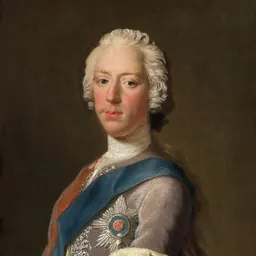


Contemporaries
People whose lives overlapped George Mackay's



Frequently asked questions
Who was George Mackay?
Scottish noble
When was George Mackay born?
George Mackay was born in 1678.
When did George Mackay die?
George Mackay died on 21 March 1748.
Sources & further reading
· DBpedia: George Mackay, 3rd Lord Reay
Cite this page
APA: Biography.guide. (2026). George Mackay. https://biography.guide/george-mackay-1678/
MLA: "George Mackay." Biography.guide, https://biography.guide/george-mackay-1678/.
Chicago: "George Mackay." Biography.guide. https://biography.guide/george-mackay-1678/.
Data last updated: 2026-09-20 · Spot an error? Report a correction.
Page generated 2026-09-27 05:14 UTC