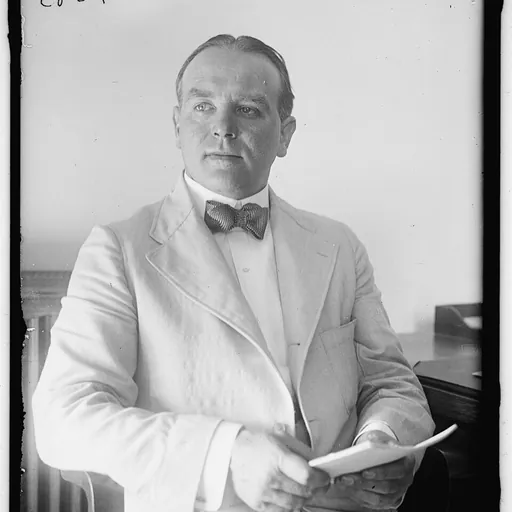
George M. Rolph
Businessman from the United States, member of the Food Administration
About George M. Rolph
Lived 1873 – 1932 (aged 58–59). George M. Rolph was an American entrepreneur.
George Morrison Rolph (February 6, 1873 – July 21, 1932) was an American sugar-industry executive, author, and federal administrator. He was the longtime general manager and later president of the California and Hawaiian Sugar Refining Corporation (C&H), chief of the Sugar Division of the United States Food Administration, a member of the wartime International Sugar Committee, and the first president of the government-owned Sugar Equalization Board.
After working in Hawaii's sugar industry, Rolph helped organize and operate C&H's cane-sugar refinery at Crockett, California. Under his management, C&H became one of the Pacific Coast's leading refineries and the principal economic institution in Crockett. He promoted employee housing, recreation, parks, community buildings, and an eight-hour working day, giving him a lasting place in Crockett's local history.
During World War I, Herbert Hoover selected Rolph to organize federal administration of the sugar supply. Rolph helped negotiate prices, regulate refining margins, allocate scarce supplies, supervise exports, and coordinate purchases and distribution for the United States and its Allies. Although Hoover was chairman of the Sugar Equalization Board, Rolph served as its president and operating executive.
Early life and family
George Morrison Rolph was born in San Francisco on February 6, 1873, the son of James Rolph Sr., a merchant and shipbuilder, and Margaret Nicol Rolph. His elder brother, James Rolph, became a shipping executive, mayor of San Francisco from 1912 to 1931, and governor of California from 1931 until his death in 1934.
Rolph married Lilian Ashton. They had two daughters, Dorothy Ashton Rolph and Elizabeth Rolph Shaw.
Career
By 1898 Rolph was working in the Hawaiian sugar trade. He served as secretary of the Hawaiian Commercial and Sugar Company, a Maui-based plantation and milling company.
His Hawaiian experience exposed him to plantation management, raw-sugar production, transportation, refining, and the marketing system through which island plantations sold their crops on the mainland.
California and Hawaiian Sugar Refining Corporation In 1905 the Sugar Factors Company of Honolulu, representing Hawaiian plantation owners, acquired control of a refinery at Crockett on the Carquinez Strait. The plant had previously processed beet sugar but had been idle since 1903. It was converted into a cane-sugar refinery and reopened in 1906 as the California and Hawaiian Sugar Refining Corporation ("C&H").
Rolph came to the San Francisco Bay Area in 1906 to manage the new operation and became its first plant manager. The same account valued the plant and its improvements at approximately $7 million.
Because C&H dominated Crockett's economy, the company's industrial policies also shaped the town. C&H financed roads, sewers, parks, playgrounds, schools, libraries, clubhouses, auditoriums, and recreation facilities. Written for general readers and school students, the book described the cultivation of sugar cane and sugar beets, the manufacture of raw sugar, refining, chemical testing, transportation, international production, and the historical development of the trade.
United States Food Administration
Appointment as sugar chief
Following the United States' entry into World War I, Congress enacted the Food and Fuel Control Act and President Woodrow Wilson appointed Herbert Hoover as United States Food Administrator. Sugar presented an unusually difficult problem because supplies came from domestic beet producers, Louisiana and other cane-growing areas, Hawaii, Puerto Rico, the Philippines, Cuba, and other foreign sources, each with different harvest seasons, costs, and shipping requirements.
On August 15, 1917, Hoover appointed Rolph chief of the Food Administration's Sugar Division. Rolph served as a wartime "dollar-a-year man", temporarily leaving private business to perform federal service.
The division negotiated voluntary agreements with producers and refiners, set or approved prices and refining margins, administered licenses, allocated supplies geographically, and sought to prevent both shortages and speculative price increases.
International Sugar Committee
In September 1917 the Food Administration and Allied purchasing authorities established the International Sugar Committee to coordinate the purchase and distribution of sugar from the West Indies and American insular possessions. Rolph was the committee's fifth member and its administrative head. The other members were British representatives Sir Joseph White-Todd and John Ramsay Drake, and American refiners Earl D. Babst and William A. Jamison.
Congressional investigation and controversy
The Food Administration's reliance on executives drawn from the industries it regulated was controversial. In late 1917, sugar refiner Claus A. Spreckels accused Rolph, Babst, and the Food Administration of favoring refineries associated with C&H and the American Sugar Refining Company. Spreckels alleged that some independent refineries had been unable to obtain raw sugar while favored companies retained or received supplies. He defended the price agreements and argued that without federal intervention sugar might have risen to approximately 15 or 20 cents per pound. Hoover publicly defended Rolph and maintained that the administration's policies had reduced prices and improved distribution during wartime scarcity.
Contemporary economic studies found that the Food Administration succeeded in preventing an uncontrolled rise in consumer prices, although its system depended heavily on voluntary agreements and cooperation from established refiners.
United States Sugar Equalization Board In July 1918 President Wilson approved the incorporation of the United States Sugar Equalization Board under Delaware law as an agency of the Food Administration. Wilson supplied $5 million in capital from presidential emergency funds.
Rolph eventually resigned because of illness and was succeeded as president by Zabriskie. The corporation continued winding up its affairs after its principal purchasing work ended and was formally abolished in 1926. Later litigation concerned the board's remaining assets and its responsibility for losses incurred during government-directed efforts to import Argentine sugar in 1920.
Return to private industry
After leaving Washington, D.C., Rolph returned to C&H and resumed his role as president. He remained one of the best-known sugar executives on the Pacific Coast. In March 1931 the federal government brought an antitrust action against the institute, C&H, other refining companies, and numerous officers, including Rolph.
The district court later concluded that the institute and participating companies had maintained an unlawful combination restraining interstate sugar commerce. Because Rolph had died before the final decree, the action against him individually was dismissed without a determination of personal liability. Private funeral services were held in San Francisco. He was survived by his wife and two daughters and was buried at Greenlawn Memorial Park in Colma.
Contemporary obituaries emphasized his dual career as head of C&H and as one of Hoover's principal wartime sugar administrators. "Rolph Avenue" in Crockett was named in his honor.
Selected work
Don’t just read it —
keep it.
Full-length biographies made to live with: read them, listen on the way to work, watch them tonight.
- E-book
- Audio
- Video
Instant download · yours to keep · every purchase keeps this site free
Important facts
People in George M. Rolph's life
Named in this biography and alive at the same time



Related people
Same field, nearest in time




Contemporaries
People whose lives overlapped George M. Rolph's

Frequently asked questions
Who was George M. Rolph?
Businessman from the United States, member of the Food Administration
When was George M. Rolph born?
George M. Rolph was born in 1873.
When did George M. Rolph die?
George M. Rolph died on 21 July 1932 in San Francisco.
What was George M. Rolph's occupation?
George M. Rolph was an entrepreneur.
What nationality was George M. Rolph?
George M. Rolph was American.
Sources & further reading
Cite this page
APA: Biography.guide. (2026). George M. Rolph. https://biography.guide/george-m-rolph/
MLA: "George M. Rolph." Biography.guide, https://biography.guide/george-m-rolph/.
Chicago: "George M. Rolph." Biography.guide. https://biography.guide/george-m-rolph/.
Data last updated: 2026-09-20 · Spot an error? Report a correction.
Portrait: Wikimedia Commons · author & licence
Page generated 2026-09-27 04:58 UTC