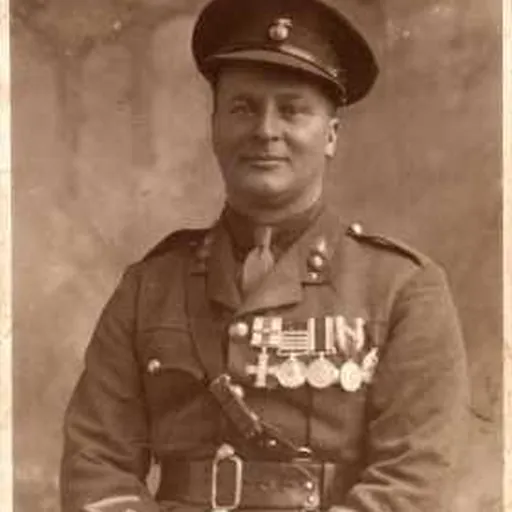
About George Latham
Lived 1881 – 1939 (aged 58). George Latham was a British association football player and association football coach.
George Latham MC & Bar (1 January 1881 – 9 July 1939) was a Welsh international footballer and coach. A veteran of the Second Boer War and World War I, he was awarded the Military Cross for his actions in Gaza, Palestine and Turkey between 1917 and 1918. He finished his military career at the rank of captain.
As a player, he played for Newtown, Cardiff City, Liverpool, Stoke and Southport Central, and played 10 times for Wales. He coached Cardiff City during its greatest period of success between 1911 and 1936. The team won the FA Cup in 1927, and only missed out on the League Championship by goal difference. He also coached Great Britain at the 1920 Summer Olympics.
Early life and military career Latham was born in Newtown, Powys, in 1881. He was the fifth of six boys born to William Latham, a general labourer originally from Shrewsbury, and Esther Latham, a laundress from Birmingham. He attended New Road School as a youngster, playing for the school's football team, before training as a tailor in Market Street. At the age of 16, he joined his hometown side Newtown where he played as an inside forward. In his first season, the side reached the fourth round of the Welsh Cup before suffering defeat to Aberystwyth Town. In 1900, Latham volunteered to serve in South Africa during the Second Boer War as a private in the Fifth South Wales Borderers regiment. The battalion had a unit stationed in Newtown which prompted Latham to enlist.
Playing career Latham began his career as a teenager at his hometown club Newtown in 1897 and spent several years at the club. During his time serving in South Africa, he played for a team named the Docks between the months of May and August, the winter league at the time in the country, finishing as runners-up in the league. He also played in a number of representative matches in the area, including an England vs Scotland match, appearing on the English side, and a Britain vs Colonials match. His form at the time saw him offered a trial with Everton, during which time he was set to be named in a friendly match against West Bromwich Albion but the game was called off due to heavy snowfall in the area. A different friendly match was planned a fortnight later but by then Latham had decided to return to South Africa and he left the country on 22 March 1902. He spent his time there playing for Caledonians, again finishing as runner up in the league and losing the final of the Mayor's Cup to his former side Docks. He struggled to fully established himself in the team, making just 19 appearances in all competitions during a seven-year spell at the club. After leaving Anfield, Latham had spells with Southport, becoming the first player to win an international cap at the club. He joined Stoke in 1910 and played eight times for the club during the 1910–11 season.
Latham joined Cardiff City as a player-coach in February 1911 under manager Fred Stewart. In his first season, the club won the Welsh Cup by defeating Pontypridd 3–0 in a final replay. After the two sides had drawn the first leg, Bob Lawrie suffered an injury and was ruled out of the replay. Latham took his place for the victory but presented his winner's medal to Lawrie after the game. He appeared sporadically for the side in years preceding the First World War, usually filling in for injuries to the first team. He made 11 league appearances between 1912 and 1914, scoring once in a 6–0 win over Chesham on 1 April 1911.
During his career, Latham won 10 caps for Wales, making his debut on 6 March 1905 in a 3–1 win over Scotland. He was selected for the game after his Liverpool teammate Maurice Parry was recalled by the club to play in a league fixture against Bradford City, He spent several months training with his regiment at Park Hall Camp near Oswestry before being deployed in June 1916. He was awarded the Military Cross in 1917 and was reportedly originally recommended for the Victoria Cross, Having charged and captured an entrenched position with his platoon, he was described as "cleared the cactus gardens and rounded up all the prisoners under heavy fire from snipers, helped Major Pemberton of the Cheshire Regiment, to organise all the men he could get hold of and built up a line of defence". Some of the troops captured were a Turkish general and his staff. The same night, orders were given to retreat from the position, but these never found their way to Latham and another captain who spent the night in position with the area still "seething with Turks". When daylight came the following morning, the pair found themselves alone but were able to make their way back to their lines. He was also mentioned in dispatches by General Archibald Murray, commander of the Egyptian Expeditionary Force at the time. He later traveled with his regiment to fight in Palestine.
It was during his service in the First World War that Latham first met his longtime friend Harry Beadles. During their time in Palestine, Latham and Beadles played football for their division, the 7th battalion of the Royal Welch Fusiliers, and won the British Forces in Egypt Football League Cup Final in 1919.
Coaching career
There is no more painstaking football coach — The County Times, 2 May 1925, describing Latham While serving as a coach, Latham was forced into playing for the side in a 3–1 win over Blackburn Rovers on 2 January 1921 after two of the club's players were taken ill prior to the match, becoming the oldest Football League debutant in the history of the club at 41. To this day he also remains their oldest ever player. Working alongside Fred Stewart, his spell at Ninian Park coincided with one of the most successful spells in the history of the club, including reaching the FA Cup final on two occasions, losing 1–0 to Sheffield United in 1925 before beating Arsenal 1–0 in 1927. During his spell with the club, Latham arranged annual charity matches in his hometown between Cardiff and Newtown to rise money for the Montgomery County Infirmary. He also managed the British team at the 1920 Olympic Games. After leaving Cardiff, Latham worked as a coach at Chester City until his retirement.
Career statistics Club Source:
International Source:
Don’t just read it —
keep it.
Full-length biographies made to live with: read them, listen on the way to work, watch them tonight.
- E-book
- Audio
- Video
Instant download · yours to keep · every purchase keeps this site free
Important facts
People in George Latham's life
Named in this biography and alive at the same time





Related people
Same field, nearest in time



Contemporaries
People whose lives overlapped George Latham's


Frequently asked questions
Who was George Latham?
Welsh footballer (1881-1939)
When was George Latham born?
George Latham was born on 1 January 1881 in Newtown.
When did George Latham die?
George Latham died on 9 July 1939 in Newtown.
What was George Latham's occupation?
George Latham was an association football player and association football coach.
What nationality was George Latham?
George Latham was British.
Sources & further reading
· DBpedia: George Latham (footballer)
Cite this page
APA: Biography.guide. (2026). George Latham. https://biography.guide/george-latham/
MLA: "George Latham." Biography.guide, https://biography.guide/george-latham/.
Chicago: "George Latham." Biography.guide. https://biography.guide/george-latham/.
Data last updated: 2026-09-24 · Spot an error? Report a correction.
Portrait: Wikimedia Commons · author & licence
Page generated 2026-09-27 05:09 UTC