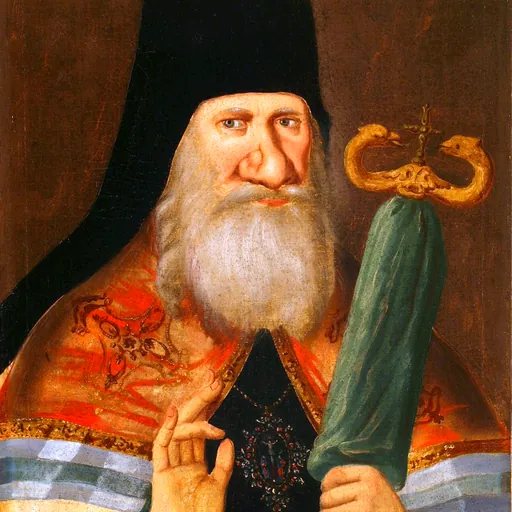
George (Konissky)
Orthodox archbishop, preacher, philosopher and theologian
About George (Konissky)
Lived 1717 – 1795 (aged 77). George (Konissky) was a Polish and Russian eastern Orthodox priest, eparch, orthodox theologian, philosopher, theologian and preacher.
He was the son of the mayor of Nezhin. He graduated from the Academia Mohileana and later became a lecturer there. He taught poetics, philosophy and theology successively, and in 1751 he assumed the duties of its rector. Three years later he was ordained Bishop of , and became Ordinary of the last Orthodox eparchy within the borders of the First Republic.
Sincerely devoted to Russia, from 1762 he played a significant role in Tsarina Catherine II's policy toward the Republic, collaborating with Russian MP Nikolai Repnin in the campaign for the equality of dissidents. Defending the rights of the Orthodox population was only a pretext for the tsarina to intervene in the internal affairs of the Republic. At the same time, Bishop George acted in defense of the state of possession of the Orthodox Church in the Republic, and on several occasions addressed the Polish kings with memoranda listing the losses suffered by his denomination as a result of the activities of the Roman Catholic and Uniate Churches. He unsuccessfully demanded the legalization of conversion from Catholicism (of both rites) to Orthodoxy. He was one of the founders of the Słuck Confederation. In 1767, he published in Warsaw the . In 1768, he contributed to the outbreak of Koliivshchyna; he and the clergy under him urged Orthodox peasants and haidamakas to rise up against the Bar Confederation, in which he saw a direct threat to his religion.
After the First Partition of Poland, he continued his pastoral work in Mogilev already within the borders of the Russian Empire, but maintained contacts with the Orthodox clergy of the Republic of Poland and, until the end of his life, conducted diplomatic and propaganda activities to improve the situation of his co-religionists in that country. A staunch opponent of the Uniate Church, in 1780, with the support of the tsarist administration, he led to the closure of a number of its parishes in the Mogilev and Mstsislaw lands and the transition of more than 100,000 believers to the Russian Orthodox Church.
Author of textbooks and treatises on Orthodox dogmatic and moral theology, textbooks on poetics and philosophy, homilies, polemical texts against Catholicism, as well as literary works. He wrote in Latin, Russian and Polish.
In 1993 he was canonized by the Belarusian Orthodox Church as a locally venerated saint in the Mogilev and Mstsislaw eparchies. Since 2011, his cult has also been functioning in the Ukrainian Orthodox Church of the Moscow Patriarchate.
Early life
Youth and early activities The Konissky family belonged to the Russian nobility. The future hierarch's father, Joseph, was mayor of Nizhyn. From 1728 (or 1738) he attended the Kyiv Mohyla Academy. Nevertheless, the efforts of Metropolitanate Florian Hrebnicki were supported by Pope Benedict XIV, who sent a papal brief to King August III demanding the liquidation of the Belarusian eparchy by incorporating it into the Uniate Church. After sending to the Synod a project for the expansion of the cathedral, commissioned from architect Johann Christoph Glaubitz, Bishop George obtained a subsidy of 10,000 rubles for its expansion, but the money did not arrive in Mogilev until 1758. The hierarch received additional funds for the organization of a seminary in Mogilev; in his letter to the Synod, he pointed to the low intellectual level of the clergy and the lack of educated priests as a major problem. Attempts to change this situation and subordinate all monasteries located within the borders of the eparchy to its ordinaries had already been made by Bishop George's predecessors, but their efforts did not bring the expected result, and only caused competence disputes and personal conflicts that dragged on for years.
Bishop George was particularly active in improving the moral and intellectual level of the clergy under his authority. He refused to ordain illiterate candidates or those who had not mastered . In 1757, in a pastoral letter to all the clergy of the eparchy, he rated their competence low; he attached a Russian language textbook and a catechism to the letter. Catherine II was not a religious person herself, but she saw the lack of equality for Orthodox in the Republic as a good excuse to intervene in the country's domestic politics. George (Konissky) was sincerely devoted to Russia and completely supported Catherine II's policy in this regard. From Moscow he went to St. Petersburg and remained in that city until 1765, (Serchik even calls him an advisor in matters of the Orthodox population), the unlawful seizure of Orthodox church land and its transfer to Jewish tenants, discrimination against the Orthodox in the courts, and the public vilification of the Orthodox by the Latin and Uniate clergy. He accused the royal administration of violating the rights of Mogilev's Orthodox burghers and the clergy of that denomination. He also demanded that in mixed marriages there should be no cases of forcing an Orthodox spouse to convert to Catholicism and forcing the baptism of children in churches. Finally, he called for Orthodox townspeople to be admitted to municipal offices Attached to the memorandum was . These solutions did not fully satisfy the Belarusian bishop, who demanded the right to freely convert from Catholicism to Orthodoxy. Both clergymen later denied their involvement in inspiring the revolt, but the Russian envoy in Warsaw did not find their explanations credible.
George (Konissky) saw the formation of the Bar Confederation as a direct threat to his person, and in April 1768 he left Warsaw for Mogilev and then Smolensk, entrusting the supervision of his eparchy to , rector of the Mogilev seminary. The post-partition Polish-Russian treaty preserved the freedom of worship of Catholics of both rites in the lands incorporated into Russia. Taking advantage of this arrangement, some Uniate parishes converted to the Latin rite. Others adopted Orthodoxy. Archbishop George remained in constant contact with him and gave him advice on matters of day-to-day pastoral activity. His grave in the chapel of St. Barbara of the same church was opened at the time of the French invasion of Russia in 1812 and again during the renovation of the cathedral in 1875. According to the Russian Orthodox Church, it was found at that time that the body of the hierarch was not decomposed. The burial site was destroyed along with the entire Transfiguration Cathedral.
Veneration The informal veneration of George (Konissky) appeared almost immediately after his death, but the canonization of the cleric did not occur until 1993. In August of that year, the Belarusian Orthodox Church recognized him as a locally venerated saint in the Mogilev and Mstsislaw eparchies, In 2014, veneration of the bishop was introduced in the non-canonical Ukrainian Orthodox Church of the Kyiv Patriarchate, within its Chernihiv eparchy. In the Kyiv Patriarchate, the liturgical memory of George falls on 13/26 February and 24 July/6 August.
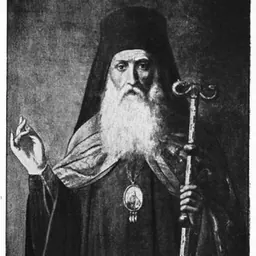
The image of the clergyman on the icons is modeled on his portrait created during his lifetime and kept first in the Lutheran Church in Mogilev, then in the Orthodox Church of Saints Boris and Gleb in Mogilev, and since 1960 in the local national history museum. George (Konissky) is shown with the Gospel in his left hand and with his right hand raised in a gesture of blessing. Depending on the variant, he is dressed in episcopal liturgical or extra-liturgical garb (riasa, bishop's mantia and black klobuk).
Don’t just read it —
keep it.
Full-length biographies made to live with: read them, listen on the way to work, watch them tonight.
- E-book
- Audio
- Video
Instant download · yours to keep · every purchase keeps this site free
Important facts
People in George (Konissky)'s life
Named in this biography and alive at the same time

Related people
Same field, nearest in time


Contemporaries
People whose lives overlapped George (Konissky)'s




Frequently asked questions
Who was George (Konissky)?
orthodox archbishop, preacher, philosopher and theologian
When was George (Konissky) born?
George (Konissky) was born on 9 November 1717 in Nizhyn.
When did George (Konissky) die?
George (Konissky) died on 2 February 1795 in Mahilyow.
What was George (Konissky)'s occupation?
George (Konissky) was an eastern Orthodox priest, eparch, orthodox theologian, philosopher, theologian and preacher.
What nationality was George (Konissky)?
George (Konissky) was Polish and Russian.
Sources & further reading
· Wikipedia: George (Konissky)
Cite this page
APA: Biography.guide. (2026). George (Konissky). https://biography.guide/george-konissky/
MLA: "George (Konissky)." Biography.guide, https://biography.guide/george-konissky/.
Chicago: "George (Konissky)." Biography.guide. https://biography.guide/george-konissky/.
Data last updated: 2026-09-23 · Spot an error? Report a correction.
Portrait: Wikimedia Commons · author & licence
Page generated 2026-09-27 05:07 UTC