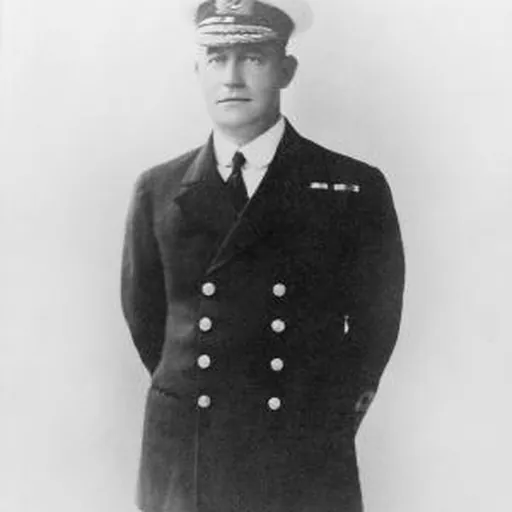
About George Hyde
Lived 1877 – 1937 (aged 60). George Hyde was a military personnel.
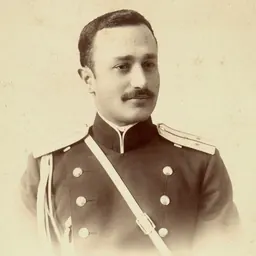
Admiral Sir George Francis Hyde, (19 July 1877 – 28 July 1937) was an English-born Australian admiral, known as a former head and the first officer to achieve the rank of full admiral in the Royal Australian Navy.
Early life Hyde was born in the seaside resort, Southsea, in the city of Portsmouth. He was the son of a clerk, Ebenezer Hyde, and Maria, née Alexander. Educated at a private school in Portsmouth, Hyde's desire to attain a high rank in the Royal Navy was strengthened by a love to serve his country, and love for the sea.
Entrance into Britain's Royal Navy In 1894, Hyde entered the merchant service as an apprentice, hoping to gain a commission into the Royal Naval Reserve. Finishing his apprenticeship after four trips aboard a sailing ship, Mount Stewart, he journeyed as second mate in the barque Amulree in 1898. He was promoted to the rank of lieutenant the following month, on 19 July 1902, and was posted to for 12 months training from late August 1902. He continued his services to the Naval Reserve until he was gazetted as a lieutenant in the Royal Navy in July 1905. This was due to winning an essay competition about the Russo-Japanese War, in which he was, upon the intervention of Admiral Lord Charles Beresford, "elevated to join the list of Supplementary Lieutenants". The admiral had submitted three applications before Hyde was promoted to the Royal Navy. In 1913, he sailed in the , to Australia.
First World War to the 1920s In July 1915, Hyde was appointed by the Admiralty, to command the light cruiser , into the Coast of Ireland Command. He remained in Adventure after he reached the Command, acting as captain of the fleet to Vice Admiral Sir Lewis Bayly. Between 24 April and 29 April 1916, during the Irish Easter Rebellion, after fears of international communication problems between the British Army's commander-in-chief of Ireland, Adventure was sent as communication aid and general assistance. Vice Admiral Bayly reported back to the Admiralty on 30 April 1916, when commenting about the incident, that Hyde "performed his duties with great tact and ability".
Officially promoted to captain on 1 April 1917 (having acted under the rank of Captain since his assumption of control of ), Hyde joined the Mercantile Movements Division in the Admiralty, becoming a Senior Naval Officer on 6 June 1918. On 10 August of the same year, he married Alice Marjorie Trefusis, before returning to Australia. He was appointed as Director of the war staff at the Naval Office in Melbourne, remaining at the appointment until August 1919. Upon the personal request of John Jellicoe, 1st Earl Jellicoe, he was attached to Jellicoe's staff in 1919, and became the aide-de-camp to the Governor-General, a post he remained until 1924. Hyde was given command of from 1919 until 1921, and became the second naval member of the Australian Naval Board during 1923–24.
In 1926, Hyde was appointed as commodore, taking command of the Australian Squadron. He was awarded a Commander of the Order of the British Empire in 1926, and a Commander of the Royal Victorian Order in 1927. In 1928, Hyde became the first Australian naval officer to become an honorary aide-de-camp to King George V. On 23 February 1928, he became a rear admiral, taking command of two s; and . On 16 February 1929, after the deterioration of his marriage with his first wife, Alice Trefusis, which ended in divorce in 1928, Hyde married Isla Robertson.
1930s and command of the Royal Australian Navy For one year after May 1930, Hyde held the Royal Navy's command of the 3rd Battle Squadron of the British Home Fleet. He was given command of two s, , and then . After returning to Australia, he became the first naval member of the Australian Naval Board on 20 October 1931, and consequently, the first seagoing officer to become a first naval member. He became a vice admiral in 1932, was appointed a Knight Commander of the Order of the Bath in 1934, and was promoted to admiral in 1936.
Taking over as the head of the Royal Australian Navy in 1931, Hyde was particularly concerned with the navy's inadequacy of defence, and lack of funding, following the Great Depression. He attended a naval commander-in-chief conference in Singapore, and traveled to England in 1935, for a technical discussion with the Admiralty. In 1936, while still in England, he acted as adviser to the Australian High Commissioner, Stanley Melbourne Bruce, and was a participant in discussions which led to the formation of the Second London Naval Treaty. As World War II threatened in the mid-1930s, Hyde became responsible, as the first naval member of the Australian Naval Board, for the strengthening of the Royal Australian Navy. He did this by creating close associations and relationships with the Royal Navy.
Personal health In 1915, Hyde was diagnosed with sub-acute pneumonia. He had an operation for mouth cancer in 1933, before his health started deteriorating in April 1937, after several small falls. On 20 June 1937, Hyde killed a pedestrian whilst driving in his car. Although a coronial inquiry relinquished him of any blame, the incident caused him enormous distress, contributing to his death of pneumonia in Melbourne eight days later. In accordance with Hyde's wishes, he was given a private funeral service and cremated, instead of a ceremonial naval funeral.
Footnotes
Don’t just read it —
keep it.
Full-length biographies made to live with: read them, listen on the way to work, watch them tonight.
- E-book
- Audio
- Video
Instant download · yours to keep · every purchase keeps this site free
Important facts
People in George Hyde's life
Named in this biography and alive at the same time


Related people
Same field, nearest in time





Contemporaries
People whose lives overlapped George Hyde's




Frequently asked questions
Who was George Hyde?
Australian admiral (1877-1937)
When was George Hyde born?
George Hyde was born on 19 July 1877 in Southsea.
When did George Hyde die?
George Hyde died on 28 July 1937 in Melbourne.
What was George Hyde's occupation?
George Hyde was a military personnel.
Sources & further reading
· DBpedia: George Hyde (admiral)
Cite this page
APA: Biography.guide. (2026). George Hyde. https://biography.guide/george-hyde-military-personnel/
MLA: "George Hyde." Biography.guide, https://biography.guide/george-hyde-military-personnel/.
Chicago: "George Hyde." Biography.guide. https://biography.guide/george-hyde-military-personnel/.
Data last updated: 2026-09-20 · Spot an error? Report a correction.
Portrait: Wikimedia Commons · author & licence
Page generated 2026-09-27 04:57 UTC