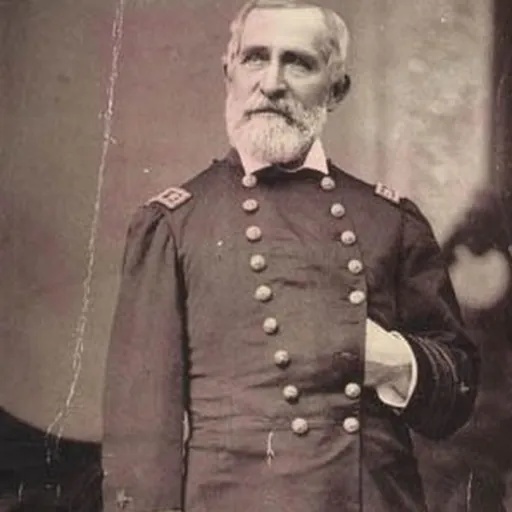
About George Henry Preble
Lived 1816 – 1885 (aged 69). George Henry Preble was an American military officer and sailor.
Preble's 1873 photo of the Ft. McHenry flag in the Boston Navy Yard George Henry Preble (February 25, 1816 – March 1, 1885) was an American naval officer and writer, notable for his history of the flag of the United States and for taking the first photograph of the Fort McHenry flag that inspired the U.S. national anthem, "The Star-Spangled Banner".
Early life and education He was born in Portland, Maine, whose brother was the noted Commodore Edward Preble. George entered the Navy as a midshipman on October 10, 1835, serving on the frigate until 1838.
Career He was in the Florida war in 1841, and was on the sloop for its circumnavigation of the world in 1843–1845, taking ashore the first American force to land in China. In the Mexican–American War, he participated in the capture of Alvarado, Veracruz, and Tuxpan. He became master on July 15, 1847, and lieutenant on February 5, 1848. While serving on the frigate , he went with Matthew C. Perry to Japan in 1853, during which Preble surveyed various harbors in the Far East.
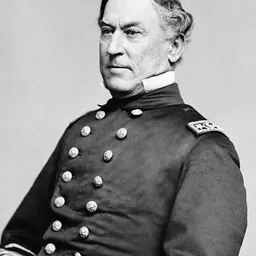
After a period as lighthouse inspector and at Charlestown Navy Yard, he served on , 1859–1861, then took command of the steam-gunboat , serving with David Farragut on the Mississippi River, was promoted to commander on July 16, 1862, and given command of the steam-sloop blockading Mobile Bay.
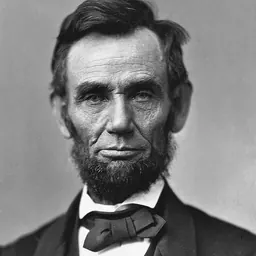
After the Confederate cruiser CSS Florida ran the blockade into Mobile Bay on September 4, 1862, Preble was dismissed from the Navy. On February 12, 1863, President Abraham Lincoln nominated him for restoration.
In 1872, a formal court of inquiry concluded that Preble’s failure to stop Florida was a “venial violation of duty” and that, once the vessel’s intention to violate the blockade became apparent, he did all that a loyal, brave, and efficient officer could do to capture or destroy her. According to their accounts, Florida appeared at around 5:00 pm on September 4, 1862, bearing the ensign of a ship of the English Navy. Preble commanded Oneida and served as the senior officer of the blockading force off Mobile; Commander James S. Thornton commanded Winona. at the Navy Department Library. He was also active in various learned and genealogical societies of the time. In 1868, he published a genealogical history of the Preble family in North America, which included his biography and portrait, as well as that of his famous uncle, Edward The book also set forth a defense of his actions that led to his dismissal from the Navy, as well as the efforts of himself and others that led to his exoneration and reinstatement. In 1872, he published his Our Flag: Origin and Progress of the Flag of the United States of America, which is still cited as a source. He also took care of the original "Star-Spangled Banner" which had flown over Fort McHenry and had the flag sewn to a piece of sailcloth in order to preserve it.
Later life and death After the war, Preble commanded the steamer , and rescued 600 passengers from the wrecked steamer Golden Rule. He was at the Boston Navy Yard from 1865 to 1868, where he was promoted to captain on March 16, 1867, then commanded the screw steamer until 1870. He became commodore on November 2, 1871, commanding the Philadelphia Navy Yard from 1873 to 1875. Preble became rear admiral on September 30, 1876, commanding the South Pacific Station from 1877 to 1878. He retired from active duty on February 25, 1878.
He was a member of the Military Order of the Loyal Legion of the United States.
In 1873 Preble was elected a member of the American Antiquarian Society
Preble died while living at the home of his son in Brookline, Massachusetts near Boston, on March 1, 1885. He is buried in the Evergreen Cemetery in Portland, Maine.
Dates of rank Midshipman - 10 October 1835 Passed Midshipman - 22 June 1841 Master - 15 July 1847 Lieutenant - 5 February 1848 Commander - 16 July 1862 Captain - 29 January 1867 Commodore - 2 November 1871 Rear Admiral - 30 September 1876 Retired List - 25 February 1878
Publications Chase of the Rebel Steamer of War "Oreto" (Cambridge, 1862) A genealogical Sketch of the First Three Generations of Prebles in America (Boston, 1868) First Cruise of the United States Frigate "Essex" (Salem, 1870) Our Flag: Origin and Progress of the Flag of the United States of America (Albany, 1872) History of Steam Navigation (Philadelphia, 1883) History of the Flag of the United States of America (1880)
Don’t just read it —
keep it.
Full-length biographies made to live with: read them, listen on the way to work, watch them tonight.
- E-book
- Audio
- Video
Instant download · yours to keep · every purchase keeps this site free
Important facts
People in George Henry Preble's life
Named in this biography and alive at the same time
Related people
Same field, nearest in time

Contemporaries
People whose lives overlapped George Henry Preble's





Frequently asked questions
Who was George Henry Preble?
United States Navy Rear Admiral
When was George Henry Preble born?
George Henry Preble was born on 25 February 1816 in Portland.
When did George Henry Preble die?
George Henry Preble died on 1 March 1885 in Boston, Brookline.
What was George Henry Preble's occupation?
George Henry Preble was a military officer and sailor.
What nationality was George Henry Preble?
George Henry Preble was American.
Sources & further reading
· Wikipedia: George Henry Preble
· DBpedia: George Henry Preble
Cite this page
APA: Biography.guide. (2026). George Henry Preble. https://biography.guide/george-henry-preble/
MLA: "George Henry Preble." Biography.guide, https://biography.guide/george-henry-preble/.
Chicago: "George Henry Preble." Biography.guide. https://biography.guide/george-henry-preble/.
Data last updated: 2026-09-21 · Spot an error? Report a correction.
Portrait: Wikimedia Commons · author & licence
Page generated 2026-09-27 05:00 UTC