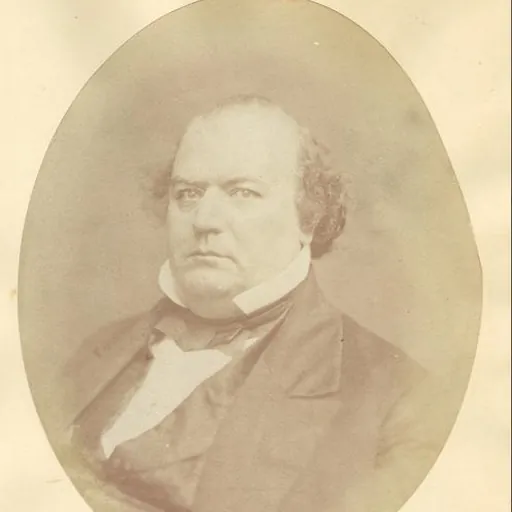
About George Haynes Walker
Lived 1811 – 1866 (aged 54). George Haynes Walker was an American politician.
George Haynes Walker (October 22, 1811 – September 20, 1866) was an American trader, Democratic politician, and Wisconsin pioneer. He was one of three key founders of the city of Milwaukee, Wisconsin, establishing the first settlement in what is now Milwaukee's south side. The site of his settlement is still known as Walker's Point. He went on to serve as the 5th and 7th mayor of Milwaukee, and represented Milwaukee in the Wisconsin State Assembly during the 1851 term.
Prior to Wisconsin statehood, he also served in the House of Representatives of the Wisconsin Territory, and was speaker for two sessions of the 4th Wisconsin Territorial Assembly.
His younger brother, Isaac P. Walker, was one of the first two from Wisconsin.
Background Walker was born in Lynchburg, Virginia, and moved with his family to Illinois in 1825. The fur trade brought him to the vicinity of the Milwaukee River in 1833, and, on March 20, 1834, he established a fur trading outpost on the south bank of the river; at the time, he and Solomon Juneau were described as the only white settlers in the area, and they both conducted active trade with Native American populations. In June 1835, he laid claim to much of the area surrounding his trade post, which is now the Milwaukee neighborhood known as Walker's Point. Some legal disputes ensued over the legitimacy of the claim, but Walker's claim was upheld by a special act of Congress in 1842.
Walker's Point became one of the three original settlements that would make up the city of Milwaukee, the other two being Juneau's Juneautown (present-day East Town), and Byron Kilbourn's Kilbourntown (present-day Westown). The three settlements voted to incorporate as a single city in 1846, establishing the city of Milwaukee.
During the 4th Wisconsin Legislature, the Legislature wrote a new city charter for Milwaukee with new ward lines, modified taxation powers, and a reorganized governance structure. The legislature also delayed the city election—normally held in April—until May 20, to give time for a referendum on the new charter in early May. The charter referendum was a disorganized mess, with some wards failing to report their results; but only 750 of the 2,219 returned votes clearly indicated approval of the charter, so it was deemed a rejection.
The Democrats' intra-party split—previously on display in Walker's 1850 Assembly election—was highlighted again in the May 20 municipal election. The Free Soil and "Locofoco" Democrats commanded the "regular" Democratic city convention, and nominated Abram D. Smith. The "Hunker" Democrats of the city and the city's small Whig minority nominated Walker at a "People's Convention" held the day before the election. At the May 20 election, Walker prevailed with about 55% of the vote. A People's convention was held again and nominated Walker for mayor. The city split more along geographic than ideological lines in this election, with the 2nd ward in northwestern Milwaukee giving nearly all of its support to Kneeland, but the rest of the city largely supporting Walker; Walker prevailed with about 56% of the vote.
Personal life and family
George H. Walker was the eldest son and third of six children born to George Reynolds Walker and his wife Rebecca ( Hamer). George's younger brother, Isaac P. Walker, followed him to the Wisconsin Territory and became a prominent lawyer and politician; when Wisconsin achieved statehood, Isaac Walker was elected as one of Wisconsin's first U.S. senators, serving from 1848 to 1855. Both of Walker's parents and one sister also eventually moved to Wisconsin.
George H. Walker married the widow Caroline Pratt Brown ( Spencer) in the late 1850s. They had no known children.
Electoral history Wisconsin Assembly (1850)
Milwaukee mayor (1851)
Milwaukee mayor (1853)
Don’t just read it —
keep it.
Full-length biographies made to live with: read them, listen on the way to work, watch them tonight.
- E-book
- Audio
- Video
Instant download · yours to keep · every purchase keeps this site free
Important facts
People in George Haynes Walker's life
Named in this biography and alive at the same time




Related people
Same field, nearest in time




Contemporaries
People whose lives overlapped George Haynes Walker's





Frequently asked questions
Who was George Haynes Walker?
American politician (1811–1866)
When was George Haynes Walker born?
George Haynes Walker was born on 22 October 1811 in Lynchburg.
When did George Haynes Walker die?
George Haynes Walker died on 20 September 1866 in Milwaukee.
What was George Haynes Walker's occupation?
George Haynes Walker was a politician.
What nationality was George Haynes Walker?
George Haynes Walker was American.
Sources & further reading
· Wikipedia: George Haynes Walker
Cite this page
APA: Biography.guide. (2026). George Haynes Walker. https://biography.guide/george-haynes-walker/
MLA: "George Haynes Walker." Biography.guide, https://biography.guide/george-haynes-walker/.
Chicago: "George Haynes Walker." Biography.guide. https://biography.guide/george-haynes-walker/.
Data last updated: 2026-09-21 · Spot an error? Report a correction.
Portrait: Wikimedia Commons · author & licence
Page generated 2026-09-27 04:59 UTC