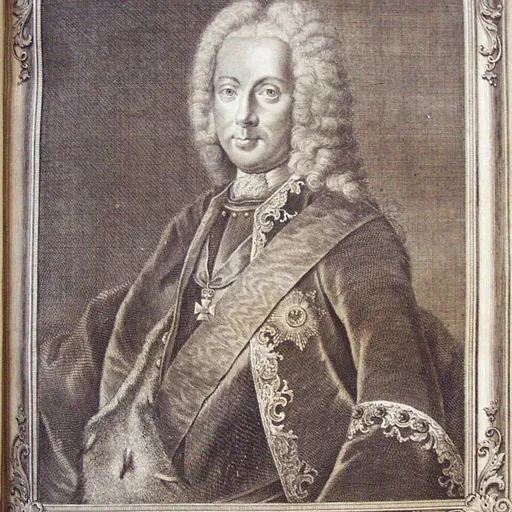
George Frederick Charles, Margrave of Brandenburg-Bayreuth
Margrave of Brandenburg-Kulmbach and Margrave of Brandenburg-Bayreuth
About George Frederick Charles, Margrave of Brandenburg-Bayreuth
Lived 1688 – 1735 (aged 46). George Frederick Charles, Margrave of Brandenburg-Bayreuth was a German ruler and statesperson.
George Frederick Charles, Margrave of Brandenburg-Bayreuth (19 June 1688 at Obersulzbürg Castle, near Mühlhausen – 17 May 1735 in Bayreuth), was a German prince, member of the House of Hohenzollern, nominal Margrave of Brandenburg-Bayreuth-Kulmbach (1708–35) and Margrave of Brandenburg-Bayreuth (1726–35).
Family He was the eldest of the fourteen children born to Margrave Christian Heinrich of Brandenburg-Bayreuth-Kulmbach by his wife, Countess Sophie Christiane of Wolfstein. Besides him, only six of his siblings survived childhood: Albrecht Wolfgang, killed in battle in 1734; Dorothea Charlotte, Countess of Hohenlohe-Weikersheim, who died in 1712 after only seven months of marriage; Sophie Magdalene, Queen of Denmark; Frederick Ernst; Sophie Caroline, Princess of Ostfriesland; and Frederick Christian, who later inherited the margraviate of Bayreuth.
Life During his early years, George Frederick Charles was instructed by his very religious mother, and later received a careful formal education in Bielefeld. From 1700 to 1704, he travelled to western Europe as part of a traditional educational journey (Grand Tour), and visited, among other countries, Denmark, France and the Dutch Republic. Later, he studied four years at the University of Utrecht. After the death of his father in 1708 he returned with his family, who had lived since 1704 in the Schloss Weferlingen near Magdeburg, and assumed the nominal title of Margrave of Brandenburg-Bayreuth-Kulmbach.
Schloss Weferlingen had been assigned to his family as an appanage by King Frederick I of Prussia, after George Frederick Charles's heavily indebted father had renounced his succession rights to the Franconian Hohenzollern estates of Bayreuth and Ansbach in favour of Prussia in the Contract of Schönberg. George Frederick Charles nonetheless tried to recover his rights after the death of his father and sought the abolition of this contract. He was able to secure the support of the Franconian states, who feared being merged into the Franconian Circle by Prussia. George Frederick Charles could also rely on the decisive assistance of the Archbishop of Mainz, the Aulic Council (Imperial Supreme Court), and Prince-Bishop of Bamberger Lothar Franz von Schönborn and his nephew, the Imperial Vice-Chancellor (German: Reichsvizekanzler) Friedrich Karl von Schönborn, who supported the abolition of the Contract of Schönberg. His efforts finally succeeded only in 1722 after long and difficult discussions and the payment of a substantial indemnity to Prussia.
When the Margrave Georg Wilhelm died in 1726 without surviving male issue, George Frederick Charles assumed the principality of Bayreuth without further difficulties.
After his accession, George Frederick Charles put great value on the improvement of the ruined finances of his territories and made local government his highest priority. In contrast to many of his contemporary rulers, he had no political or military ambitions. Instead he was very pious and intensely supported August Hermann Francke in inculcating the importance of religious life for his subjects. He was remarkable for his support of orphanages.
He was uninterested in court life, and in his last years built up Schloss Himmelkron, a former monastery, probably with plans to retire there.
In the memoirs of his daughter-in-law Wilhelmine of Prussia, George Frederick Charles is described as a thin, bandy-legged, egotistical, wrong-headed, jealous person. The antipathy was mutual. The margrave harassed his daughter-in-law in much the same way that her parents had done. When Wilhelmine gave birth to a daughter, it destroyed George Frederick Karl's hopes to take charge of his grandchild's upbringing, since he was allowed to supervise the education of his son Frederick's child only if it were a boy, according to the marriage contract signed with Wilhelmine. Frederick supported his wife and the drunk margrave hit him with his stick without injuring him.
Marriage and issue In Reinfeld on 17 April 1709 George Frederick Charles married Dorothea of Schleswig-Holstein-Sonderburg-Beck. They had five children: Sophie Christiane Luise (b. Weferlingen, 4 January 1710 – d. Brussels, 13 June 1739), married on 11 April 1731 to Alexander Ferdinand, 3rd Prince of Thurn and Taxis. Frederick (b. Weferlingen, 10 May 1711 – d. Bayreuth, 26 February 1763), successor of his father as Margrave of Bayreuth. Wilhelm Ernst (b. Weferlingen, 26 July 1712 – d. Mantua, 7 November 1733). Sophie Charlotte Albertine (b. Weferlingen, 27 July 1713 – d. Ilmenau, 2 March 1747), married on 7 April 1734 to Duke Ernst August I of Saxe-Weimar. Sophie Wilhelmine (b. Weferlingen, 8 July 1714 – d. Aurich, 7 September 1749), married on 25 May 1734 to Prince Charles Edzard of East Frisia.
After seven years of unhappy marriage, George Frederick Charles and Dorothea separated in 1716. Eight years later (1724), their marriage was formally dissolved. Dorothea later emigrated to Sweden, where she died in 1761, twenty years after her former husband. Neither of them remarried.
Ancestry
Don’t just read it —
keep it.
Full-length biographies made to live with: read them, listen on the way to work, watch them tonight.
- E-book
- Audio
- Video
Instant download · yours to keep · every purchase keeps this site free
Important facts
Family & relationships
People in George Frederick Charles, Margrave of Brandenburg-Bayreuth's life
Named in this biography and alive at the same time

Related people
Same field, nearest in time





Contemporaries
People whose lives overlapped George Frederick Charles, Margrave of Brandenburg-Bayreuth's




Frequently asked questions
Who was George Frederick Charles, Margrave of Brandenburg-Bayreuth?
Margrave of Brandenburg-Kulmbach and Margrave of Brandenburg-Bayreuth
When was George Frederick Charles, Margrave of Brandenburg-Bayreuth born?
George Frederick Charles, Margrave of Brandenburg-Bayreuth was born on 19 June 1688 in Mühlhausen.
When did George Frederick Charles, Margrave of Brandenburg-Bayreuth die?
George Frederick Charles, Margrave of Brandenburg-Bayreuth died on 17 May 1735 in Bayreuth.
What was George Frederick Charles, Margrave of Brandenburg-Bayreuth's occupation?
George Frederick Charles, Margrave of Brandenburg-Bayreuth was a ruler and statesperson.
What nationality was George Frederick Charles, Margrave of Brandenburg-Bayreuth?
George Frederick Charles, Margrave of Brandenburg-Bayreuth was German.
Sources & further reading
· Wikipedia: George Frederick Charles, Margrave of Brandenburg-Bayreuth
· DBpedia: George Frederick Charles, Margrave of Brandenburg-Bayreuth
Cite this page
APA: Biography.guide. (2026). George Frederick Charles, Margrave of Brandenburg-Bayreuth. https://biography.guide/george-frederick-charles-margrave-of-brandenburg-bayreuth/
MLA: "George Frederick Charles, Margrave of Brandenburg-Bayreuth." Biography.guide, https://biography.guide/george-frederick-charles-margrave-of-brandenburg-bayreuth/.
Chicago: "George Frederick Charles, Margrave of Brandenburg-Bayreuth." Biography.guide. https://biography.guide/george-frederick-charles-margrave-of-brandenburg-bayreuth/.
Data last updated: 2026-09-20 · Spot an error? Report a correction.
Portrait: Wikimedia Commons · author & licence
Page generated 2026-09-27 04:57 UTC