
About George F. Carter
Lived 1912 – 2004 (aged 91). George F. Carter was an American anthropologist and geographer.
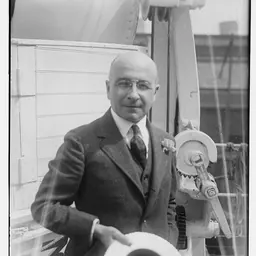
George Francis Carter (April 6, 1912 – March 16, 2004) was an American professor of geography who taught at Johns Hopkins University and later Texas A&M University. Carter had a background in anthropology and conducted archaeological excavations in Southern California. He is best known for supporting the theories of trans-cultural diffusion and early human settlement of the Americas.
Early life and education Carter was born in San Diego, California on 6 April 1912. As a teenager, he expressed interest in anthropology and began to spend much of his free time at the San Diego Museum of Man. At the age of fifteen, Carter befriended the archaeologist Malcolm Jennings Rogers, who was the museum's curator. Rogers allowed the young Carter to volunteer at the museum, and in the summer of 1930, Carter accompanied Rogers on a five-week expedition to San Nicolas Island, where they excavated numerous sites. The following autumn, Carter began classes at San Diego State College. He would eventually transfer to the University of California at Berkeley and earn a B.A. in anthropology in 1934.
San Diego Museum of Man Immediately after graduating, Carter was hired by the San Diego Museum of Man and began working with his old mentor Malcolm Jennings Rogers. The two conducted field work on the coasts of Southern California and in the Mojave Desert. While surveying in 1937-1938 near Silver Lake in the Mojave, Carter found a fluted projectile point which he recognized to be Folsom. Critics dismissed much of Carter's claims for early inhabitance, questioning his dating techniques and the possibility that most of the lithic artifacts were actually geofacts. Throughout the 1960s to the 1980s, Carter continued to publish papers and articles dealing with hyperdiffusionism and the early Peopling of the Americas.
In 1967, Carter left Johns Hopkins for Texas A&M University, where he was a distinguished professor of geography until 1978, retiring to become a professor emeritus. Carter died on 16 March 2004.
Earlier Than You Think
In 1980, Carter published Earlier than You Think: A Personal View of Man in America. The book describes Carter's evidence for humans arriving in North America approximately 100,000 years ago. Carter also mentions the Polynesians' and Vikings' maritime abilities as support. Hyperdiffusionism also assumes that if artifacts are similar in appearance, they must be related in some manner.
Don’t just read it —
keep it.
Full-length biographies made to live with: read them, listen on the way to work, watch them tonight.
- E-book
- Audio
- Video
Instant download · yours to keep · every purchase keeps this site free
Important facts
People in George F. Carter's life
Named in this biography and alive at the same time




Related people
Same field, nearest in time

Contemporaries
People whose lives overlapped George F. Carter's



Frequently asked questions
Who was George F. Carter?
American anthropologist and geographer
When was George F. Carter born?
George F. Carter was born on 6 April 1912 in San Diego.
When did George F. Carter die?
George F. Carter died on 16 March 2004.
What was George F. Carter's occupation?
George F. Carter was an anthropologist and geographer.
What nationality was George F. Carter?
George F. Carter was American.
Sources & further reading
Cite this page
APA: Biography.guide. (2026). George F. Carter. https://biography.guide/george-f-carter/
MLA: "George F. Carter." Biography.guide, https://biography.guide/george-f-carter/.
Chicago: "George F. Carter." Biography.guide. https://biography.guide/george-f-carter/.
Data last updated: 2026-09-20 · Spot an error? Report a correction.
Page generated 2026-09-27 04:57 UTC