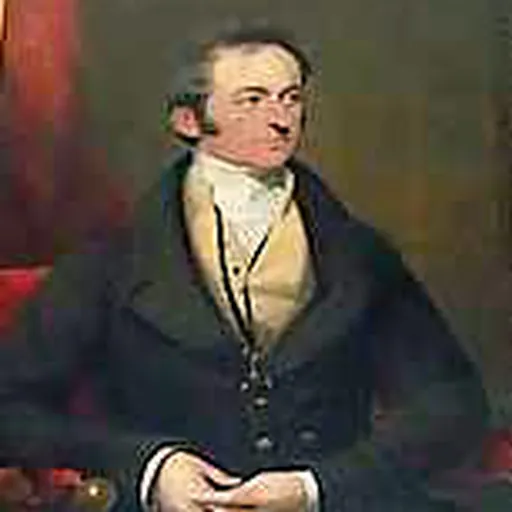
About George Dundas
Lived 1778 – 1834 (aged 56). George Dundas was a British politician and plantation owner.
Rear-Admiral George Heneage Lawrence Dundas (8 September 1778 – 7 October 1834) was a senior officer in the Royal Navy. As a junior officer he came to prominence due to his brave conduct during a fire on the first-rate HMS Queen Charlotte. As a result of this he was appointed to the command of the sixth-rate HMS Calpe in which he took part in the Battle of Algeciras Bay in July 1801 during the French Revolutionary Wars. After serving for four years as Whig Member of Parliament for Richmond, he was given command of the fifth-rate HMS Euryalus and took part in the unsuccessful Walcheren Campaign in July 1809 during the Napoleonic Wars. He transferred to the third-rate HMS Edinburgh and landed troops at Viareggio in Italy in November 1812 later in that War. He went on to be Member of Parliament for Orkney and Shetland and became First Naval Lord in the First Melbourne ministry in August 1834 but died in office just two months later in October 1834.
Naval career
Early career Born the fifth son of Thomas Dundas (created Baron Dundas in 1794) by his wife Charlotte Dundas (daughter of William Fitzwilliam, 3rd Earl Fitzwilliam), Dundas became a lieutenant in the Royal Navy in 1797 and served for several years with the Mediterranean Fleet.
HMS Queen Charlotte
In February 1800 Dundas was aboard Lord Keith's flagship, the first-rate HMS Queen Charlotte. Dundas was junior to Lieutenant Lord Cochrane but Cochrane had taken command of Nelson's prize, the Genereaux, in late 1799 to take her into port; Dundas therefore became 5th Lieutenant of the Queen Charlotte. One month later, early in the morning of 17 March 1800, cries of "Fire" rang out throughout the vessel. Some hay lying under the half-deck had been set on fire by a match kept there for the signal guns. Dundas was in the forecastle where he organized fire-fighting efforts. Dundas led a party below decks where they secured the main and fore hatches and then opened the lower-deck ports and the sea cocks to flood the lower decks to prevent the fire spreading down. These efforts delayed the fire from reaching the two magazines. Dundas continued working below decks until some middle-deck guns fell through the deck. At about 9am Dundas climbed out the foremost lower-deck port and climbed up to the forecastle, joining the about 150 men there who were throwing water on the fire. Despite the crew's exertions, the Queen Charlotte eventually blew up with the loss of 673 people out of its complement of 840 officers, men and boys, including the Captain and her first Lieutenant. Dundas however survived.
HMS Cameleon By 14 June 1800 Dundas was captain of the sloop Cameleon. She and Salamine shared in the capture on that day of the Genoese brig Anima Purgatoria, which was sailing from Bastia to Salcolight.
HMS Calpe Next, Dundas was appointed to the command of the sixth-rate HMS Calpe. On the night of 27 October 1800, Francis Beaufort, inventor of the Beaufort Wind-Scale, had led Phaeton's boats on a cutting out expedition. They captured the San José, alias Aglies, of 14 guns, which they immediately re-commissioned under the name of HMS Calpe, the ancient name of Gibraltar. Although it would have been usual to promote Beaufort, the successful and heroic leader of the expedition, to command Calpe, Lord Keith chose instead to promote Dundas who not only was not present at the battle, but was junior to Beaufort. Dundas was promoted to commander in December 1800. In the subsequent second phase of the Battle of Algeciras Bay, the two Spanish first-rates Real Carlos and Hermenegildo fired upon each other during the night, caught fire and exploded, with tremendous loss of life. The British captured the third-rate St Antoine, with Superb and Calpe then assisting in securing the prize and removing the prisoners. Rear Admiral James Saumarez promoted Dundas to post-captain on 9 August 1801 but resigned in February 1806, using the device of applying to be Steward of the Manor of East Hendred, to take up an offer of a naval command again and to allow his brother Charles to re-enter Parliament. Euryalus was asked, along with and several other warships to act as escorts to a large convoy bound for Oporto, Lisbon and the Mediterranean. Towards the end of 1807 Euryalus returned to England with as escort to a convoy of several thousand troops under Sir John Moore from Gibraltar. She went into dock at Plymouth for a refit and was then stationed in the North Sea. She carried the Duke d'Angoulême from Yarmouth to Gottenburg and escorted the Baltic convoys through the Great Belt. During the same year Dundas went to Elbing, a small port in West Prussia about 60 kilometers east of Danzig (now in Poland) to embark Marie Joséphine of Savoy (the consort of Louis XVIII), the Duc du Berry and other members of the French royal family. He took them to Carlscrona in southern Sweden and, after re-embarking them at Gottenburg, finally to Harwich. Later she was stationed off Cherbourg under the orders of Captain Sir Richard King, and in November 1809 she captured the French privateer lugger Etoile of 14 guns and 48 men. In the spring of 1810 Euryalus escorted a large convoy from Spithead to Portugal and the Mediterranean and was then attached to Captain Blackwood's inshore squadron off Toulon.
Dundas became Member of Parliament for Richmond again at a by-election in 1812 but was defeated at the 1812 general election. The place was defended by two batteries mounting three heavy guns each on the mole, a tower with one gun and a battery with two guns. During the attack in the afternoon, Edinburgh supported Eclair and Pylades as they bore up against the battery to the south. After the ships opened fire, landing parties brought out the 29 vessels of the convoy, 20 of which were laden with wood for the arsenal at Toulon. All the works were blown up.
Post-war
At the end of the war, Dundas left the Edinburgh at Genoa and traveled overland back to Britain. After retiring from the Navy in 1815,
Dundas became Second Naval Lord in the Grey ministry in November 1830; having been appointed a Deputy Lieutenant of York in 1831. On 2 November 1831 he was appointed as Comptroller of the Navy and member of the Navy Board until June 1832 when it was abolished and its functions were merged with the Board of Admiralty. He was elevated to First Naval Lord in the First Melbourne ministry in August 1834 but died in office, unmarried, of apoplexy at Upleatham in North Yorkshire just two months later on 7 October 1834.
Dundas is a peripheral character in C. Northcote Parkinson's 1976 novel Touch and Go who, like O'Brian, places his hero at the Battle of Algeciras, where he interacts with Dundas.
Don’t just read it —
keep it.
Full-length biographies made to live with: read them, listen on the way to work, watch them tonight.
- E-book
- Audio
- Video
Instant download · yours to keep · every purchase keeps this site free
Important facts
People in George Dundas's life
Named in this biography and alive at the same time




Related people
Same field, nearest in time



Contemporaries
People whose lives overlapped George Dundas's

Frequently asked questions
Who was George Dundas?
Royal Navy admiral (1778-1834)
When was George Dundas born?
George Dundas was born on 8 September 1778 in Upleatham.
When did George Dundas die?
George Dundas died on 7 October 1834 in Upleatham.
What was George Dundas's occupation?
George Dundas was a politician and plantation owner.
What nationality was George Dundas?
George Dundas was British.
Sources & further reading
· DBpedia: George Dundas (Royal Navy officer)
Cite this page
APA: Biography.guide. (2026). George Dundas. https://biography.guide/george-dundas/
MLA: "George Dundas." Biography.guide, https://biography.guide/george-dundas/.
Chicago: "George Dundas." Biography.guide. https://biography.guide/george-dundas/.
Data last updated: 2026-09-21 · Spot an error? Report a correction.
Portrait: Wikimedia Commons · author & licence
Page generated 2026-09-27 04:59 UTC