
About George de Roerich
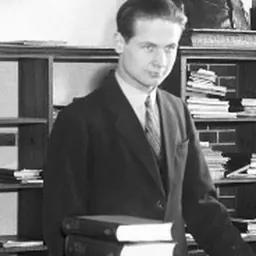
Lived 1902 – 1960 (aged 57). George de Roerich was a Russian explorer, dialectologist, translator, university teacher and orientalist.
George Nicolas de Roerich (, ; 1902–1960) was a Russian Tibetologist and translator. Roerich's work encompassed many areas of Tibetan studies, but he is most known for his contributions to Tibetan dialectology, his translation of the Blue Annals, and his 11-volume Tibetan–Russian–English dictionary (published posthumously).
Early life George was the son of the painter and explorer Nicholas Roerich and Helena Roerich. Much of Roerich's early life was spent in Saint Petersburg. His brother, Svetoslav Roerich, was born in 1904. Both sons' interests were nurtured by their mother, who wrote of her oldest son's childhood: "The elder one showed love for history and tin soldiers. He had thousands of them. His passion for the art of war has survived until now. Strategy is his pet subject. By the way, this talent is inborn, and he is very proud of his ancestor — field marshal of the Russian Empire Mikhail Kutuzov, the hero of Patriotic War of 1812."
Education By the time Roerich was 15, he had begun studying Egyptology with Boris Turayev and Mongolian language and history with Andrei Dmitriyevich Rudnyev. He was a student with broad interests and many talents. After finishing his studies at Karl May School, he entered the Indian and Iranian Department of Oriental Languages at London University in 1918. Under Indologist Professor Edward Denison Ross he studied Sanskrit and Pali. He was recognized for his language abilities and was introduced as the best Sanskrit student to the Secretary of State for Indian Affairs who visited the university.
Upon completion of his study at London University in 1920, he moved to America with his parents. He studied in the Indian Philology Department of Harvard University. At the age of 18, Roerich was already firmly rooted in his passion for Oriental studies. He mastered Sanskrit during his time at Harvard under the direction of Professor Charles Rockwell Lanman, whose comparative grammar lessons made a lifelong impact on George's future studies. Roerich also attended lectures by Professor Michael Rostovtzeff on Middle Asia influences in the art of southern Russia. During his years at Harvard, he studied Buddhism classical Chinese.
Career
Early work Roerich began his independent research at the age of 21. In November 1923, he left for Bombay with his family. After years of study and preparation, his dream of going to India came true. By December 1923, he had arrived at the base of the Himalayas as a member of a scientific expedition to Sikkim. The purpose of this expedition was to visit ancient monuments and Buddhist monasteries as well as to record local legends, beliefs, and artistic traditions. In Darjeeling, George polished his colloquial Tibetan with scholar Lama L.M. Dorje, who guided him in the study of Tibetan Art. Roerich found strong similarities between ancient Russian icon painting and the art of thangka painting in both technique and in the treatment of the subject. He wrote: "Indeed, it seems that the Russian icon art and the Tibetan pictorial art derive their methods of work from a common source...Thus we often see on Tibetan paintings the principal figures enthroned on an island (this being usually the case when Buddha or Bodhisattva is represented). Similar images are frequently found on Russian icons." His study of the geography, archeology, ethnology, and linguistics during the expedition formed the basis of his work Trails to Inmost Asia, published in 1930. This publication put the young orientalist on par with the famous researchers of Central Asia, such as Nikolay Przhevalsky, Grigory Potanin, Pyotr Kozlov, and Sven Hedin.
Manchuria expedition In 1934–1935, the U.S. Department of Agriculture organized an expedition for Roerich and his father Nicholas Roerich to Manchuria and Inner Mongolia for the purpose of collecting the seeds of drought resistant plants, with the hopes that they that would help prevent erosion of soils and the spreading of pests. This expedition was also to create wider agricultural cooperation and public collaboration.
Works de Roerich, George (1925). Tibetan Paintings. Paris: Paul Geuthner. de Roerich, George (1930). The Animal Style Among the Nomads of Northern Tibet. Prague: Seminarium Kondakovianum. de Roerich, George (1931). Trails to Inmost Asia. Yale University Press. de Roerich, George (1931). “Modern Tibetan Phonetics: With special reference to the Dialect of Central Tibet.” Journal and Proceedings of the Asiatic Society of Bengal 27.1: 285-312. de Roerich, George (1932). Review of Jäschke 1881. Journal of Urusvati 2: 165-169. de Roerich, George (1933). Dialects of Tibet: The Tibetan Dialect of Lahul. (Tibetica 1) New York: Urusvati Himalayan Research Institute of Roerich Museum. de Roerich, George (1958). Le Parler de l’Amdo: Étude d’un Dialecte Archaïque du Tibet. (Serie Orientale Roma 18). Rome: Istituto Italiano per il Medio ed Estremo Oriente. de Roerich, George Nicolas ( 11 vols., 1983–1993 ). Tibetsko-russko-angliiskii slovar: s sanskritskimi paralleliami. Tibetan-Russian-English dictionary with Sanskrit parallels. Y. Parfionovich and V. Dylykova, eds. Moscow: Izd-vo "Nauka," Glav. red. vostochnoi lit-ry / Central Department of Oriental Literature. de Roerich, George N. and Tse-Trung Lopsang Phuntshok (1957). Textbook of colloquial Tibetian: dialect of central Tibet. Calcutta: Govt. of West Bengal, Education Dept., Education Bureau. Roerich, George N. and Gedun Choepel (Translator) (1988). The Blue Annals by Gö Lotsawa. Motilal Banarsidass, Delhi, 1976, Reprint in 1979. [reprint of Calcutta, Royal Asiatic Society of Bengal, 1949, in two volumes].
Don’t just read it —
keep it.
Full-length biographies made to live with: read them, listen on the way to work, watch them tonight.
- E-book
- Audio
- Video
Instant download · yours to keep · every purchase keeps this site free
Important facts
People in George de Roerich's life
Named in this biography and alive at the same time




Related people
Same field, nearest in time



Contemporaries
People whose lives overlapped George de Roerich's





Frequently asked questions
Who was George de Roerich?
Russian tibetologist (1902–1960)
When was George de Roerich born?
George de Roerich was born on 3 August 1902 in Okulovka (town), Novgorod Oblast.
When did George de Roerich die?
George de Roerich died on 21 May 1960 in Moscow.
What was George de Roerich's occupation?
George de Roerich was an explorer, dialectologist, translator, university teacher and orientalist.
What nationality was George de Roerich?
George de Roerich was Russian.
Sources & further reading
· Wikipedia: George de Roerich
Cite this page
APA: Biography.guide. (2026). George de Roerich. https://biography.guide/george-de-roerich/
MLA: "George de Roerich." Biography.guide, https://biography.guide/george-de-roerich/.
Chicago: "George de Roerich." Biography.guide. https://biography.guide/george-de-roerich/.
Data last updated: 2026-09-20 · Spot an error? Report a correction.
Page generated 2026-09-27 05:29 UTC