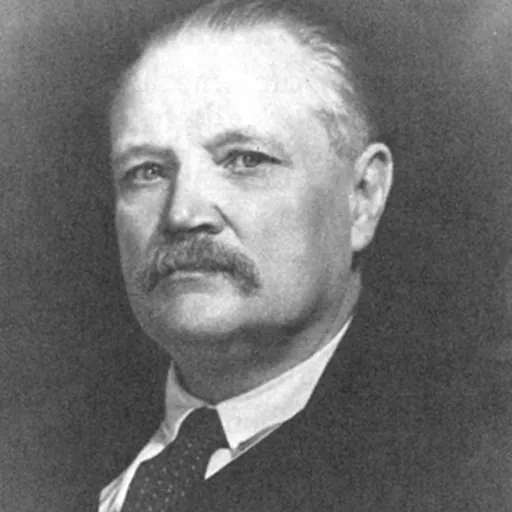
Michael Rostovtzeff
Russian historian of ancient history
About Michael Rostovtzeff
Lived 1870 – 1952 (aged 81). Michael Rostovtzeff was a Russian and American economic historian, classical archaeologist, historian of classical antiquity, university teacher, social historian and economist.
Career Rostovtzeff was the son of a Latin teacher. Upon completing his studies at the universities of Kiev and , Rostovtsev served as an assistant and then as a full Professor of Latin at the from 1898 to 1918. In 1918, following the Russian Revolution, he emigrated first to Sweden, then to England, and finally in 1920 to the United States. There he accepted a chair at the University of Wisconsin–Madison before moving to Yale University in 1925 where he taught until his retirement in 1944. He oversaw all archaeological activities of the latter institution in general and the excavations of Dura-Europos in particular. He is believed to have coined the term "caravan city".
While working in Russia, Rostovtzeff became an authority on the ancient history of South Russia and Ukraine. He summed up his knowledge on the subject in Iranians and Greeks in South Russia (1922) and Skythien und der Bosporus (1925). His most important archaeological findings at Yale were described in Dura-Europos and Its Art (1938).
Glen Bowersock described Rostovtzeff's views as having been largely formed by the age of thirty, developing mainly only in the quality of execution in later life, and making him "the last of the nineteenth-century ancient historians". Rostovtzeff was known as a proud and slightly overpowering man who did not fit in easily. In later life, he suffered from depression.
The Social and Economic History of the Roman Empire
Rostovtzeff's notable theories, particularly on Roman Empire's collapse, were expounded in The Social and Economic History of the Roman Empire (1926). Scarred by his experience of fleeing from the Russian Revolution, he attributed the collapse of the Roman Empire to an alliance between the rural proletariat and the military in the third century A.D. Despite not being a Marxist himself, Rostovtzeff used terms such as proletariat, bourgeoisie and capitalism freely in his work and the importation of those terms into a description of the ancient world, where they did not necessarily apply, caused criticism. Skythien und der Bosporus. 1925. The Social and Economic History of the Roman Empire. 1926. (Revised edition in German 1931, and further revised edition in Italian 1933) (Second edition, revised by P.M. Fraser, Oxford, 1957) A History of the Ancient World: Volume I The Orient and Greece. Oxford: Clarendon Press, 1926. A History of the Ancient World: Volume II Rome. Oxford: Clarendon Press, 1927. Mystic Italy. New York: Henry Holt, 1927. (Brown University, the Colver lectures series) Caravan Cities. Oxford: Clarendon Press, 1932. (First published in book form as O Blijnem Vostoke. Paris, 1931.) Dura-Europos and Its Art. 1938. The Social and Economic History of the Hellenistic World. Oxford: Clarendon Press, 1941. (2nd edition 1953)
Don’t just read it —
keep it.
Full-length biographies made to live with: read them, listen on the way to work, watch them tonight.
- E-book
- Audio
- Video
Instant download · yours to keep · every purchase keeps this site free
Important facts
People in Michael Rostovtzeff's life
Named in this biography and alive at the same time

Related people
Same field, nearest in time




Contemporaries
People whose lives overlapped Michael Rostovtzeff's


Frequently asked questions
Who was Michael Rostovtzeff?
Russian historian of ancient history (1870–1952)
When was Michael Rostovtzeff born?
Michael Rostovtzeff was born on 29 October 1870 in Zhytomyr, Kyiv.
When did Michael Rostovtzeff die?
Michael Rostovtzeff died on 20 October 1952 in New Haven.
What was Michael Rostovtzeff's occupation?
Michael Rostovtzeff was an economic historian, classical archaeologist, historian of classical antiquity, university teacher, social historian and economist.
What nationality was Michael Rostovtzeff?
Michael Rostovtzeff was Russian and American.
Sources & further reading
· Wikipedia: Michael Rostovtzeff
· DBpedia: Michael Rostovtzeff
Cite this page
APA: Biography.guide. (2026). Michael Rostovtzeff. https://biography.guide/michael-rostovtzeff/
MLA: "Michael Rostovtzeff." Biography.guide, https://biography.guide/michael-rostovtzeff/.
Chicago: "Michael Rostovtzeff." Biography.guide. https://biography.guide/michael-rostovtzeff/.
Data last updated: 2026-09-22 · Spot an error? Report a correction.
Portrait: Wikimedia Commons · author & licence
Page generated 2026-09-27 05:03 UTC