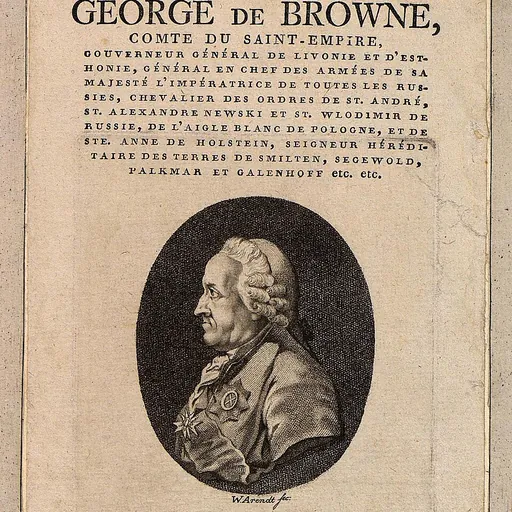
About George Browne
Lived 1698 – 1792 (aged 93). George Browne was a military personnel, military officer, marshal and governor.
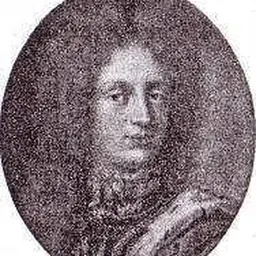
George Browne (; ; , ), known as Count von Browne in the nobility of the Holy Roman Empire (15 June 1698 – 18 February 1792), was an Irish soldier of fortune who became full general in the Russian service.
Biography Browne was descended from a family that could trace its descent to the time of William the Conqueror, and had settled in Ireland at a very early period. His immediate ancestors were the Brownes of Camas, Limerick, where he was born 15 June 1698. He was educated at Limerick diocesan school.
A Catholic and a Jacobite, Browne, like several of his other relations, sought scope for his ambition in a foreign military career (Flight of the Wild Geese). In his twenty-seventh year he entered the service of the Electoral Palatinate, from which he passed in 1730 to that of Russian Empire. He distinguished himself in the Polish, French, and Turkish wars, and had risen to the rank of general, with the command of 30,000 men, when he was taken prisoner by the Turks. After being sold three times as a slave to an Albanian, he obtained his freedom through the intervention of the French ambassador Villeneuve, at the instance of the Russian court, and, remaining for some time at Constantinople in his slave's costume, succeeded in discovering important state secrets which he carried to Saint Petersburg.
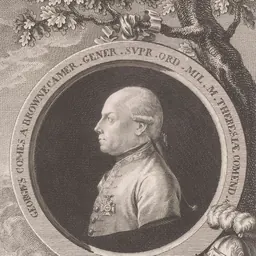
In recognition of this special service Browne was raised by Anna to the rank of major-general, and in this capacity accompanied General Lacy on his first expedition to Finland. On the outbreak of the Swedish war his tactical skill was displayed to great advantage in checking Swedish attacks on Livonia. In the Seven Years' War he rendered important assistance as lieutenant-general under his cousin Maximilian Ulysses, Reichsgraf von Browne.
Browne's fortunate diversion of the enemy's attacks at Kolin, 18 June 1757, contributed materially to the allied victory, and in token of her appreciation of his conduct on the occasion Maria Theresa presented him with a snuff-box set with brilliants and adorned with her portrait. At Zorndorf, 25 August 1758, he again distinguished himself in a similar manner, his opportune assistance of the right wing at the most critical moment of the battle changing almost inevitable defeat into victory. By Peter III he was named general-in-chief, and appointed to the chief command in the Danish war.
On his addressing a remonstrance to the czar against the war as impolitic, Browne was deprived of his honours and commanded to leave the country, but the czar, repenting of his hasty decision, recalled him three days afterward and appointed him Governor of Livonia. He was confirmed in the office under Catherine II who granted him Smiltene Manor, and for thirty years to the close of his life administered its affairs with remarkable practical sagacity, and with great advantage both to the supreme government and to the varied interests of the inhabitants. He died 18 February 1792 in Riga. His remains were buried Close to those of his kinsman, Peter Lacy, in the crypt of the Catholic church in Skaistkalne, in southern Latvia
Browne's son Johann Georg von Browne, also an officer in the Russian army, was a patron of Ludwig van Beethoven.
Don’t just read it —
keep it.
Full-length biographies made to live with: read them, listen on the way to work, watch them tonight.
- E-book
- Audio
- Video
Instant download · yours to keep · every purchase keeps this site free
Important facts
People in George Browne's life
Named in this biography and alive at the same time

Related people
Same field, nearest in time



Contemporaries
People whose lives overlapped George Browne's



Frequently asked questions
Who was George Browne?
Irish soldier of fortune (1698–1792)
When was George Browne born?
George Browne was born on 15 June 1698 in Limerick.
When did George Browne die?
George Browne died on 18 February 1792 in Riga.
What was George Browne's occupation?
George Browne was a military personnel, military officer, marshal and governor.
What nationality was George Browne?
George Browne's recorded nationality: Kingdom of Ireland.
Sources & further reading
· DBpedia: George Browne (soldier)
Cite this page
APA: Biography.guide. (2026). George Browne. https://biography.guide/george-browne-military-personnel/
MLA: "George Browne." Biography.guide, https://biography.guide/george-browne-military-personnel/.
Chicago: "George Browne." Biography.guide. https://biography.guide/george-browne-military-personnel/.
Data last updated: 2026-09-20 · Spot an error? Report a correction.
Page generated 2026-09-27 05:10 UTC