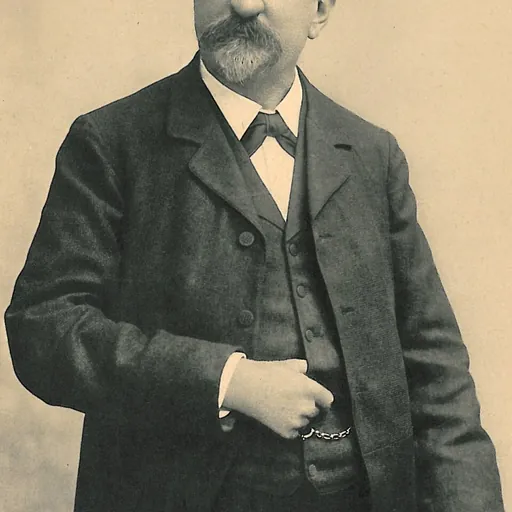
Georg Wilhelm Rauchenecker
German composer, conductor, and violinist
About Georg Wilhelm Rauchenecker
Lived 1844 – 1906 (aged 62). Georg Wilhelm Rauchenecker was a German conductor, composer, university teacher, violinist, chapelmaster and musician.
Georg Wilhelm Rauchenecker (8 March 1844, Munich – 17 July 1906, Elberfeld, today part of Wuppertal) was a German composer, conductor and violinist.
Life
Childhood and youth (1844–1860) Rauchenecker was born in Munich on 8 March 1844; he was the first child of Jakob Rauchenecker (1815–1876), an official musician of the city, and Rosina Crescenz Rauchenecker, née Wening (1815–1876) and was baptised a Catholic two days later at St Peter's in Munich. As a young boy he was sent by his father to his uncle, Georg Wening, who had been pastor of the parish of Thalheim (pop. 260) near Erding since 1855. It is possible that Rauchenecker was expected to follow the same career path as his uncle. After this he attended the King Maximilian Grammar School in Munich and here, at the age of eleven, he played first violin accompanying the church choir. a physician and musical patron from Winterthur.
In the spring of 1873 he converted to Protestantism as his second wife was a Protestant. The marriage to Anna Karolina Ulrica Kempin (1845–1904) took place at the Diaconal Church in Neuminster (Zürich).
On 29 October 1873 Rauchenecker, having been proposed by Ziegler-Sulzer, was elected to the post of head of music in Winterthur and, from the beginning of December 1873, he was also director of the School of Music there. When he left the city, his departure was marked by a concert given on 13 March 1884.
Berlin years (1884–1885) On 30 March 1884 was the day Rauchenecker moved to Berlin to take up the conductorship of the Berlin Philharmonic Orchestra, then located in Bernburger Strasse in the district of Kreuzberg. He attained this position thanks to the extraordinarily favourable reception given to his Symphony in F minor which he had performed in Berlin in October 1883. He conducted his first symphony concert as early as 30 April that year. In addition, he worked as a piano teacher at the Stern Conservatoire and also took practices with small ensembles there.
Elberfeld years (1885–1906) After a brief stay in Kassel, Rauchenecker moved to Barmen in the early summer of 1885. He then took over the Orchestral Society there, remaining until December 1887 when he became conductor of the Elberfeld Band (since 1929 the Wuppertal Band). In 1889 he founded a music school in Elberfeld. Among its students were the trombonist Joseph Franz Serafin Alschausky (1879–1948) and the composer (1867–1920).
From 1892 to 1893 he conducted the men's choral society called "The German Singers' Circle". 1902 Rauchenecker was appointed "City Conductor".
His second wife, Anna, died in Elberfeld on 2 January 1904. In 1905 Rauchenecker was accorded the title of "Royal Prussian Director of Music".
Rauchenecker died of pneumonia in Elberfeld on 17 July 1906.
Works Rauchenecker composed numerous works in all musical genres:
Orchestral works La Serenade pour Orchestre (1857) Ouverture Souvenirs d'Aix (1863) Grand Ouverture pour Musique Militaire (1867) La Marseillaise pour Musique Militaire (1868) "Friedrich Rotbart" (ca. 1870), symphonic poem Symphony No. 1 in F minor (1875) Symphonic Composition in the Style of an Ouverture (1880) Symphony No. 2 in B-flat major "Triumphal" (1885) "Hochzeits-Idyll" (1889) Intermezzo from the opera "Sanna" (ca. 1893) "Aus der Jugendzeit" (ca. 1896), symphonic poem "Alarich auf der Akropolis" (ca. 1899/1900), symphonic poem Symphony No. 3 in D major "Elegiac" (1903/1904)
Concertos Violin Concerto No. 1 A minor (1876/1885) Violin Concerto No. 2 B minor (1900) Piano Concerto No. 1 B minor (1898) Piano Concerto No. 2 F minor (1894) Cello Concerto D minor (1904) Oboe Concerto H minor (1905)
Songs "Fünf Lieder der Brautzeit (Bräutigamslieder)" (1894) for baritone and piano "Sieben Lieder" after the novel Der Liedermacher (1894) for soprano and piano "Abendlied" (1896) "Maria Wiegenlied" (1898) "Wirtstöchterlein" (1898) "Schwing dich auf" (1900) "Ave verum corpus" (1903) for contralto, cello, harp and organ "So geht's" (ca. 1888) for voice and piano "Bergisches Lied" for baritone and piano "Drei Gesänge" for baritone "Fünf Lieder" (ca. 1883/84) for deep voice "Königsmordliche Ballade" (ca. 1874) with flute accompaniment
Choral works "Sechs Lieder" (1878) for mixed chorus "Zwei Särge" (1900) for mixed chorus and piano "Pharao" (1897) for four-part mixed chorus or three-part women's chorus and piano "Lied von der Glocke" for four-part mixed chorus with speaker and piano or three part women's chorus (ca. 1895) "Hymne zur Einweihung des Kaiser-Wilhelm- und des Kaiser-Friedrich-Denkmals in Elberfeld" (1883) for men's chorus "Deutsches Schwert und deutscher Sang" (1891) for four-part men's chorus "Gotenzug", op. 137 (1899) for four-part men's chorus with winds or piano "Gotentreue", op. 138 (1899) for men's chorus, soloists and orchestra (or piano) "Germania" (ca. 1896) for men's chorus "Sechs Lieder" for men's chorus "Schwert und Palme" for men's chorus "Baracher Wein" (ca. 1889) for four-part men's chorus "Chorlied der Deutschen in Amerika" (1885) for four-part men's chorus "Der Lenz ist da" (ca. 1890) for men's chorus "O du taufrischer Morgen" (1877) for men's chorus "Wie lieb ich dich" (1877) for men's chorus "Walther von der Vogelweide" (1899) for four-part men's chorus a cappella "Das heutige Vaterland" (1883) for men's chorus "Gruss der Heimat: Wo immer ich weile" (um 1888) for men's chorus "Die Schönheit der Natur" (1900) for four-part women's chorus "Im Abendrot" (1900) for four-part women's chorus "Geduld" (1900) for three-part women's chorus "Zur heiligen Nacht" (1900) for mixed and three-part women's chorus and piano "Vater unser" (1895) for three-part women's chorus with harmonium and flute "Weihnachtsgruss" (1898) for three-part women's chorus and piano "Ode an das 19. Jahrhundert" (1899) "An die Freiheit" (1891) for soloists, chorus and orchestra "Niklaus von der Flüe" (1874), Swiss Peace Cantata, for soloists, male chorus and orchestra "Trauerkantate auf den Tod Friedrichs III." (1888) for mixed chorus, baritone and orchestra "Meine Göttin" (1897), cantata for tenor, men's chorus and orchestra "Huldigung der schönen Künste" (1898), cantata for soloists, chorus and orchestra "Heil dir Germania", cantata for four-part mixed chorus, piano and orchestra and speaker "Hinaus auf hohen Bergesgipfel", (1889) festive cantata "Die Murtenschlacht", (1876) cantata for soloist, chorus and orchestra "Kaiser Otto I.", Kantate für Solo, dreistimmigen Frauchenchor und Klavier oder für Solo, gemischten Chor und Klavier "Borussia" (1899/1900), cantata for three-part women's chorus and piano or soloist, mixed chorus and piano "Durch Nacht zum Licht (per tenebras ad lucem)" (ca. 1900) oratorio for chorus, soloists and orchestra "Grosse Vokale Messe" (1863/64) for six-part chorus "Titanenschicksal" (1899) "Festgesang" (1877) for mixed chorus, soloists and orchestra
Stage works La graine de coquelicot (ca. 1863), opéra comique in 1 act Tristanderl und Süßholde (1865), parody Le florentin (1871), opera in 3 acts Adelheid von Burgund (1886), opera Die letzten Tage von Thule (ca. 1889), opera in 4 acts Sanna (1893), opera in 2 acts Ingo (1893), opera in 4 acts Don Quijote (1895), opera in 3 acts Der Florentiner (1901), opera in 3 acts (new version of "Le florentin") Ovid bei Hof, incidental music (after 1885) Theodor Körner, festival (1891) Amalasuntha, opera
Chamber music String Quartet No. 1 in C minor (1874) String Quartet No. 2 in D major (1878) String Quartet in A minor (ca. 1879) String Quartet in E major (ca. 1883) String Quartet in G minor (in the Form of a Suite) (ca. 1890) String Quartet in E-flat major Piano Quintet in D major (1897) for piano, flute, 2 violins, viola and cello String Sextet in E-flat major Wind Octet in B-flat major (1897) for flute, oboe, cor anglais, 2 horns, bass clarinet and bassoon
Works for solo instruments "6 Charakteristische Tonbilder", op. 24–29 (1873) for violin and piano "Orientalische Phantasie" (1874) for violin and string quartet or piano "Die vier Temperamente", 4 short pieces for piano "5 kleine Klavierstücke" "26 kleine Orgelpräludien" (ca. 1902/03) "Jesu, komm zu mir" for organ "Präludium für Harmonium" (after 1885)
Honours In 1905 Rauchenecker was given the title of Royal Prussian Director of Music.
Discography (selection) String Quartett No. 1 (1874) (Jecklin, DDD, 95)
Don’t just read it —
keep it.
Full-length biographies made to live with: read them, listen on the way to work, watch them tonight.
- E-book
- Audio
- Video
Instant download · yours to keep · every purchase keeps this site free
Important facts
People in Georg Wilhelm Rauchenecker's life
Named in this biography and alive at the same time


Related people
Same field, nearest in time



Contemporaries
People whose lives overlapped Georg Wilhelm Rauchenecker's

Frequently asked questions
Who was Georg Wilhelm Rauchenecker?
German composer, conductor, and violinist (1844–1906)
When was Georg Wilhelm Rauchenecker born?
Georg Wilhelm Rauchenecker was born on 8 March 1844 in Munich.
When did Georg Wilhelm Rauchenecker die?
Georg Wilhelm Rauchenecker died on 17 July 1906 in Elberfeld.
What was Georg Wilhelm Rauchenecker's occupation?
Georg Wilhelm Rauchenecker was a conductor, composer, university teacher, violinist, chapelmaster and musician.
What nationality was Georg Wilhelm Rauchenecker?
Georg Wilhelm Rauchenecker was German.
Sources & further reading
· Wikipedia: Georg Wilhelm Rauchenecker
· DBpedia: Georg Wilhelm Rauchenecker
Cite this page
APA: Biography.guide. (2026). Georg Wilhelm Rauchenecker. https://biography.guide/georg-wilhelm-rauchenecker/
MLA: "Georg Wilhelm Rauchenecker." Biography.guide, https://biography.guide/georg-wilhelm-rauchenecker/.
Chicago: "Georg Wilhelm Rauchenecker." Biography.guide. https://biography.guide/georg-wilhelm-rauchenecker/.
Data last updated: 2026-09-23 · Spot an error? Report a correction.
Portrait: Wikimedia Commons · author & licence
Page generated 2026-09-27 05:06 UTC