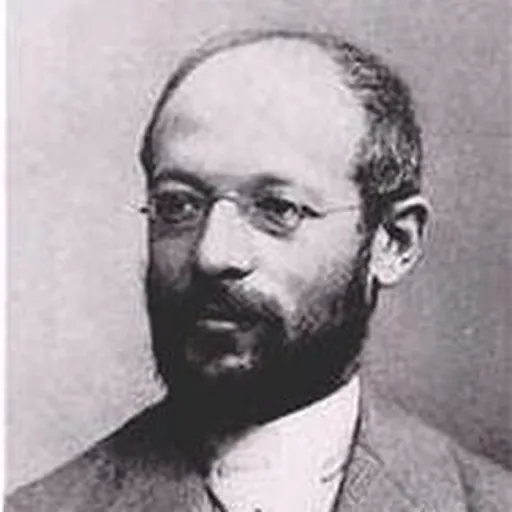
Georg Simmel
German sociologist, philosopher, and critic
About Georg Simmel
Lived 1858 – 1918 (aged 60). Georg Simmel was a German philosopher, sociologist and university teacher.
Georg Simmel (; ; 1 March 1858 – 26 September 1918) was a German sociologist, philosopher, and critic. A founding figure of sociology, his neo-Kantian approach helped establish sociological antipositivism, asking "What is society?" in analogy to Kant's "What is nature?". He pioneered analyses of individuality and social fragmentation.
Simmel discussed social and cultural phenomena in terms of "forms" and "contents" with a transient relationship, wherein form becomes content, and vice versa dependent on context. In this sense, Simmel was a forerunner to structuralist styles of reasoning in the social sciences and heralded relational sociology.
In "The Metropolis and Mental Life", Simmel anticipates urban sociology, symbolic interactionism, and social network analysis. An acquaintance of Max Weber, Simmel wrote on the topic of personal character in a manner reminiscent of the sociological ideal type. He broadly rejected academic standards, however, philosophically covering topics such as emotion and romantic love. Both Simmel and Weber's nonpositivist theory informed the eclectic critical theory of the Frankfurt School.
Biography Early life and education Georg Simmel was born in Berlin, Germany, as the youngest of seven children to an assimilated Jewish family. His father, Eduard Simmel (1810–1874), a prosperous businessman and convert to Roman Catholicism, had founded a confectionery store called "Felix & Sarotti" that would later be taken over by a chocolate manufacturer. His mother Flora Bodstein (1818–1897) came from a Jewish family who had converted to Lutheranism. Georg, himself, was baptized as a Protestant when he was a child.
His father died in 1874, when Georg was 16, leaving a sizable inheritance. Georg was then adopted by Julius Friedländer, the founder of an international music publishing house known as Peters Verlag, who endowed him with the large fortune that enabled him to become a scholar.
Beginning in 1876, Simmel studied philosophy and history at the Humboldt University of Berlin, going on to receive his doctorate in 1881 for his thesis on Kantian philosophy of matter, titled "" ("The Nature of Matter According to Kant's Physical Monadology"). His lectures were not only popular inside the university, but attracted the intellectual elite of Berlin as well. Although his applications for vacant chairs at German universities were supported by Max Weber, Simmel remained an academic outsider. However, with the support of an inheritance from his guardian, he was able to pursue his scholarly interests for many years without needing a salaried position.
Simmel had a hard time gaining acceptance in the academic community despite the support of well-known associates, such as Max Weber, Rainer Maria Rilke, Stefan George and Edmund Husserl. This was partly because he was seen as a Jew during an era of anti-Semitism, but also simply because his articles were written for a general audience rather than academic sociologists. This led to dismissive judgements from other professionals. Simmel nevertheless continued his intellectual and academic work, as well as taking part in artistic circles.
Later life
In 1890, Georg married Gertrud Kinel, a philosopher who published under the pseudonym Marie-Luise Enckendorf, and under her own name. They lived a sheltered and bourgeois life, their home becoming a venue for cultivated gatherings in the tradition of the salon. They had one son, Hans Eugen Simmel, who became a medical doctor. Georg and Gertrud's granddaughter was the psychologist Marianne Simmel. Simmel also had a secret affair with his assistant Gertrud Kantorowicz, who bore him a daughter in 1907, though this fact was hidden until after Simmel's death.
In 1909, Simmel, Ferdinand Tönnies, Max Weber, and others, co-founded the German Society for Sociology. In 1914, Simmel received an ordinary professorship with chair, at the then German University of Strassburg, In 1917, Simmel stopped reading the newspapers and withdrew to the Black Forest to finish the book The View of Life (Lebensanschauung).
Simmel focused on these forms of association while paying little attention to individual consciousness. Simmel believed in the creative consciousness that can be found in diverse forms of interaction, which he observed both the ability of actors to create social structures, as well as the disastrous effects such structures had on the creativity of individuals. Simmel also believed that social and cultural structures come to have a life of their own.
"The Metropolis and Mental Life" was not particularly well received during Simmel's lifetime. The organisers of the exhibition overemphasised its negative comments about city life, because Simmel also pointed out positive transformations. During the 1920s the essay was influential on the thinking of Robert E. Park and other American sociologists at the University of Chicago who collectively became known as the "Chicago School". It gained wider circulation in the 1950s when it was translated into English and published as part of Kurt Wolff's edited collection, The Sociology of Georg Simmel. It now appears regularly on the reading lists of courses in urban studies and architecture history. However, the notion of the blasé is actually not the central or final point of the essay, but is part of a description of a sequence of states in an irreversible transformation of the mind. In other words, Simmel does not quite say that the big city has an overall negative effect on the mind or the self, even as he suggests that it undergoes permanent changes. It is perhaps this ambiguity that gave the essay a lasting place in the discourse on the metropolis.
The Philosophy of Money
In The Philosophy of Money, Simmel views money as a component of life which helped us understand the totality of life. Simmel believed people created value by making objects, then separating themselves from that object and then trying to overcome that distance. He found that things which were too close were not considered valuable and things which were too far for people to get were also not considered valuable. Considered in determining value was the scarcity, time, sacrifice, and difficulties involved in getting the object.
A stranger is far enough away that he is unknown but close enough that it is possible to get to know him. In a society there must be a stranger. If everyone is known then there is no person that is able to bring something new to everybody.
The stranger bears a certain objectivity that makes him a valuable member to the individual and society. People let down their inhibitions around him and confess openly without any fear. This is because there is a belief that the Stranger is not connected to anyone significant and therefore does not pose a threat to the confessor's life.
More generally, Simmel observes that because of their peculiar position in the group, strangers often carry out special tasks that the other members of the group are either incapable or unwilling to carry out. For example, especially in pre-modern societies, most strangers made a living from trade, which was often viewed as an unpleasant activity by "native" members of those societies. In some societies, they were also employed as arbitrators and judges, because they were expected to treat rival factions in society with an impartial attitude.
On one hand the stranger's opinion does not really matter because of his lack of connection to society, but on the other the stranger's opinion does matter, because of his lack of connection to society. He holds a certain objectivity that allows him to be unbiased and decide freely without fear. He is simply able to see, think, and decide without being influenced by the opinion of others.
On secrecy According to Simmel, in small groups, secrets are less needed because everyone seems to be more similar. In larger groups secrets are needed as a result of their heterogeneity. In secret societies, groups are held together by the need to maintain the secret, a condition that also causes tension because the society relies on its sense of secrecy and exclusion. For Simmel, secrecy exists even in relationships as intimate as marriage. In revealing all, marriage becomes dull and boring and loses all excitement. Simmel saw a general thread in the importance of secrets and the strategic use of ignorance: To be social beings who are able to cope successfully with their social environment, people need clearly defined realms of unknowns for themselves. Furthermore, sharing a common secret produces a strong "we feeling." The modern world depends on honesty and therefore a lie can be considered more devastating than it ever has been before. Money allows a level of secrecy that has never been attainable before, because money allows for "invisible" transactions, due to the fact that money is now an integral part of human values and beliefs. It is possible to buy silence.
On fashion In the eyes of Simmel, fashion is a form of social relationship that allows those who wish to conform to the demands of a group to do so. It also allows some to be individualistic by deviating from the norm. There are many social roles in fashion and both objective culture and individual culture can have an influence on people. In the initial stage everyone adopts what is fashionable and those that deviate from the fashion inevitably adopt a whole new view of what they consider fashion. Ritzer wrote:
Works Simmel's major monographic works include, in chronological order:
Über sociale Differenzierung (1890). Leipzig: Duncker & Humblot [On Social Differentiation] Einleitung in die Moralwissenschaft 1 & 2 (1892–1893). Berlin: Hertz [Introduction to the Science of Ethics] Die Probleme der Geschichtphilosophie (1892). Leipzig: Duncker & Humblot. (2nd ed., 1905) [The Problems of the Philosophy of History] Philosophie des Geldes (1900). Leipzig: Duncker & Humblot (2nd ed., 1907) [The Philosophy of Money] Die Großstädte und das Geistesleben (1903). Dresden: Petermann. [The Metropolis and Mental Life] Kant (1904). Leipzig: Duncker & Humblot. (6th ed., 1924) Philosophie der Mode (1905). Berlin: Pan-Verlag. Kant und Goethe (1906). Berlin: Marquardt. Die Religion (1906). Frankfurt am Main: Rütten & Loening. (2nd ed., 1912). Schopenhauer und Nietzsche (1907). Leipzig: Duncker & Humblot. Soziologie (1908). Leipzig: Duncker & Humblot. [Sociology: inquiries into the construction of social forms] Hauptprobleme der Philosophie (1910). Leipzig: Göschen. Philosophische Kultur (1911) Leipzig: Kröner. (2nd ed., 1919). Goethe (1913). Leipzig: Klinkhardt. Rembrandt (1916) Leipzig: Wolff. Grundfragen der Soziologie (1917) Berlin: Göschen. [Fundamental Questions of Sociology] Lebensanschauung (1918). München: Duncker & Humblot. [The View of Life] Zur Philosophie der Kunst (1922). Potsdam: Kiepenheur. Fragmente und Aufsäze aus dem Nachlass (1923), edited by G. Kantorowicz. München: Drei Masken Verlag. Brücke und Tür (1957), edited by M. Landmann & M. Susman. Stuttgart: Koehler.
Works in periodicals "Alpenreisen." Die Zeit, Wiener Wochenschrift für Politik, Vollwirtschaft, Wissenschaft und Kunst [weekly newspaper] (13 June 1895) "Rom, eine ästhetische Analyse." Die Zeit, Wiener Wochenschrift für Politik, Vollwirtschaft, Wissenschaft und Kunst (28 May 1898). "Florenz." Der Tag [magazine] (2 March 1906). "Venedig." Der Kunstwart, Halbmonatsschau über Dichtung, Theater, Musik, bildende und angewandte Kunst [magazine] (June 1907). "Der Begriff und die Tragödie der Kultur" ["The Concept and Tragedy of Culture"]. Logos. Internationale Zeitschrift für Philosophie der Kultur 2 (1911–1912): 1–25.
Don’t just read it —
keep it.
Full-length biographies made to live with: read them, listen on the way to work, watch them tonight.
- E-book
- Audio
- Video
Instant download · yours to keep · every purchase keeps this site free
Important facts
People in Georg Simmel's life
Named in this biography and alive at the same time




Related people
Same field, nearest in time




Contemporaries
People whose lives overlapped Georg Simmel's


Frequently asked questions
Who was Georg Simmel?
German sociologist, philosopher, and critic (1858–1918)
When was Georg Simmel born?
Georg Simmel was born on 1 March 1858 in Berlin.
When did Georg Simmel die?
Georg Simmel died on 26 September 1918 in Strasbourg.
What was Georg Simmel's occupation?
Georg Simmel was a philosopher, sociologist and university teacher.
What nationality was Georg Simmel?
Georg Simmel was German.
Sources & further reading
Cite this page
APA: Biography.guide. (2026). Georg Simmel. https://biography.guide/georg-simmel/
MLA: "Georg Simmel." Biography.guide, https://biography.guide/georg-simmel/.
Chicago: "Georg Simmel." Biography.guide. https://biography.guide/georg-simmel/.
Data last updated: 2026-09-21 · Spot an error? Report a correction.
Portrait: Wikimedia Commons · author & licence
Page generated 2026-09-27 04:59 UTC