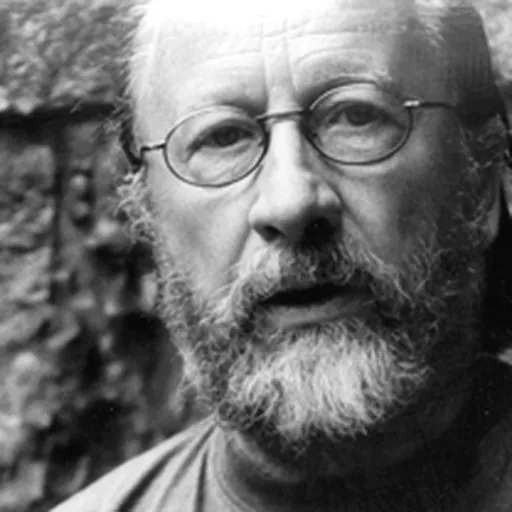
About Georg Katzer
Lived 1935 – 2019 (aged 84). Georg Katzer was a German composer, university teacher, film score composer and musician.
Georg Katzer (; 10 January 1935 – 7 May 2019) was a German composer and teacher. The last master student of Hanns Eisler, he composed music in many genres, including works for the stage. Katzer was one of the pioneers of electronic new music in the German Democratic Republic and the founder of the first electronic-music studio in the GDR. He held leading positions in music organisations, first in the East (Akademie der Künste der DDR), then in the united Germany (Academy of Arts, Berlin, and Deutscher Musikrat), and received many awards, including the Art Prize of the German Democratic Republic, the National Prize of the German Democratic Republic, the Order of Merit of the Federal Republic of Germany, and the German Music Authors' Prize.
Biography Katzer was born in Habelschwerdt, Lower Silesia (now Bystrzyca Kłodzka, Poland), on 10 January 1935. From 1954 to 1960 he studied piano, music theory, and composition with (amongst others) Rudolf Wagner-Régeny and Ruth Zechlin at the Hanns Eisler Hochschule für Musik in East Berlin, then from 1957 to 1958 he studied in Prague with . From 1961 to 1963 he was a postgraduate student of Hanns Eisler and Leo Spies at the German Academy of the Arts in Berlin, the last master student of Eisler. In 1963, he became a freelance composer and musician.
From 1976 to 1977 he worked in electronic-music studios in Bratislava and Paris. In 1978 Katzer was elected to membership in the Academy of the Arts in East Berlin. In 1980 he was appointed a professor and subsequently taught a masterclass in composition at the Academy of the Arts until 1991. In 1986 he founded the Studio for Experimental Music, affiliated with the Music Department of the Academy of the Arts, and was its artistic director.
Katzer was a member of the Academy of Arts in East Berlin until 1993, and then a member of the Berlin section of music until his death. He served as vice president of the music section from 1994 to 2003. From 1989 to 1991, he was president of the German Section of the C.I.M.E. (International Confederation of Electroacoustic Music). From 1990 to 2001, he was a presiding member of the Deutscher Musikrat (German Music Council, a member of the International Music Council).
Katzer lived in Zeuthen near Berlin until his death on 7 May 2019; he was 84 years old.
Compositions Katzer's earlier works owe a great deal to the music of Béla Bartók, Igor Stravinsky, and his teacher, Hanns Eisler. In the late 1960s he came under the influence of Witold Lutosławski and Bernd Alois Zimmermann, departing from conventional tonality and forms. From this point on, his vocabulary included serial, aleatory, and collage techniques, as well as electronic sounds. His compositions included works for chamber ensembles, orchestral works, solo concertos, operas, ballets, puppet plays, and oratorios. His work also encompassed electroacoustical pieces, music for radio dramas, multimedia projects, and projects involving improvised music. His compositions are held by the Saxon State and University Library Dresden, including: String Quartet No. 1 (1965) (1972) Die Igeltreppe for narrator and 13 instruments, text by Sarah Kirsch (1973) Das Land Bum-Bum, opera (1973) (Music machine in D major), for orchestra (1973) Schwarze Vögel, ballet (1975) Szene für Kammerensemble, instrumental theatre (1975) Bevor Ariadne kommt, for electronic sounds (1976) Concerto for Harpsichord and Wind Quintet (1978) Ein neuer Sommernachtstraum, ballet (1979) Aide-memoire, for electronic sounds (1983) Gastmahl oder über die Liebe, opera, libretto by Gerhard Müller (1987) Antigone oder die Stadt, opera, libretto by Gerhard Müller (1989) Mein 1989, radio composition (1990) Ich bin ein anderer, Hörspiel after Arthur Rimbaud (1990) L'homme machine, multimedia scenic action (2000) Medea in Korinth, oratorical scenes, libretto by Christa Wolf (after ). Premiered on 6 September 2002 at the Konzerthaus Berlin Fukujamas Kiste, for electronic sounds (2002)
Awards
1976: Art Prize of the German Democratic Republic 1981: National Prize of the German Democratic Republic for complete compositions 1987: for music from the Free German Trade Union Federation 1992: 1992: Honorary guest of the Villa Massimo 1998: 2003: Officer's Cross of the Order of Merit of the Federal Republic of Germany 2011: Preis der deutschen Schallplattenkritik 2012: German Music Authors' Prize in the category Composition Experimental music
Don’t just read it —
keep it.
Full-length biographies made to live with: read them, listen on the way to work, watch them tonight.
- E-book
- Audio
- Video
Instant download · yours to keep · every purchase keeps this site free
Important facts
People in Georg Katzer's life
Named in this biography and alive at the same time




Related people
Same field, nearest in time



Contemporaries
People whose lives overlapped Georg Katzer's

Frequently asked questions
Who was Georg Katzer?
German composer and teacher (1935–2019)
When was Georg Katzer born?
Georg Katzer was born on 10 January 1935 in Bystrzyca Kłodzka.
When did Georg Katzer die?
Georg Katzer died on 7 May 2019 in Berlin.
What was Georg Katzer's occupation?
Georg Katzer was a composer, university teacher, film score composer and musician.
What nationality was Georg Katzer?
Georg Katzer was German.
Sources & further reading
Cite this page
APA: Biography.guide. (2026). Georg Katzer. https://biography.guide/georg-katzer/
MLA: "Georg Katzer." Biography.guide, https://biography.guide/georg-katzer/.
Chicago: "Georg Katzer." Biography.guide. https://biography.guide/georg-katzer/.
Data last updated: 2026-09-23 · Spot an error? Report a correction.
Portrait: Wikimedia Commons · author & licence
Page generated 2026-09-27 05:05 UTC