
About Gazi Hüseyin Paşa
Lived 1610 – 1658 (aged 47–48). Gazi Hüseyin Paşa was a Turkish politician and writer.
Gazi Hüseyin Pasha ("Hüseyin Pasha the Warrior"; died 1659), also known as Deli Hüseyin Pasha ("the Mad") or Sarı Hüseyin Pasha ("the Blonde") or Baltaoğlu Hüseyin Pasha ("of the Axe"), was an Ottoman military officer and statesman. He was governor of Egypt (1635–1637), Kapudan Pasha in the 1630s, and briefly Grand Vizier in 1656.
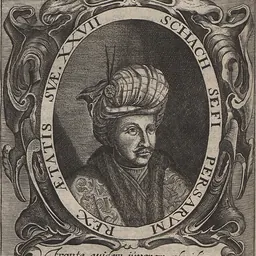
Background Hüseyin was of Turkish origin and was born in Yenişehir near Bursa in northwest Anatolia. Other than that, little is known about his early days in Constantinople (present-day İstanbul), the Ottoman capital. During the reign of Sultan Murad IV, he was a member of palace staff. The Shah Safi of Persia had sent Murad IV a prestigious gift, a bow which was reputed as being undrawable. Hüseyin attracted attention when he easily drew the bow. After winning sultan's appreciation, he was promoted to various posts: chief stableman, governor of Silistria (now in modern Bulgaria), beylerbey (high governor) of Egypt, beylerbey of Anatolia, Kapudan Pasha (grand admiral), etc. He participated in campaigns around Baghdad in modern Iraq (Capture of Baghdad (1638)) Azov in modern Russia (Siege of Azov (1637–1642)) and Yerevan (now in modern Armenia). During the reign of Sultan Ibrahim, he served in various European provinces as a governor, and in 1646, he became the governor of Chania, Crete (now in Greece).
Governor of Egypt Hüseyin Pasha was appointed the governor of Egypt Eyalet in 1635, succeeding Bakırcı Ahmed Pasha and serving until 1637. He was reportedly a cruel and violent governor who murdered for sport. From the very first day of his arrival in Egypt, when he confiscated his finance minister and advisors' temporary tents for his own, Hüseyin Pasha began a series of actions that made him widely disliked by the local populace.
Despite his cruelty, Hüseyin Pasha was an able commander and leader of the local troops, which was a particularly difficult task in Egypt. He was attentive to government details in the divan and successfully decreased robbery and burglary in Egypt.
Cretan War
Conquest of the Aegean island Crete from Venice was uncharacteristically trying for Ottoman Empire. While the Ottoman Empire was in stagnation, the military and naval technology of the Europeans was on the rise. Although Chania, a major Cretan city, had been captured in 1645, the rest of the island, especially the capital Candia (Heraklion), was able to resist the Ottomans. The Ottoman Empire was unable to send reinforcements to Crete because the strait of Dardanelles (Çanakkale) was blocked by the Venetian navy.
Thus, the Ottoman army in Crete was deadlocked. Even under these circumstances, Hüseyin captured several forts including Rethymno and laid a siege to Heraklion. He also reconstructed many buildings and the fort of Chania. Sultan Mehmed IV promoted him to be the Grand Vizier on 28 February 1656.
However he never exercised the post. Long before Huseyin's return to Constantinople, the sultan changed his mind and appointed Hüseyin's rival Zurnazen Mustafa Pasha as grand vizier on 6 March 1656 (although Zurnazen's term was even shorter than that of Hüseyin).
Later years Hüseyin was assigned to be the beylerbey (governor) of Rumeli, a post inferior to that of grand vizier, but superior to those of the beylerbeys of other provinces. Nevertheless, the new grand vizier Köprülü Mehmet Pasha was afraid of Hüseyin's prestige. He called Hüseyin to Constantinople and persuaded the sultan to jail and later to execute Hüseyin in 1659.
Don’t just read it —
keep it.
Full-length biographies made to live with: read them, listen on the way to work, watch them tonight.
- E-book
- Audio
- Video
Instant download · yours to keep · every purchase keeps this site free
Important facts
People in Gazi Hüseyin Paşa's life
Named in this biography and alive at the same time

Related people
Same field, nearest in time

Contemporaries
People whose lives overlapped Gazi Hüseyin Paşa's






Frequently asked questions
Who was Gazi Hüseyin Paşa?
Ottoman grand vizier (1610–1658)
When was Gazi Hüseyin Paşa born?
Gazi Hüseyin Paşa was born in 1610 in Yenişehir.
When did Gazi Hüseyin Paşa die?
Gazi Hüseyin Paşa died on 29 December 1658 in Istanbul.
What was Gazi Hüseyin Paşa's occupation?
Gazi Hüseyin Paşa was a politician and writer.
What nationality was Gazi Hüseyin Paşa?
Gazi Hüseyin Paşa was Turkish.
Sources & further reading
· Wikipedia: Gazi Hüseyin Paşa
Cite this page
APA: Biography.guide. (2026). Gazi Hüseyin Paşa. https://biography.guide/gazi-huseyin-pasa/
MLA: "Gazi Hüseyin Paşa." Biography.guide, https://biography.guide/gazi-huseyin-pasa/.
Chicago: "Gazi Hüseyin Paşa." Biography.guide. https://biography.guide/gazi-huseyin-pasa/.
Data last updated: 2026-09-20 · Spot an error? Report a correction.
Page generated 2026-09-27 05:26 UTC