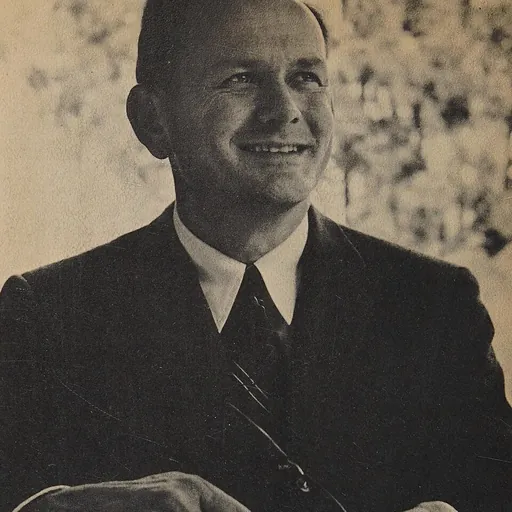
About Garrett Hardin
Lived 1915 – 2003 (aged 88). Garrett Hardin was an American ecologist, statistician, demographer, university teacher and microbiologist, known for Tragedy of the commons.
Garrett James Hardin (April 21, 1915 – September 14, 2003) was an American ecologist, microbiologist, and white nationalist best known for the concept of the tragedy of the commons.
Hardin focused his career on human overpopulation, holding anti-immigrant and racist positions on race and eugenics. In 1968, Hardin wrote a paper titled "The Tragedy of the Commons" in Science about "the damage that innocent actions by individuals can inflict on the environment." He is also known for Hardin's First Law of Human Ecology: "We can never do merely one thing. Any intrusion into nature has numerous effects, many of which are unpredictable." The Southern Poverty Law Center described Hardin's publications as "frank in their racism and quasi-fascist ethnonationalism."
Early career Hardin received a BS in zoology from the University of Chicago in 1936 and a PhD in microbiology from Stanford University in 1941 where his dissertation research addressed symbiosis among microorganisms. Moving to the University of California, Santa Barbara in 1946, he served there as Professor of Human Ecology from 1963 until his (nominal) retirement in 1978. He was among the first members of the Society for General Systems Research.
Neomalthusian approach
A major focus of his career, and one to which he returned repeatedly, was the issue of human overpopulation. This led to writings on controversial subjects such as advocating abortion rights, which earned him criticism from the political right, and advocating strict limits to all immigration, which earned him criticism from the political left. In his essays, he also tackled subjects such as conservation and creationism.
Hardin is known for what some call Hardin's First Law of Human Ecology: "We can never do merely one thing. Any intrusion into nature has numerous effects, many of which are unpredictable."
"The Tragedy of the Commons" In 1968, Hardin applied his conceptual model developed in his essay "The Tragedy of the Commons" to human population growth, the use of the Earth's natural resources, and the welfare state. Hardin stated in his analysis of the tragedy of the commons that "Freedom in a commons brings ruin to all."
Despite the criticisms, the theory has nonetheless been influential.
Living Within Limits In 1993, Garrett Hardin published Living Within Limits: Ecology, Economics, and Population Taboos, which he described at the time as a summation of all his previous works. The book won the 1993 Phi Beta Kappa Award in Science. In the book, he argues that the natural sciences are grounded in the concept of limits (such as the speed of light), while social sciences, such as economics, are grounded in concepts that have no limits (such as the widespread "infinite-Earth" economic models). He notes that most of the more notable scientific (as opposed to political) debates concerning ecological economics are between natural scientists, such as Paul R. Ehrlich, and economists, such as Julian Simon, one of Ehrlich's most well known and vocal detractors. A strong theme throughout the book is that economics, as a discipline, can be as much about mythology and ideology as it is about real science.
Hardin goes on to label those who reflexively argue for growth as "growthmaniacs", and his wife, Jane, who suffered from Lou Gehrig's disease, were members of End-of-Life Choices, formerly known as the Hemlock Society.
Believing in individuals' choice of when to die, they killed themselves in their Santa Barbara home in September 2003, shortly after their 62nd wedding anniversary. He was 88 and she was 81. He caused controversy for his support of anti-immigrant causes during his lifetime. The Southern Poverty Law Center noted that Hardin served on the board of the Federation for American Immigration Reform and Social Contract Press and co-founded the anti-immigration Californians for Population Stabilization and The Environmental Fund, which according to the SPLC "served to lobby Congress for nativist and isolationist policies". 1952, Biology: Its Human Implications, Second Edition W. H. Freeman 1959, Nature and Man's Fate, Rinehart & Co. 1961, Biology Its Principles and Implications W. H. Freeman 1966, Biology Its Principles and Implications, Second Edition W. H. Freeman 1972, Exploring new ethics for survival: the voyage of the spaceship Beagle Viking Press. 1973, Stalking the Wild Taboo W. Kaufmann. 1974, Mandatory Motherhood: The True Meaning of 'Right to Life''' Beacon Press. 1977, The Limits of Altruism: an Ecologist's view of Survival Indiana University Press. 1980, Promethean Ethics: Living With Death, Competition, and Triage University of Washington Press. 1982, Naked Emperors: Essays of a Taboo-Stalker William Kaufmann, Inc. 1985, Filters Against Folly, How to Survive despite Economists, Ecologists, and the Merely Eloquent Viking Penguin. 1993, Living Within Limits: Ecology, Economics, and Population Taboos Oxford University Press. 1999, The Ostrich Factor: Our Population Myopia Oxford University Press.
Selected journal articles
Chapters in books 1993. The entire text of Garrett Hardin's Living Within Limits: Ecology, Economics, and Population Taboos, Chapter Eight, Growth: Real and Spurious Reprinted at GarrettHardinSociety.org, by permission of Oxford University Press, Inc 1991. "Paramount positions in ecological economics." In Costanza, R. (editor) Ecological Economics: The Science and Management of Sustainability, New York: Columbia University Press. 1991. "The tragedy of the 'Unmanaged' commons – population and the disguises of providence." In: R. V. Andelson, (editor), Commons Without Tragedy, London: Shepheard-Walwyn, pp. 162–185. (U.S.)
Awards and honors Hardin was elected to the American Academy of Arts and Sciences in 1973. Hardin was elected to the American Philosophical Society in 1974. Hardin's 1993 book Living Within Limits: Ecology, Economics, and Population Taboos, received the 1993 Award in Science from Phi Beta Kappa society.
Don’t just read it —
keep it.
Full-length biographies made to live with: read them, listen on the way to work, watch them tonight.
- E-book
- Audio
- Video
Instant download · yours to keep · every purchase keeps this site free
Important facts
People in Garrett Hardin's life
Named in this biography and alive at the same time





Related people
Same field, nearest in time




Contemporaries
People whose lives overlapped Garrett Hardin's





Frequently asked questions
Who was Garrett Hardin?
American ecologist (1915–2003)
When was Garrett Hardin born?
Garrett Hardin was born on 21 April 1915 in Dallas.
When did Garrett Hardin die?
Garrett Hardin died on 14 September 2003 in Santa Barbara.
What was Garrett Hardin's occupation?
Garrett Hardin was an ecologist, statistician, demographer, university teacher and microbiologist.
What was Garrett Hardin known for?
Garrett Hardin was known for Tragedy of the commons.
What nationality was Garrett Hardin?
Garrett Hardin was American.
Sources & further reading
Cite this page
APA: Biography.guide. (2026). Garrett Hardin. https://biography.guide/garrett-hardin/
MLA: "Garrett Hardin." Biography.guide, https://biography.guide/garrett-hardin/.
Chicago: "Garrett Hardin." Biography.guide. https://biography.guide/garrett-hardin/.
Data last updated: 2026-09-23 · Spot an error? Report a correction.
Portrait: Wikimedia Commons · author & licence
Page generated 2026-09-27 05:06 UTC