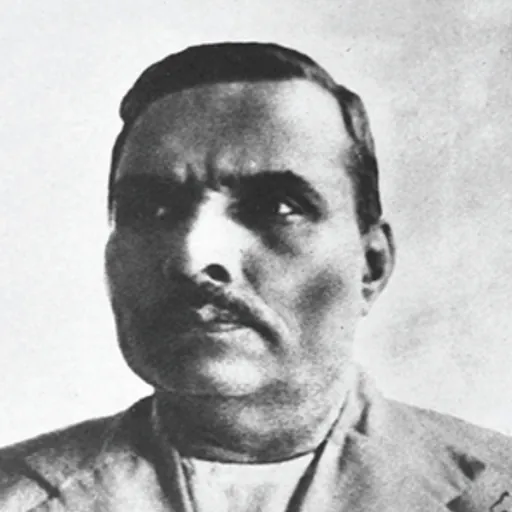
About Ganesh Damodar Savarkar
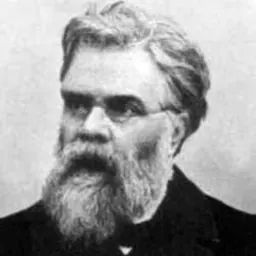
Lived 1879 – 1945 (aged 65). Ganesh Damodar Savarkar was an Indian writer.
Ganesh Damodar Savarkar (13 June 1879 – 16 March 1945), also known as Babarao Savarkar, was an Indian Hindutva activist. He was the founder of the Abhinav Bharat Society along with Vinayak Damodar Savarkar, his younger brother. He was a political prisoner twice; first from 1909-1922 (of which 1910-1921 was spent in the Cellular Jail); and second from 1933-1937. Both times he was unconditionally released.
He was one of the first five founding members of the Rashtriya Swayamsevak Sangh, a Hindutva paramilitary organisation. He was also a member of the Hindu Mahasabha, a Hindu Nationalist political party.
Early life Ganesh was the eldest sibling of the Savarkar brothers Vinayak, and Narayan, they also had a sister Mainabai, who was the penultimate child of their parents. Ganesh took responsibility of developing and influencing his brothers’ since their childhood. His parents' death laid the liability of his family at an age of twenty years.
In December 1919, King George V promulgated the Royal Amnesty. Thousands of prisoners were released in the mainland; and in 1920 majority of Andaman political prisoners were sent back to the mainland; most released shortly after arrival. However, there were 30 "dangerous" Andaman political prisoners which were excluded; including the Savarkar Brothers.
The Viceroy accepted the recommendations of the Indian Jails Committee (1919-20) after a massive pressure campaign for the release of the Savarkar Brothers. In May 1921; they were returned to the mainland, however they were kept imprisoned. Ganesh's health was failing, in fact his condition was worse on the mainland than it was in the Andamans. It was certain Ganesh was going to expire in September 1922. To avoid the embarrassment of a death in custody; he was unconditionally released in a corpse like state on a stretcher.
Second Political Imprisonment (1933-1937) In 1933, there occurred a bomb explosion in the Empire Theatre of Bombay. The police in a raid found a pamphlet which had the art of bomb making. When the police interrogated youngsters; they caved under pressure and informed the police that Savarkar had left a trunk at the youngsters’ house which belonged to him, and left it there. Inside contained the pamphlet .
Savarkar’s residence in the Kher Area of Bombay was raided. He was arrested and brought before court. Savarkar said “I hardly know this young man. He used to come to me two or three years ago to record some songs that could be sung on festive occasions. Other than that, I have no relation with him. So why should I keep my trunk with someone with whom I have a passing acquaintance.” The youngster also corroborated Ganesh's narrative. The court acquitted Ganesh for lack of firm evidence.
As he walked out of the court in April 1933, he was immediately re-arrested & imprisoned without trial under the Special Powers Ordinance X of 1932. He was kept in Byculla Jail, Bombay for 3 weeks; then Nashik Jail Bombay for the remaining 5 weeks.
Immediately after that, he was served with restrictions:
1) Internment in Nashik Municipality, meaning he was banned from leaving the municipal limits.
2) Ban from political activity (indirectly or directly).
3) Ban from partaking in any public meeting.
These restrictions were only supposed to apply for a month, but was periodically extended.
In 1937, provincial elections (with an expanded but still limited franchise) were held across the 11 Governors’ Provinces under the Government of India Act 1935. In Bombay, the Indian National Congress won, but refused to form a government because of fear of misuse of the Governors’ Special Powers under the Act In the meantime, the Governor appointed an interim government led by Dhanjsah Cooper on 1st April 1937. Cooper needed the seats to form a majority government, and Jamnadas M. Mehta, a representative of the Tilakite Democratic Swaraj Party, expressed his willingness, in exchange for the release of the Savarkar Brothers. In May 1937, the Governor agreed to Mehta’s request.
M. J. Akbar writes that "The five friends who started the RSS were B. S. Moonje, L. V. Paranjape, Dr. Tholkar, Babarao Savarkar and Hedgewar himself."
Don’t just read it —
keep it.
Full-length biographies made to live with: read them, listen on the way to work, watch them tonight.
- E-book
- Audio
- Video
Instant download · yours to keep · every purchase keeps this site free
Important facts
People in Ganesh Damodar Savarkar's life
Named in this biography and alive at the same time
Related people
Same field, nearest in time





Contemporaries
People whose lives overlapped Ganesh Damodar Savarkar's



Frequently asked questions
Who was Ganesh Damodar Savarkar?
Marathi revolutionary
When was Ganesh Damodar Savarkar born?
Ganesh Damodar Savarkar was born on 13 June 1879 in Bhagur.
When did Ganesh Damodar Savarkar die?
Ganesh Damodar Savarkar died on 16 March 1945 in Sangli.
What was Ganesh Damodar Savarkar's occupation?
Ganesh Damodar Savarkar was a writer.
What nationality was Ganesh Damodar Savarkar?
Ganesh Damodar Savarkar was Indian.
Sources & further reading
· Wikipedia: Ganesh Damodar Savarkar
· DBpedia: Ganesh Damodar Savarkar
Cite this page
APA: Biography.guide. (2026). Ganesh Damodar Savarkar. https://biography.guide/ganesh-damodar-savarkar/
MLA: "Ganesh Damodar Savarkar." Biography.guide, https://biography.guide/ganesh-damodar-savarkar/.
Chicago: "Ganesh Damodar Savarkar." Biography.guide. https://biography.guide/ganesh-damodar-savarkar/.
Data last updated: 2026-09-21 · Spot an error? Report a correction.
Portrait: Wikimedia Commons · author & licence
Page generated 2026-09-27 04:59 UTC