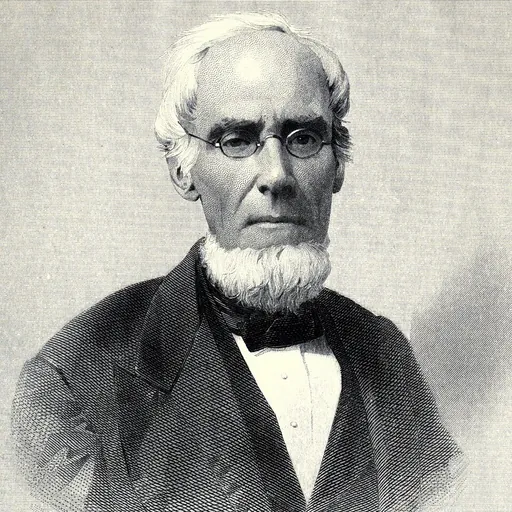
About Gail Borden
Lived 1801 – 1874 (aged 72). Gail Borden was an American inventor, businessperson, entrepreneur and cartography, known for Condensed milk.
Gail Borden Jr. (November 9, 1801 – January 11, 1874) was an American inventor and manufacturing pioneer. He was born in New York state and settled in Texas in 1829 (then part of Mexico), where he worked as a land surveyor, newspaper publisher, and food company entrepreneur. He created a process in 1853 to make sweetened condensed milk. Earlier, Borden helped plan the cities of Houston and Galveston in 1836.
Borden's process for making sweetened condensed milk enabled the dairy product to be transported and stored without refrigeration and for longer periods than fresh milk. After returning to the New York area to market another product, he set up factories for condensed milk in Connecticut and later in New York and Illinois. Demand by the Union Army was high during the American Civil War. His New York Condensed Milk Company changed its name to Borden Dairy Co. after his death.
Early life Gail Borden Jr. was born in Norwich, New York, on November 9, 1801, to Gail Borden Sr. (1777–1863), and Philadelphia (née Wheeler) Borden (1780–1828). The family moved to Kennedy's Ferry, Kentucky (renamed as Covington in 1814). There, he learned the art of surveying while aiding his father in the surveying of what would become Covington. Borden also moved to New London, Indiana, in 1816. Borden received his only formal schooling in Indiana during 1816 and 1817.
In 1822, Borden and his brother Thomas left home and settled in Amite County, Mississippi. Borden stayed in Liberty for seven years, working as the county surveyor and as a schoolteacher in Bates and Zion Hill.
Migration to Texas After initially landing in Texas at Galveston Island at the end of 1829, Borden settled in what is currently Fort Bend County, where he surveyed and raised stock. After a short time, he took over as chief surveyor for Stephen F. Austin. Baker was considered "one of the best informed men in the Texian colony on the Texas-Mexican situation". The men based their newspaper in San Felipe de Austin, which was centrally located among the colonies in eastern Texas. They ran the first issue under the banner of Telegraph and Texas Planter on October 10, 1835, days after the Texas Revolution began, though the later issues bore the name Telegraph and Texas Register. As editor, Gail Borden worked to be objective.
Soon after the newspaper began publishing, John Borden left to join the Texian Army, and their brother Thomas took his place as Borden's partner. Historian Eugene C. Barker describes the Borden newspaper as "an invaluable repository of public documents during this critical period of the state's history". On March 27, the Texas Army reached San Felipe, carrying word that the Mexican advance guard was approaching. According to a later editorial in the Telegraph, the publishers were "the last to consent to move". The Bordens dismantled the printing press and brought it with them as they evacuated with the rear guard on March 30. The Bordens retreated to Harrisburg. On April 14, as they were in the process of printing a new issue, Mexican soldiers arrived and seized the press. The soldiers threw the type and press into Buffalo Bayou and arrested the Bordens. The Texas Revolution ended days later.
Supposedly, during the war, Gail Borden Jr. helped to design the Baker's San Felipe flag which was flown in the Battle of San Jacinto on April 21, 1836.
After the war Lacking funds to replace his equipment, Borden mortgaged his land to buy a new printing press in Cincinnati. The 23rd issue of the Telegraph was published in Columbia on August 2, 1836.
Political career and early inventions Borden was a delegate at the Convention of 1833, where he assisted in writing early drafts of a Republic of Texas constitution. He also shared administrative duties with Samuel May Williams during 1833 and 1834 when Stephen F. Austin was away in Mexico. In addition to surveying, he also he served the Galveston Town Company for 12 years as a secretary and agent. During that period, he helped sell 2,500 lots of land, for a total of $1,500,000.
In the 1840s, he began to experiment with disease cures and mechanics. His wife Penelope died of yellow fever on September 5, 1844. Frequent epidemics had swept through the nation, and the disease had a high rate of fatalities during the 19th century. Borden began experimenting with finding a cure to the disease via refrigeration. No one understood how it was transmitted. He also experimented with an amphibious vehicle that he called a "terraqueous machine". This was a sail-powered wagon designed to travel over land and sea, but designed more specifically for the western prairies. He abandoned the invention after a test run resulted in ejecting its riders into the Gulf of Mexico.
Processed foods Meat biscuits In 1849, Borden started experimenting with beef processing. He developed a dehydrated beef product known as the "meat biscuit", which was loosely based upon a traditional Native American processed dried food known as pemmican. Pioneers seeking gold in California needed a readily transportable food that could endure harsh conditions, and Borden sold some of his meat biscuits to miners. Notably, explorer Elisha Kane purchased several hundred pounds of meat biscuits for his Arctic expedition. The product won Borden the Great Council Medal at the 1851 London World's Fair, and the same year he set up a meat-biscuit factory in Galveston. Entering middle age with $100,000, , he put these at risk for his newest invention. His desired markets were military organizations, domestic or foreign, which required easily transported food that did not spoil easily. He prepared promotional materials, arranged for product trials, and demonstrated the preparation of meat biscuits at cooking facilities for hospitals and ships. He invested $60,000, , yet none of these large institutional customers materialized. Not only did people complain about the taste and texture, but the U.S. Army concluded that the meat biscuits failed to slake hunger and even made people ill. In 1852, Borden filed for bankruptcy protection.
Condensed milk In 1851, during Borden's return voyage from the London exhibition, a disease infected both cows aboard the ship. (Ships carried livestock to supply passenger and crew needs during a voyage.) The cows eventually died, as did several children who drank the contaminated milk. Contamination often threatened other supplies of milk across the country. Borden became interested in developing a way to preserve milk.
U.S. Patent RE2103 "Vacuum Pan" for Improvements in Condensing Milk issued November 14, 1865 He was inspired by the vacuum pan he had seen being used by Shakers to condense fruit juice and herbs. He learned to reduce milk without scorching or curdling it. His first two factories established to manufacture it failed. With his third factory, built with new partner Jeremiah Milbank in Wassaic, New York, Borden finally produced a usable milk derivative that was long-lasting and needed no refrigeration.
In 1856, after three years of refining his model, Borden received the patent for his process of condensing milk by vacuum. He abandoned the meat biscuit, to focus on his new product. Borden was forced to recruit financial partners to begin production and marketing of this new product. He offered Thomas Green three-eighths of his patent rights and gave James Bridge a quarter interest on his investment; together, the three men built a condensery in Wolcottville, Connecticut (within modern-day Torrington), which opened in 1856. Green and Bridge were eager for profits, and when the factory was not immediately successful, they withdrew their support. The factory closed within a year.
To ensure against disease, Borden established strict sanitary requirements (the "Dairyman's Ten Commandments") for farmers who wanted to sell him raw milk; they were required to wash the cows' udders before milking, keep barns swept clean, and scald and dry their strainers morning and night.
Borden persuaded his former partners and a third investor, Reuel Williams, to build a new factory. It opened in 1857 in Burrville, Connecticut (also within modern-day Torrington). This second factory was hurt by the Panic of 1857 and had trouble turning a profit. The following year, Borden's fortunes began to change after he met Jeremiah Milbank, a financier from New York, on a train. Milbank was impressed by Borden's enthusiasm for and confidence in condensed milk, and the two became equal partners. Together, they founded the New York Condensed Milk Company. As a railroad magnate and banker, Milbank understood large-scale finance, which was critical to development of the business and Borden's success. Milbank invested around $100,000 into Borden's business. When Milbank died in 1884, the market value of his holdings was estimated at $8,000,000. This was the largest and most advanced milk factory of its day, and it was Borden's first commercially successful plant. Over 200 dairy farmers supplied of milk daily to the Brewster plant as demand increased driven by the American Civil War.
As the Civil War continued, he expanded his New York Condensed Milk Company quickly to meet the growing demand. Many new factories were built and he granted licenses (for pay) to individuals to begin producing condensed milk in their own factories, using Borden's patent. Despite the quick growth of the company, Borden continued to emphasize strict sanitation. He developed cleanliness practices that continue to be used in the production of condensed milk to this day.
While this rapid growth was occurring, Borden continued to experiment with condensing meat, tea, coffee, and cocoa. In 1862 while operating a factory in Amenia, New York, he patented the condensing of juice from fruits, such as apples and grapes. Borden tried to incorporate these other products into the line of the New York Condensed Milk Company, but the greatest demand was always for milk. It continued as the company's major product.
Throughout Borden's business success, he maintained an eye toward the scientific community. He published reports filled with testimonials of "impartial" scientists who observed and tested his inventions, including the meat biscuit and condensed milk. Borden coupled ambition for success with an enduring desire to produce quality products.
Personal life In 1828, Borden married Penelope Mercer of Amite County, Mississippi. The couple had five children during their 16-year marriage. On February 15, 1845, he married A. [Augusta or Azalea] F. Stearns in Galveston. She died in 1857. In 1860, he married Emeline E. (Eno) Church in Connecticut.
Death and legacy
Borden died on January 11, 1874, in Borden in Colorado County, Texas. His body was shipped by private car to New York City to be buried in Woodlawn Cemetery.
Genealogy Borden was distantly related to Robert Borden (1854–1937), Canada's Prime Minister during World War I. One of his great-grandchildren was Gail Borden, an American figure skater in the 1932 Winter Olympics. Another notable relative is the infamous Lizzie Borden from the Fall River murders. Sir Robert, Lizzie, and Gail Borden (founder) are fourth cousins, all descended from John Borden (b. 1640), the son of Richard from Headcorn, Kent, who immigrated to the United States aboard the ship Elizabeth and Anne in 1635.
Patents November 14, 1865; Improvements in Condensing Milk
Don’t just read it —
keep it.
Full-length biographies made to live with: read them, listen on the way to work, watch them tonight.
- E-book
- Audio
- Video
Instant download · yours to keep · every purchase keeps this site free
Important facts
People in Gail Borden's life
Named in this biography and alive at the same time



Related people
Same field, nearest in time
Contemporaries
People whose lives overlapped Gail Borden's






Frequently asked questions
Who was Gail Borden?
American inventor (1801–1874)
When was Gail Borden born?
Gail Borden was born on 9 November 1801 in Norwich.
When did Gail Borden die?
Gail Borden died on 11 January 1874 in Borden.
What was Gail Borden's occupation?
Gail Borden was an inventor, businessperson, entrepreneur and cartography.
What was Gail Borden known for?
Gail Borden was known for Condensed milk.
What nationality was Gail Borden?
Gail Borden was American.
Sources & further reading
Cite this page
APA: Biography.guide. (2026). Gail Borden. https://biography.guide/gail-borden/
MLA: "Gail Borden." Biography.guide, https://biography.guide/gail-borden/.
Chicago: "Gail Borden." Biography.guide. https://biography.guide/gail-borden/.
Data last updated: 2026-09-22 · Spot an error? Report a correction.
Portrait: Wikimedia Commons · author & licence
Page generated 2026-09-27 05:02 UTC