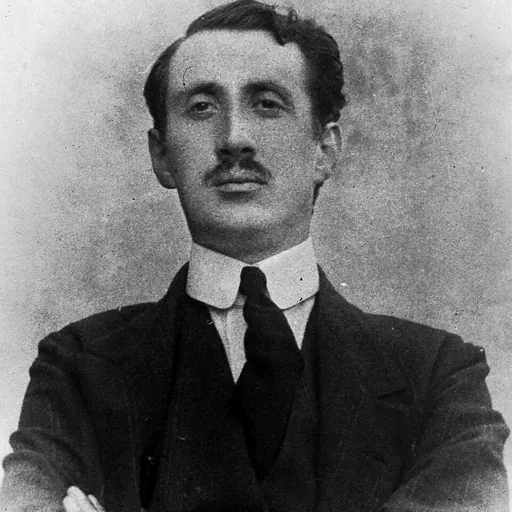
About Gaetano Perusini
Lived 1879 – 1915 (aged 36). Gaetano Perusini was an Italian physician, psychiatrist and neurologist, known for Alzheimer's disease.
Gaetano Perusini (24 February 1879 – 8 December 1915) was an Italian physician. He was the pupil and colleague of Alois Alzheimer and contributed to the definition of Alzheimer's disease.
Education and early family life Gaetano Perusini was born in Udine on February 24, 1879, to a successful family of physicians. Perusini's father, Andrea, was the Chief Physician of the Civil Hospital of Udine and his mother, Paolina Cumano, was the daughter of two prominent surgeons from Trieste. Perusini lost his father when he was only seven years old. This lack of a paternal force in the family enabled his growth and upbringing to be influenced mainly by his mother, a strong maternal personality, who guided his studies and encouraged his interest in medicine.
Perusini began studying medicine at the University of Pisa and then went on to finish his training at the University of Rome. In Rome, he often visited the local psychiatric clinic, the Lungara Mental hospital.
After graduating, Perusini decided to specialize in psychiatry, spending time at the psychiatric clinic of Augusto Giannelli and the neuropathology laboratory of Giovanni Mingazzini. Thanks to his time at professor Giovanni Mingazzini's laboratory, Perusini gained a deep passion for mental illnesses and an interest in pathological anatomy, which led to his enthusiasm to discover the organic basis of mental illnesses. Perusini graduated with a degree in Medicine at the age of 22, defending a thesis on Criminal Anthropology written under the guidance of prof. Giannelli.
The presentation of the case was received coldly and no questions were asked for clarification from the speaker, much less from the moderator of the debate, the psychiatrist Alfred Hoche, of Freudian origin and therefore an opponent of Kraepelin, who made Alzheimer's report seem clinically and scientifically irrelevant. Only the following year, after having changed the title, will Alzheimer be able to publish it in a brief report, without iconographic material.
Alzheimer was convinced that he was facing a rare brain pathology and therefore decided to entrust the case to Perusini for a more in-depth and detailed evaluation of both the clinical aspects and the histopathological findings. Perusini re-examined the case of Auguste Deter and collected three other cases (47, 63 and 67 years old) of severe and rapid dementia in a 59 pages treatment accompanied by 79 drawings depicting the neuronal alterations, made by Perusini and collected in four tables.
Perusini believed that the neuro-pathological findings of the early onset cases did not differ from the senile ones, in fact in his discussion, he deliberately included the two senile cases (63 and 67 years old). By doing this, Perusini would have predicted the modern conception of this disease according to which presenile and senile dementia are not two isolated entities and, at the same time, disproved the position of Kraepelin that rejected this possibility.
Perusini’s contribution to the definition of Alzheimer's disease In his mesmerising work “On the nosographic value of some typically senile histological findings” Perusini defines the history of neuropathology of senile dementia. According to his findings, the first ever mention of senile plaques was by Blocq and Marinesco, in 1892, regarding an elderly patient suffering of epilepsy. Unfortunately, the description for miliary scleroses was attributed to Redlich in 1898 and Perusini's work was overlooked at the time. Perusini's dissertation on senile plagues convey the following topics: nomenclature, history, staining techniques results of microhistochemical research, differential diagnosis, origin and nature of senile plaques and their meaning in various human conditions.
The Return to Italy and World War I Perusini eventually returned to Italy in 1911, and although his work was known all over Europe he was unable to find a suitable and stable academic position. It was not until 1913 that he was able to find a professional post as an assistant in the Mombello Psychiatric Hospital in Milan. Perusini was raised in a patriotic family which likely influenced his decision to enlist, albeit hiding his professional identity, into the army as a volunteer at the outbreak of the First World War. Eventually, the military discovered his medical professional background and was assigned to the first aid post in San Floriano del Collio, where on November 28, 1915, he was hit by shrapnel while assisting the wounded.
Death and legacy Gaetano Perusini died on December 8, 1915, in the Red Cross hospital in Cormons, in one of the houses his family owned, and received the silver medal for valor. Although Peursini died at a young age of 36 and was thus unable to continue his research, his scientific contribution to the definition of the clinical and neuropathological aspects of neurodegenerative dementia, must be remembered. It is widely believed that his name has the right to be joined to that of Alzheimer's in the more correctly defined disease of Alzheimer-Perusini.
Main works
On the clinical and histological aspects of a particular mental illness of advanced age. Histological and Histopathological Works, Volume III. H.2 (Über klinische und histologische eigenartige psychische Erkrankung das späteren Lebensalters | Nissl-Alzheimer), published in 1909 Pathological anatomy in psychiatry (L'anatomia patologica in psichiatria (suoi fini, suoi mezzi)) written in 1909, published by Rivista Sperimentale di Freniatria. On the nosographic value of some histopathological findings characteristic for senility (Sul valore nosografico di alcuni reperti istopatologici caratteristici per la senilità. Rivista di Neuropatologia, Psichiatria ed Elettroterapia 4), published by Journal of Neuropathology, Psychiatry and Electrotherapy 4 (IV) in two parts in 1911.
Don’t just read it —
keep it.
Full-length biographies made to live with: read them, listen on the way to work, watch them tonight.
- E-book
- Audio
- Video
Instant download · yours to keep · every purchase keeps this site free
Important facts
People in Gaetano Perusini's life
Named in this biography and alive at the same time


Related people
Same field, nearest in time

Contemporaries
People whose lives overlapped Gaetano Perusini's



Frequently asked questions
Who was Gaetano Perusini?
Italian psychiatrist (1879-1915)
When was Gaetano Perusini born?
Gaetano Perusini was born on 24 February 1879 in Udine.
When did Gaetano Perusini die?
Gaetano Perusini died on 8 December 1915 in Cormons.
What was Gaetano Perusini's occupation?
Gaetano Perusini was a physician, psychiatrist and neurologist.
What was Gaetano Perusini known for?
Gaetano Perusini was known for Alzheimer's disease.
What nationality was Gaetano Perusini?
Gaetano Perusini was Italian.
Sources & further reading
Cite this page
APA: Biography.guide. (2026). Gaetano Perusini. https://biography.guide/gaetano-perusini/
MLA: "Gaetano Perusini." Biography.guide, https://biography.guide/gaetano-perusini/.
Chicago: "Gaetano Perusini." Biography.guide. https://biography.guide/gaetano-perusini/.
Data last updated: 2026-09-22 · Spot an error? Report a correction.
Portrait: Wikimedia Commons · author & licence
Page generated 2026-09-27 05:02 UTC