
About Gaetano Martino
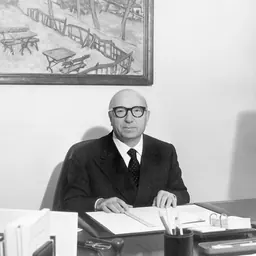
Lived 1900 – 1967 (aged 66). Gaetano Martino was an Italian politician, diplomat and physician.
Gaetano Martino (25 November 1900 – 21 July 1967) was an Italian politician, physician, and university teacher.
Early life and medicine Gaetano Martino was born in 1900 in Messina, Sicily, son of its Mayor Antonino Martino. He graduated in medicine from the Sapienza University of Rome in 1923. He worked as physician for Saint-Antoine Hospital in Paris. In 1934, he became a teacher at the University of Messina and later was also dean of the university from 1943 to 1954. From 1966 to 1967, Martino was also dean of the Sapienza University of Rome.
Political career
Foreign minister Gaetano Martino (mid), with Halvard Lange (r), and Lester B. Pearson (l), in 1956 Martino was a prominent Liberal politician. He was elected in 1948 to the Chamber of Deputies, becoming briefly Minister of Public Education in 1954 under Christian Democrat Mario Scelba. Later that year, Martino became Minister of Foreign Affairs after replacing Attilio Piccioni, who was involved in the Montesi Affair.
As Minister of Foreign Affairs, Martino promoted closer European integration and internationalism, first with the Messina Conference in 1955. In 1956, he facilitated Italian entry to the United Nations. In that same year Martino, along with Halvard Lange from Norway and Lester Pearson from Canada, became a "sage" of NATO, promoting its involvement in civil areas. Martino also attended the Treaty of Rome in 1957, which established the European Economic Community.
The "Armoire of Shame"
In 1956, the newspaper la Repubblica published an article in which Martino said that investigations on German war crimes in Italy during World War II would have a negative impact on West Germany's integration into Europe. In 1994, with the discovery at a military base of an armoire containing secret documents on Nazi war crimes in Italy, nicknamed the "Armoire of Shame" ("Armadio della Vergogna"), it emerged that Martino had blocked investigations into these crimes to avoid German isolation during the Cold War.
Later life For his role in promoting European integration, Martino was elected President of the European Parliament in 1962. He also continued to serve as Deputy in the Italian Chamber until his death in July 1967.
Electoral history ElectionHouseConstituencyPartyVotesResult 1946 Constituent Assembly Catania–Messina–Ragusa–Enna UDN 30,332 1948 Chamber of Deputies Catania–Messina–Ragusa–Enna BN 28,464 Elected 1953 Chamber of Deputies Catania–Messina–Ragusa–Enna PLI 40,671 Elected 1958 Chamber of Deputies Catania–Messina–Ragusa–Enna PLI 55,475 Elected 1963 Chamber of Deputies Catania–Messina–Ragusa–Enna PLI 61,627 Elected
Don’t just read it —
keep it.
Full-length biographies made to live with: read them, listen on the way to work, watch them tonight.
- E-book
- Audio
- Video
Instant download · yours to keep · every purchase keeps this site free
Important facts
Family & relationships
People in Gaetano Martino's life
Named in this biography and alive at the same time


Related people
Same field, nearest in time




Contemporaries
People whose lives overlapped Gaetano Martino's





Frequently asked questions
Who was Gaetano Martino?
Italian politician (1900-1967)
When was Gaetano Martino born?
Gaetano Martino was born on 25 November 1900 in Messina.
When did Gaetano Martino die?
Gaetano Martino died on 21 July 1967 in Rome.
What was Gaetano Martino's occupation?
Gaetano Martino was a politician, diplomat and physician.
What nationality was Gaetano Martino?
Gaetano Martino was Italian.
Sources & further reading
Cite this page
APA: Biography.guide. (2026). Gaetano Martino. https://biography.guide/gaetano-martino/
MLA: "Gaetano Martino." Biography.guide, https://biography.guide/gaetano-martino/.
Chicago: "Gaetano Martino." Biography.guide. https://biography.guide/gaetano-martino/.
Data last updated: 2026-09-26 · Spot an error? Report a correction.
Page generated 2026-09-27 05:15 UTC