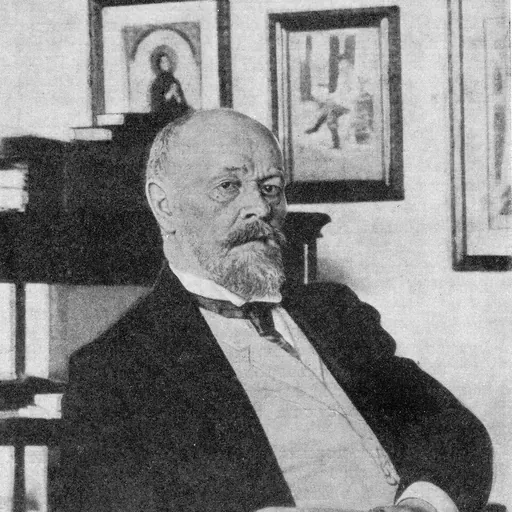
About Fyodor Uspensky
Lived 1845 – 1928 (aged 83). Fyodor Uspensky was a Russian anthropologist, archaeologist, historian, philosopher, university teacher and classical scholar.
Fyodor Ivanovich Uspensky (or Uspenskij; ; 19 February 1845 – 10 September 1928) was a Russian and Soviet Byzantinist. His works are considered to be among the finest illustrations of the flowering of Byzantine studies in the Russian Empire.
Life and career Uspensky was born near Galich on 19 February 1845. He was educated at the University of St. Petersburg, with his first thesis (1872) dedicated to Nicetas Choniates. For two decades (1874-1894) he read lectures at the Novorossiysky University in Odessa. This position allowed him to spend considerable time abroad.
Uspensky's doctoral thesis (1879) dealt with the foundation of the Second Bulgarian Empire. Although he specialized in the Byzantine-Bulgarian relations and investigated the Slavic influence on the Byzantine economy, Uspensky also researched and wrote extensively on the Crusades.
In 1894 Uspensky, who shared Slavophile ideals, decided to move to Constantinople to study and protect the surviving monuments of Byzantine antiquity, which had been neglected by the Ottoman authorities for centuries. He founded the Russian Archaeological Institute (headquartered at Studion) and presided over its pioneering archaeological research in Constantinople, Asia Minor, Macedonia and Bulgaria. In 1900, he was elected into the Russian Academy of Sciences. With the outbreak of World War I, Uspensky was forced to abandon his work and flee Turkey.
Back in Petrograd, the 70-year-old professor was invited to edit the organ of Byzantine studies, Vizantiyskiy Vremennik. After the October Revolution, he delivered lectures at the Leningrad University (1922–27) and, enduring criticism of the Bolshevik authorities, prepared for publication the results of a lifelong study, a monumental three-volume account of the history of the Byzantine Empire.
Uspensky died in Leningrad in 1928. The posthumous publication of his magnum opus, based on numerous unpublished sources and unprecedented in scope, demonstrated the wide range of his scholarship. His book about the Trapezuntine Empire also appeared posthumously. The Taktikon Uspensky is named after him.
Don’t just read it —
keep it.
Full-length biographies made to live with: read them, listen on the way to work, watch them tonight.
- E-book
- Audio
- Video
Instant download · yours to keep · every purchase keeps this site free
Important facts
Related people
Same field, nearest in time




Contemporaries
People whose lives overlapped Fyodor Uspensky's


Frequently asked questions
Who was Fyodor Uspensky?
Russian byzaninist (1845-1928)
When was Fyodor Uspensky born?
Fyodor Uspensky was born on 7 February 1845 in Galich.
When did Fyodor Uspensky die?
Fyodor Uspensky died on 10 September 1928 in Saint Petersburg.
What was Fyodor Uspensky's occupation?
Fyodor Uspensky was an anthropologist, archaeologist, historian, philosopher, university teacher and classical scholar.
What nationality was Fyodor Uspensky?
Fyodor Uspensky was Russian.
Sources & further reading
Cite this page
APA: Biography.guide. (2026). Fyodor Uspensky. https://biography.guide/fyodor-uspensky/
MLA: "Fyodor Uspensky." Biography.guide, https://biography.guide/fyodor-uspensky/.
Chicago: "Fyodor Uspensky." Biography.guide. https://biography.guide/fyodor-uspensky/.
Data last updated: 2026-09-20 · Spot an error? Report a correction.
Portrait: Wikimedia Commons · author & licence
Page generated 2026-09-27 04:58 UTC