Fujiwara no Shōshi
Daughter of Michinaga; empress consort of Ichijō
About Fujiwara no Shōshi
Lived 988 – 1074 (aged 85–86). Fujiwara no Shōshi was a Japanese.
, also known as , the eldest daughter of Fujiwara no Michinaga, was Empress of Japan from 1000 to 1011. Her father sent her to live in the Emperor Ichijō's harem at age 12. Because of his power, influence and political machinations she quickly achieved the status of . As empress she was able to surround herself with a court of talented and educated ladies-in-waiting such as Murasaki Shikibu, author of The Tale of Genji.
By the age of 20, Shōshi had given birth to two sons for Ichijō, both of whom went on to become emperors and secured the status of the Fujiwara line. In her late 30s she took vows as a Buddhist nun, renouncing imperial duties and titles, assuming the title of imperial lady. She continued to be an influential member of the imperial family until her death at age 86.
Empress In the middle of the 9th century Fujiwara no Yoshifusa declared himself regent to Emperor Seiwa—his young grandson—the Fujiwara clan dominated court politics until the end of the 11th century, through strategic marriages of Fujiwara daughters into the imperial family and the use of regencies. Fujiwara no Michinaga had four daughters he arranged to marry to emperors. At this period emperors held little power, holding a nominal position for rituals, and often too young to make decisions. In their stead, the top position in the power structure was held by a regent, with power often measured by the how closely the regent was tied by family relationships to an emperor. In 995, Michinaga's two brothers Fujiwara no Michitaka and Fujiwara no Michikane died in rapid succession, leaving the regency vacant; Michinaga won a power struggle against his nephew Fujiwara no Korechika, brother to Emperor Ichijō's wife Teishi, aided by his sister Senshi (mother to Emperor Ichijō, as Emperor En'yū's wife). Because Teishi supported Korechika—later discredited and banished from court—her base of power disintegrated. She became Imperial Consort, nyogo of the emperor. A year after placing Shōshi in the imperial harem, in an effort to undermine Teishi's influence and increase Shōshi's standing, Michinaga had her named Empress although Teishi already held the title. As historian Donald Shively explains, "Michinaga shocked even his admirers by arranging for the unprecedented appointment of Teishi (or Sadako) and Shōshi as concurrent empresses of the same emperor, Teishi holding the usual title of "Lustrous Heir-bearer" kōgō and Shōshi that of "Inner Palatine" (chūgū), a toponymically derived equivalent coined for the occasion".
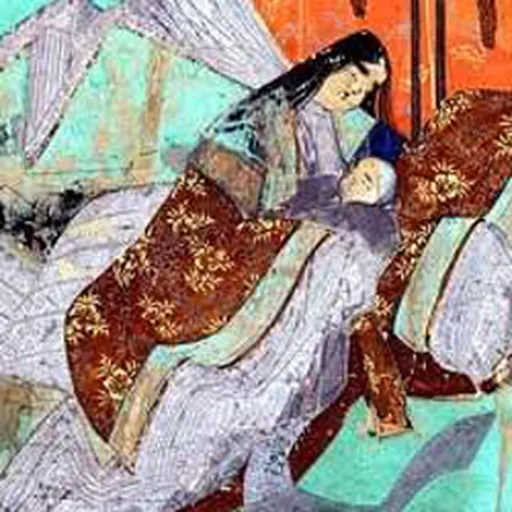
Although she lived in the Imperial palace, Shōshi's main residence for was in one or another of her father's many mansions, particularly after the Imperial palace burned down in 1005. Shōshi was about 16 when Murasaki joined her court, probably to teach her Chinese. Japanese literature scholar Arthur Waley describes Shōshi as a serious young lady based on a passage from Murasaki who wrote in her diary: "As the years go by Her Majesty is beginning to acquire more experience of life, and no longer judges others by the same rigid standards as before; but meanwhile her Court has gained a reputation for extreme dullness, and is shunned by all who can manage to avoid it". Moreover, Murasaki describes advice Shōshi gave to her ladies-in-waiting to avoid appearing too flirtatious: Her Majesty does indeed still constantly warn us that it is a great mistake to go too far, 'for a single slip may bring very unpleasant consequences,' and so on, in the old style; but she now also begs us not to reject advances in such a way as to hurt people's feelings. Unfortunately, habits of long standing are not so easily changed; moreover, now that the Empress's exceedingly stylish brothers bring so many of their young courtier-friends to amuse themselves at her house, we have in self-defence been obliged to become more virtuous than ever'. With her first son Atsuhira, Shōshi had a difficult birth; to appease evil spirits she underwent a ritual head shaving, although only a lock of hair was cut. This ritual was considered to have been a minor ordination, or jukai into Buddhism, for the purpose of receiving divine protection when her life, and that of her unborn infant, was at risk. On the 50th day after the birth a ceremony was held in which the infant was offered a piece of mochi; Michinaga performed the ritual offering of the rice cake to his grandson Atsuhira. In her diary Murasaki described the event that she probably attended.
Michinaga's influence meant that Shōshi's two sons had a better chance of ascending the throne than Teishi's children—particularly after Teishi's death in 1001. Shōshi's eldest son, the future Emperor Go-Ichijō, was named crown prince. At that time Shōshi retired from the Imperial Palace to live in a Fujiwara mansion in the Lake Biwa region, most likely accompanied by Murasaki. In 1016 when Michinaga had Emperor Sanjō—married to Shōshi's younger sister Kenshi—removed from the throne, Go-Ichijō became emperor. Shōshi's second son, Go-Suzaku, became crown prince in 1017. With an emperor and a crown prince as sons, Shōshi's position was secure and she became a powerful influence at court.
The first two empresses to take title of Imperial Lady were Seishi, later followed by Shōshi. With the title came a new residence and permission to hire men for the household. Shōshi's role as Imperial Lady, as documented in the Eiga Monogatari, was studied and emulated by imperial women who were to follow her as Imperial Ladies.
She died in 1074 aged 86.
Don’t just read it —
keep it.
Full-length biographies made to live with: read them, listen on the way to work, watch them tonight.
- E-book
- Audio
- Video
Instant download · yours to keep · every purchase keeps this site free
Important facts
more
Fujiwara no Akiko, Fujiwara no Shoshi, Fujiwara no ShoushiFamily & relationships
People in Fujiwara no Shōshi's life
Named in this biography and alive at the same time





Contemporaries
People whose lives overlapped Fujiwara no Shōshi's





Frequently asked questions
Who was Fujiwara no Shōshi?
daughter of Michinaga; empress consort of Ichijō
When was Fujiwara no Shōshi born?
Fujiwara no Shōshi was born in 988.
When did Fujiwara no Shōshi die?
Fujiwara no Shōshi died on 25 October 1074.
What nationality was Fujiwara no Shōshi?
Fujiwara no Shōshi was Japanese.
Sources & further reading
· Wikipedia: Fujiwara no Shōshi
Cite this page
APA: Biography.guide. (2026). Fujiwara no Shōshi. https://biography.guide/fujiwara-no-shoshi/
MLA: "Fujiwara no Shōshi." Biography.guide, https://biography.guide/fujiwara-no-shoshi/.
Chicago: "Fujiwara no Shōshi." Biography.guide. https://biography.guide/fujiwara-no-shoshi/.
Data last updated: 2026-09-20 · Spot an error? Report a correction.
Portrait: Wikimedia Commons · author & licence
Page generated 2026-09-27 04:57 UTC