
About Fritz von Uhde
Lived 1848 – 1911 (aged 62). Fritz von Uhde was a painter, university teacher, teacher, military personnel, history painter and genre painter.
Fritz von Uhde (born Friedrich Hermann Carl Uhde; 22 May 1848 – 25 February 1911) was a German painter of genre and religious subjects. His style lay in-between Realism and Impressionism, he was once known as "Germany's outstanding impressionist" and he became one of the first painters to introduce plein-air painting in his country.
Biography
Uhde was born in Wolkenburg, Saxony. His family, moderately wealthy civil servants, had artistic interests. Uhde found art appealing while studying at the Gymnasium at this city, and in 1866 he was admitted to the Academy of Fine Arts in Dresden. Totally at variance with the spirit prevailing there, later that year he left his studies to join the army. He became horsemanship instructor to the regiment of the assembled guard, and was promoted to Lieutenant in 1868.
After meeting the painter Makart in Vienna in 1876,
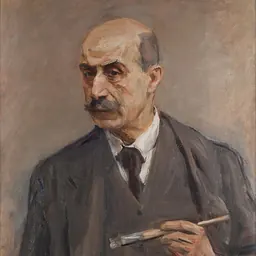
Unsuccessful in his attempts to gain admittance to the studios of Piloty, Lindenschmit, or Diez, Encouraged by his contemporary Max Liebermann, whose portrait he painted, Uhde painted Fishermen's Children in Zandvoort (1882) as an experiment in plein-air painting, but chose to exhibit a more conventional version of the composition, the Arrival of the Organ-Grinder (1883; Kunsthalle Hamburg). This conflict between innovation and caution characterized the greater part of his career. and progressing in his naturalistic conception, he came to develop his own "unacademic" syle. He gave rise to a complete change in German art, and counted among his followers most of the younger generation.
He became less active in the art world after 1900, but continued to paint until his last days. He died in Munich in 1911.
Work
His early work consisted of landscapes and battle pieces, but Uhde's inclination was later almost solely directed towards genre art and religious subjects. His father had been the President of the Lutheran Church Council in Wolkenburg, Saxony, and Uhde shared his father's Christian commitment.
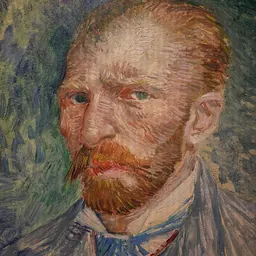
Although the social realism of Uhde's work was often criticized as vulgar or ugly, his paintings also attracted the admiration of others. His work was well known to the French public. Vincent van Gogh mentioned Uhde in personal correspondence. The critic Otto Julius Bierbaum, who prepared a biographical writing of him, said "as a painter of children ... Uhde is extraordinarily distinguished. He does not depict them ... as amusing or charming dolls, but with extreme, very strict naturalness."
In his work, Uhde often depicted the ordinary lives of families of peasants, fishermen, and seamstresses; children and youngsters, as well as young and old women. He chose both indoor and outdoor settings, with detailed and ordinary surroundings, and often natural colorful landscapes. In addition, he frequently depicted Jesus Christ as visiting common people, poor people and working class or proletarian families in settings of his country.
One of his well-known paintings was Come, Lord Jesus, be our Guest (Komm, Herr Jesus, sei unser Gast), of the Berlin National Gallery, where Christ appears among the peasant family assembled for their meal in a modern German farmhouse "parlor". This work was especially criticized by some Catholics who saw it as a "desecration" of Christ, whereas R. A. Cram wrote that by painting "Christ among the common people here and now" Uhde had "built up a most significant art." The religious content has been seen as "a vehicle for his quest to endow his work with deeper meaning". According to the art historian Bettina Brand, Uhde's work was controversial partly because "setting episodes from the Gospels in the context of contemporary poverty ... suggested that the Christian demand of equality for all men had not been met politically or socially."
Style
In general, Uhde was an unconventional naturalist, as he said: "many of the French artists wished to find the light in Nature. I wished to find the light within the figure that I was presenting. In Christ I grasped the embodiment of the outward and the inward light." Like Dostoyevsky, Uhde's concept of beauty and standard of perfection was the figure of Christ, a reason why he considered himself the "first Idealist of Naturalism."
In The Sermon on the Mount (Hungarian National Gallery), Christ addresses a crowd of 19th-century harvesters, whereas in Christus Predigt am see (Sermon at the Sea), Christ preaches to a group of modern youngsters. Similar in conception are Suffer Little Children to come unto Me (1884; Leipzig Museum), Christ at Emmaus & Road to Emmaus (the Staedel Institute, Frankfort); The Farewell of Tobias (the Liechtenstein Gallery, Vienna), Noli me tangere (1894; New Pinakothek, Munich), The Wise Men from the East (1896; Magdeburg Museum), and Woman, Why Weepest Thou? (1900; Vienna Museum). Works he painted during summers spent at Dachau and Starnberg in the 1890s show an increasingly Impressionistic rendering of sunlight, which is also evident in paintings Uhde made after the late 1890s of his daughters in the garden.
In his later years, he made paintings of a woman with wings of angels, and he reproduced some biblical scenes like Abraham's Trial (1897), The Last Supper (1897, Stuttgart Museum – which includes a portrait of the unworldly composer Anton Bruckner as one of the disciples),The Ascension of Christ (1898, New Pinakothek, Munich), Nicodemus and Christ, Die Bergpredigt, The Sermon (Die Predigt Christi, 1903), Tobias and the Angel, The Holy Night (1911, Dresden Gallery), and Christ Healing a Sick Child (1911).
Gallery
Don’t just read it —
keep it.
Full-length biographies made to live with: read them, listen on the way to work, watch them tonight.
- E-book
- Audio
- Video
Instant download · yours to keep · every purchase keeps this site free
Important facts
more
Friedrich von Uhde, fr. v. uhde, f.c. uhde, f. c. uhde, F. v. Uhde, Fritz Karl Hermann v. Uhde, f. von uhde, f. uhde, f. van uhde, prof. fritz von uhde, professor fritz von uhde, Uhde, fritz karl herm. von uhde, uhde fritz von, Fritz Uhde, Friedrich HermPeople in Fritz von Uhde's life
Named in this biography and alive at the same time


Related people
Same field, nearest in time
Contemporaries
People whose lives overlapped Fritz von Uhde's




Frequently asked questions
Who was Fritz von Uhde?
German artist (1848–1911)
When was Fritz von Uhde born?
Fritz von Uhde was born on 22 May 1848 in Limbach-Oberfrohna, Wolkenburg.
When did Fritz von Uhde die?
Fritz von Uhde died on 25 February 1911 in Munich.
What was Fritz von Uhde's occupation?
Fritz von Uhde was a painter, university teacher, teacher, military personnel, history painter and genre painter.
What nationality was Fritz von Uhde?
Fritz von Uhde's recorded nationality: Kingdom of Saxony.
Sources & further reading
Cite this page
APA: Biography.guide. (2026). Fritz von Uhde. https://biography.guide/fritz-von-uhde/
MLA: "Fritz von Uhde." Biography.guide, https://biography.guide/fritz-von-uhde/.
Chicago: "Fritz von Uhde." Biography.guide. https://biography.guide/fritz-von-uhde/.
Data last updated: 2026-09-25 · Spot an error? Report a correction.
Page generated 2026-09-27 05:07 UTC