
About Friedrich Gustav Jakob Henle
Lived 1809 – 1885 (aged 75). Friedrich Gustav Jakob Henle was a German anatomist, zoologist, medical researcher, pathologist, ichthyologist and university teacher, known for Loop of Henle.
Friedrich Gustav Jakob Henle (; 9 July 1809 – 13 May 1885) was a German physician, pathologist, and anatomist. He is credited with the discovery of the loop of Henle in the kidney. His essay, "On Miasma and Contagia," was an early argument for the germ theory of disease. He was an important figure in the development of modern medicine.
Biography
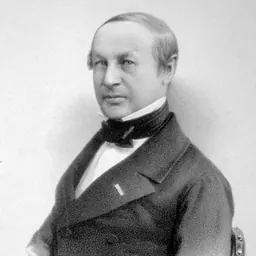
Henle was born in Fürth, Bavaria, to Simon and Rachel Diesbach Henle (Hähnlein). He was Jewish. After studying medicine at Heidelberg and at Bonn, where he took his doctor's degree in 1832, he became prosector in anatomy to Johannes Müller at Berlin. During the six years he spent in that position he published a large amount of work, including three anatomical monographs on new species of animals and papers on the structure of the lymphatic system, the distribution of epithelium in the human body, the structure and development of the hair, and the formation of mucus and pus. He also developed a friendship with another assistant of Müller, Theodor Schwann, which later became famous for his cell theory.
In 1840, he accepted the chair of anatomy at Zürich and in 1844 he was called to Heidelberg, where he taught anatomy, physiology, and pathology. About this period he was engaged on delineating his complete system of general anatomy, which formed the sixth volume of the new edition of Samuel Thomas von Sömmering's treatise, published at Leipzig between 1841 and 1844. While at Heidelberg he published a zoological monograph on the sharks and rays, in conjunction with his master Müller, and in 1846 his famous Manual of Rational Pathology began to appear; this marked the beginning of a new era in pathological study, since in it physiology and pathology were treated, in Henle's own words, as branches of one science, and the facts of disease were systematically considered with reference to their physiological relations.
In 1852, he moved to Göttingen, whence he issued three years later the first instalment of his great Handbook of Systematic Human Anatomy, the last volume of which was not published until 1873. This work was perhaps the most complete and comprehensive of its kind at that time, and it was remarkable not only for the fullness and minuteness of its anatomical descriptions but also for the number and excellence of the illustrations with which they elucidated minute anatomy of the blood vessels, serous membranes, kidney, eye, nails, central nervous system, etc. He discovered the loop of Henle and Henle's tubules, two anatomical structures in the kidney.
Other anatomical and pathological findings associated with his name are: Crypts of Henle: microscopic pockets located in the conjunctiva of the eye. Hassall–Henle bodies: transparent growths in the periphery of the Descemet's membrane of the eye. Henle's fissure: fibrous tissue between the cardiac muscle fibers. Henle's ampulla: ampulla of the uterine tube. Henle's layer: outer layer of cells of root sheath of a hair follicle. Henle's ligament: tendon of the transversus abdominis muscle. Henle's membrane: Bruch's layer forming inner boundary of the choroid of the eye. Henle's sheath: connective tissue which supports outer layer of nerve fibres in a funiculus. Henle's spine: the supra-meateal spine that serves as a landmark in the mastoid area. Glands of Henle: depressions in the eye in which epithelial cells accumulate in cases of cicatricial trachoma. Tubes of Henle: numerous tiny tubes connecting the choroid to retina, carrying vessels and nerves.
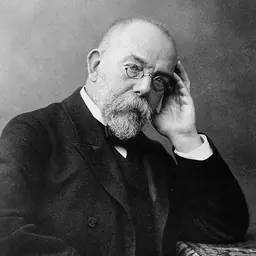
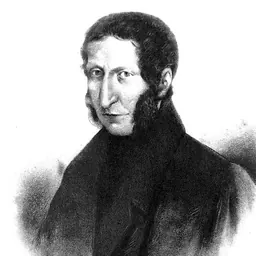
Henle developed the concepts of contagium vivum and contagium animatum, respectively (Von den Miasmen und Kontagien, 1840) – thereby following ideas of Girolamo Fracastoro and the work of Agostino Bassi; thus, co-founding the theory of microorganisms as the cause of infective diseases. He did not find a special species of bacteria himself – this was achieved by his student Robert Koch. Those two put up the fundamental rules of cleanly defining disease-causing microbes: the Henle Koch postulates.
In 1870, he was elected a foreign member of the Royal Swedish Academy of Sciences. He died in Göttingen on 13 May 1885.
Don’t just read it —
keep it.
Full-length biographies made to live with: read them, listen on the way to work, watch them tonight.
- E-book
- Audio
- Video
Instant download · yours to keep · every purchase keeps this site free
Important facts
People in Friedrich Gustav Jakob Henle's life
Named in this biography and alive at the same time
Related people
Same field, nearest in time



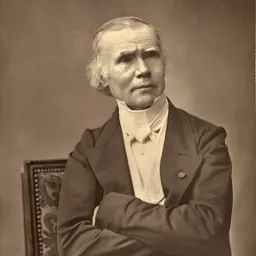

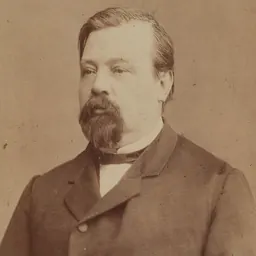
Contemporaries
People whose lives overlapped Friedrich Gustav Jakob Henle's




Frequently asked questions
Who was Friedrich Gustav Jakob Henle?
German physician (1809–1885)
When was Friedrich Gustav Jakob Henle born?
Friedrich Gustav Jakob Henle was born on 9 July 1809 in Fürth.
When did Friedrich Gustav Jakob Henle die?
Friedrich Gustav Jakob Henle died on 13 May 1885 in Göttingen.
What was Friedrich Gustav Jakob Henle's occupation?
Friedrich Gustav Jakob Henle was an anatomist, zoologist, medical researcher, pathologist, ichthyologist and university teacher.
What was Friedrich Gustav Jakob Henle known for?
Friedrich Gustav Jakob Henle was known for Loop of Henle.
What nationality was Friedrich Gustav Jakob Henle?
Friedrich Gustav Jakob Henle was German.
Sources & further reading
· Wikipedia: Friedrich Gustav Jakob Henle
· DBpedia: Friedrich Gustav Jakob Henle
Cite this page
APA: Biography.guide. (2026). Friedrich Gustav Jakob Henle. https://biography.guide/friedrich-gustav-jakob-henle/
MLA: "Friedrich Gustav Jakob Henle." Biography.guide, https://biography.guide/friedrich-gustav-jakob-henle/.
Chicago: "Friedrich Gustav Jakob Henle." Biography.guide. https://biography.guide/friedrich-gustav-jakob-henle/.
Data last updated: 2026-09-20 · Spot an error? Report a correction.
Page generated 2026-09-27 05:28 UTC