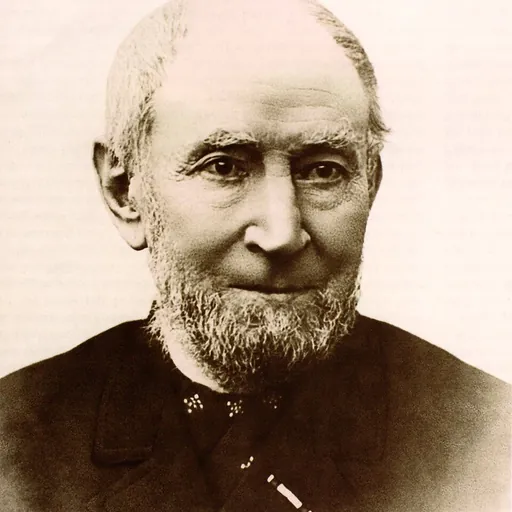
About Friedrich Gottlob Keller
Lived 1816 – 1895 (aged 79). Friedrich Gottlob Keller was a machinist, inventor, papermaker, technician and bookbinding, known for Pulp (paper).
Friedrich Gottlob Keller (27 June 1816 – 8 September 1895) was a German machinist and inventor, who (at the same time as Charles Fenerty) invented the wood pulp process for use in papermaking. He is widely known for his wood-cut machine (used for extracting the fibres needed for pulping wood). Unlike Charles Fenerty, F.G. Keller took out a patent for his wood-cut invention.
Early life
Keller spent his childhood and youth working for his father as a weaver and heddle-maker in Hainichen, Saxony (north-eastern Germany). But he was unhappy in this occupation since his interest was in machines. Keller carried with him an "idea-book", where he jotted down different kinds of machines. He had subscriptions to many of the leading publications on machines, and was well read in the sciences of mechanics. In his late years he recalled an article he read in his youth about the work of the French mathematician René Antoine Ferchault de Réaumur. Though he himself never experimented, his theory caught the interest of others, namely Matthias Koops. In 1800 Koops published a book on papermaking made from straw. Its outer covers were made from trees. His method was not like Fenerty's (pulping wood); instead, he simply ground the wood and caused the particles to adhere. His book does not mention anything about wood pulping.
From 1841 (after noting his idea), Keller worked eagerly on his wood-cut machine. He had spent most of his life so far working with his father as a weaver and heddle maker, and on the side attempting to invent all sorts of machines. A wood-cut machine, however, became his true passion, to which he remained dedicated over the following three years (from 1841 to 1844). In 1844 he completed his work and produced a piece of pulped wood paper from the output of his wood-cut machine. In the summer of 1844 he sent in a sample paper to the German government, hoping to obtain financial support for an improved wood-grinder machine and to develop papermaking further, but without success. Both Charles Fenerty and F.G. Keller started working on wood-based paper at the same time, and made their discovery public at the same time, and at the same time found that no one was interested in it.
Keller remained dedicated to the project, but since he could not obtain national support he sold his invention to a paper specialist, Heinrich Voelter, for about £80. A patent was granted in August 1845 in Saxony, Germany, in both names (Keller and Voelter), and Voelter began production on a mass scale. Voelter did not want to leave Keller out at first because only Keller possessed the knowledge of how to build a suitable wood-grinding machine. Eventually that changed. After 1848 the first machines came out, and in 1852 the renewal of the patent came due, but Keller did not have the money to renew his part of the patent. Therefore, Voelter became the sole patent holder and continued the work, earning a large profit, without Keller.
Later years
Heinrich Voelter remained the sole patent holder, leaving Keller unemployed and penniless. The wood-grinding machine was a success, though. Voelter had sold many throughout Europe and the Americas. By 1852 ground-wood pulped paper was being produced regularly in the mill of "H. Voelter’s Sons" in Heidenheim, Germany. The "Frankenberger Intelligence and Weekly" (in Saxony, Germany) was the first newspaper to use Keller's invention, pulped wood newsprint. It took a couple decades for newspaper and book printers to take over the idea of using pulped wood instead of pulped rags to produce paper, but by the 1860s the new process had gained much popularity, and the transition began. By the end of the 19th-century few printers in the Western world were still using rags in lieu of wood for paper making. Throughout his life, Keller received no royalties from his invention. However, in 1870 he received from a number of German paper makers and other associations a small sum of money, which he used to buy a house in Krippen, Germany. Towards the end of his life a fair sum of money was collected for him in various countries, enough for a worry-free retirement, and he also received several awards in recognition of his invention.
Don’t just read it —
keep it.
Full-length biographies made to live with: read them, listen on the way to work, watch them tonight.
- E-book
- Audio
- Video
Instant download · yours to keep · every purchase keeps this site free
Important facts
People in Friedrich Gottlob Keller's life
Named in this biography and alive at the same time

Related people
Same field, nearest in time





Contemporaries
People whose lives overlapped Friedrich Gottlob Keller's





Frequently asked questions
Who was Friedrich Gottlob Keller?
German machinist and inventor (1816-1895)
When was Friedrich Gottlob Keller born?
Friedrich Gottlob Keller was born on 27 June 1816 in Hainichen.
When did Friedrich Gottlob Keller die?
Friedrich Gottlob Keller died on 8 September 1895 in Krippen.
What was Friedrich Gottlob Keller's occupation?
Friedrich Gottlob Keller was a machinist, inventor, papermaker, technician and bookbinding.
What was Friedrich Gottlob Keller known for?
Friedrich Gottlob Keller was known for Pulp (paper).
What nationality was Friedrich Gottlob Keller?
Friedrich Gottlob Keller's recorded nationality: Kingdom of Saxony.
Sources & further reading
· Wikipedia: Friedrich Gottlob Keller
· DBpedia: Friedrich Gottlob Keller
Cite this page
APA: Biography.guide. (2026). Friedrich Gottlob Keller. https://biography.guide/friedrich-gottlob-keller/
MLA: "Friedrich Gottlob Keller." Biography.guide, https://biography.guide/friedrich-gottlob-keller/.
Chicago: "Friedrich Gottlob Keller." Biography.guide. https://biography.guide/friedrich-gottlob-keller/.
Data last updated: 2026-09-23 · Spot an error? Report a correction.
Portrait: Wikimedia Commons · author & licence
Page generated 2026-09-27 05:07 UTC