
About Fridugisus
Lived 800 – 834. Fridugisus was a monk, writer, teacher and philosopher.
Fridugisus, also known as Fredegisus or Fredegis of Tours (born in England towards the end of the 8th century; died in Tours around 834), was a monk, teacher, and writer.
Biography
An Anglo-Saxon, he was a pupil of Alcuin, first at York and afterwards at the court of Charlemagne in Aachen. The approximate date of his birth is determined by a reference to him as "a boy" (puer) in a letter of Alcuin dated 798. He was a favourite pupil of Alcuin and was one of the group of distinguished scholars who formed the Schola palatina in Aachen, in which he was known by the name Nathaniel. At that time he was a deacon.
When, in 796, Alcuin became abbot of Marmoutier Abbey, Tours, Fridugisus seems to have remained at the court.
According to some authorities he was Alcuin's successor as Master of the Palace School. This is, however, improbable. In 804 he succeeded his teacher as abbot of Marmoutier Abbey at Tours, retaining at the same time his relations with the emperor.
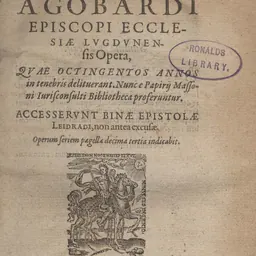
Among his contemporaries he enjoyed a reputation for great learning. He took part in controversies against Agobard de Lyon.
Works
He composed several poems. He also wrote a short treatise in epistolary form, which deals with the nature of nothing and darkness, De nihilo et tenebris. The epistle was written probably during the author's residence at Tours. It is addressed "to all the faithful and to those who dwell in the sacred Palace of the most serene prince Charles". It dealt with the question, are nothing and darkness real things? (Some suggest that this was inspired by the Biblical use of the words in the first chapter of the Book of Genesis). If the Bible uses the words "nothing" and "darkness", it seemed that there must be things corresponding to those words. Fridugisus accepts this answer and defends it both by arguments from authority and by arguments from reason. That his solution, however, was not generally accepted is clear from the opening words of the treatise, in which he refers to the long prevailing divergence of opinion in the matter. The treatise makes use of the dialectical method which was afterwards developed into the scholastic method by Abelard, Alexander of Hales, and Saint Thomas Aquinas.
Don’t just read it —
keep it.
Full-length biographies made to live with: read them, listen on the way to work, watch them tonight.
- E-book
- Audio
- Video
Instant download · yours to keep · every purchase keeps this site free
Important facts
People in Fridugisus's life
Named in this biography and alive at the same time

Related people
Same field, nearest in time


Contemporaries
People whose lives overlapped Fridugisus's

Frequently asked questions
Who was Fridugisus?
Frankish author and chancelor
When was Fridugisus born?
Fridugisus was born in 800.
When did Fridugisus die?
Fridugisus died in 834 in Tours.
What was Fridugisus's occupation?
Fridugisus was a monk, writer, teacher and philosopher.
What nationality was Fridugisus?
Fridugisus's recorded nationality: Francia.
Sources & further reading
Cite this page
APA: Biography.guide. (2026). Fridugisus. https://biography.guide/fridugisus/
MLA: "Fridugisus." Biography.guide, https://biography.guide/fridugisus/.
Chicago: "Fridugisus." Biography.guide. https://biography.guide/fridugisus/.
Data last updated: 2026-09-20 · Spot an error? Report a correction.
Page generated 2026-09-27 05:01 UTC