
About Leoluca
Lived 815 – 915 (aged 99–100). Leoluca was a Byzantine monk.
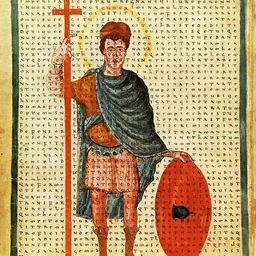
Leoluca, also known as Leone Luca, Leo Luke of Corleone, or Luke of Sicily was the abbot and wonderworker of the monastery of Mount Mula in Calabria, and a founder of Italo-Greek monasticism in southern Italy. He is venerated as a saint in the Roman Catholic and Eastern Orthodox churches.
Born in the Sicilian town of Corleone, he died about a hundred years later, after eighty years of monastic life, in Monteleone Calabro, now Vibo Valentia in Calabria. Today he is a patron saint of both towns, and his feast day is celebrated on 1 March.
In 2006 Leoluca's relics were found in the municipality of San Gregorio d'Ippona, about 2 km southeast of the city of Vibo Valentia.
Hagiographic sources
The text of the Life of Leo Luke of Corleone was published in 1657 in the Sicilian martyrology of Jesuit Ottavio Gaetani ("Vitae Sanctorum Siculorum"). He was said to have derived it from three manuscripts discovered in Sicily: one from Palermo, another from Mazara and a third from Corleone.
Later, the Bollandists published another Life, in Latin, found in the library of Joseph Acosta. |group=note
Life
In Sicily
Leoluca was born in Corleone, Sicily in the 9th century AD (c.815 to 818 AD), on the eve of the Saracen invasion of Sicily. His parents Leo and Theoktiste baptized him Leo, in honour of his father. They were a pious and wealthy family who raised him in the nurture and admonition of the Lord. Before going to Calabria however, he made a special point of going on pilgrimage to visit the tombs of Saint Peter and Paul the Apostle in Rome.
In Calabria Anachronistic map representing the two territories of Mercurion and Latinion, in the Theme of Lucania. In Calabria, he went to the Monastery of Mula, at Mount Mula (Monte La Mula ), one of the highest peaks of the Orsomarso mountains (1935 m). Here he became a monk, excelling in the virtues and in obedience, remaining there for six years. |group=note
News of Leoluca's death spread slowly to Corleone, and it is only in the 13th century that there is evidence of a church dedicated to him in his birthplace. In 1420 there are also references to a Brotherhood of San Leoluca.
Leoluca's intercession is credited with saving the city of Corleone during an outbreak of the plague of 1575, and he was made the patron saint of that town. In 1624 he was made the patron saint of Vibo Valentia as well.
In addition, the apparition of Saint Leo Luke and Saint Anthony is credited with preventing a Bourbon invasion of Corleone on 27 May 1860.
In Vibo Valentia in Calabria, during his feast day on 1 March, the local fire brigade pay him homage by placing a crown of flowers at the feet of his statue which is located high on the façade of the Cathedral Church of Santa Maria Maggiore e San Leoluca, using a turntable ladder to perform the act.
Relics Some historians assert that Leoluca was buried in Monteleone Calabro, now Vibo Valentia, in Calabria, in the church of Santa Maria Maggiore. (i.e. Cathedral Church of Santa Maria Maggiore e San Leoluca).
Don’t just read it —
keep it.
Full-length biographies made to live with: read them, listen on the way to work, watch them tonight.
- E-book
- Audio
- Video
Instant download · yours to keep · every purchase keeps this site free
Important facts
Related people
Same field, nearest in time


Contemporaries
People whose lives overlapped Leoluca's

Frequently asked questions
Who was Leoluca?
Calabrian abbot
When was Leoluca born?
Leoluca was born in 815 in Corleone.
When did Leoluca die?
Leoluca died in 915 in Vena Inferiore.
What was Leoluca's occupation?
Leoluca was a monk.
What nationality was Leoluca?
Leoluca was Byzantine.
Sources & further reading
Cite this page
APA: Biography.guide. (2026). Leoluca. https://biography.guide/leoluca/
MLA: "Leoluca." Biography.guide, https://biography.guide/leoluca/.
Chicago: "Leoluca." Biography.guide. https://biography.guide/leoluca/.
Data last updated: 2026-09-26 · Spot an error? Report a correction.
Page generated 2026-09-27 05:13 UTC