
About Frère Roger
Lived 1915 – 2005 (aged 90). Frère Roger was a Swiss and French theologian, prior and catholic priest.
Roger Schutz (12 May 1915 – 16 August 2005), popularly known as Brother Roger , was a Swiss Christian leader and monastic brother. In 1940 Schutz founded the Taizé Community, an ecumenical monastic community in Burgundy, France, serving as its first prior until his murder in 2005. Towards the end of his life, the Taizé Community was attracting international attention, welcoming thousands of young pilgrims every week, which it has continued to do after his death.
Biography
Background and early life Born on 12 May 1915, in Provence, Vaud, Schutz was the ninth and youngest child of Karl Ulrich Schutz, a Protestant pastor from Bachs in the Zürcher Unterland in Switzerland, and his wife, Amélie Henriette Marsauche, a Huguenot from Burgundy, France.
From 1937 to 1940, Schutz-Marsauche studied Reformed theology in Strasbourg and Lausanne, where he was a leader in the Swiss Student Christian Movement, part of the World Student Christian Federation. Falling ill with tuberculosis, during his convalescence he began to feel drawn to a monastic way of life.
Taizé Community
In 1940, at the start of World War II, Schutz-Marsauche felt called to serve those suffering from the conflict, as his maternal grandmother had done during World War I. He rode a bicycle from Geneva to Taizé, a small town near Mâcon, about southeast of Paris. The town was then located within unoccupied France, just beyond the line of demarcation from the zone occupied by German troops. He bought an empty house, where for two years he and his sister, Genevieve, hid refugees, both Christian and Jewish, before being forced to leave Taizé, after being tipped off that the Gestapo had become aware of their activities. In 1944, he returned to Taizé to found the Community, initially a small quasi-monastic community of men living together in poverty and obedience, open to all Christians.
Assassination
Brother Roger was stabbed to death during the evening prayer service in Taizé on 16 August 2005, by a young woman named Luminița Ruxandra Solcan. She was later deemed mentally ill and was critically stabbed as well in 2011, but survived. Brother Roger, having been stabbed several times, was carried from the church by one of the brothers, but died shortly afterward. His assailant was immediately apprehended by members of the congregation and was placed in police custody.
The funeral took place on 23 August 2005. Horst Köhler, the President of Germany, and Nicolas Sarkozy, at that time Minister of the Interior of France, were in attendance. Brother Roger's community and friends attended the liturgy in the vast monastery church at Taizé, while thousands more followed it on a huge screen in fields outside the church. Brother Roger's simple wooden coffin, a wooden icon lying upon it, was carried into the church by members of the community. In a highly unusual move, the funeral was presided over by a Catholic cardinal, Walter Kasper, the president of the Vatican's Pontifical Council for Promoting Christian Unity, who celebrated the Mass with four priest-brothers of Taizé concelebrating. In his homily he said, "Yes, the springtime of ecumenism has flowered on the hill of Taizé." In reference to Brother Roger's concern for social justice, Cardinal Kasper said "Every form of injustice or neglect made him very sad."
Personal life
Religious affiliation
Although Brother Roger had a Reformed (Protestant) background, he received the Catholic sacrament of the Eucharist at the Catholic Mass celebrated every morning in his monastery. In addition, he received the sacrament from both Pope John Paul II and Pope Benedict XVI, seemingly in contravention of canonical prohibitions reserving the sacrament exclusively to those in full communion with the Catholic Church.
According to Cardinal Walter Kasper, this was accomplished as though there was a tacit understanding between Brother Roger and the Catholic Church "crossing certain confessional" and canonical barriers through what Brother Roger called a gradual enrichment of his faith with the foundations of the Catholic Church including "the ministry of unity exercised by the bishop of Rome." Brother Roger thus appeared to have undertaken a step without precedent since the Protestant Reformation: entering progressively into full communion with the faith of the Catholic Church possibly without a formal "conversion" that would imply a break with his origins.
In 1980, during a meeting in Rome, he said in Saint Peter’s Basilica in the presence of Pope John Paul II:I have found my own identity as a Christian by reconciling within myself the faith of my origins with the mystery of the Catholic faith, without breaking fellowship with anyone.
Brother Rogers' successor at Taizé, Brother Alois, confirmed that the sacrament occurred but denied that there was a formal conversion, stating that he merely affirmed the Creed.
Successor
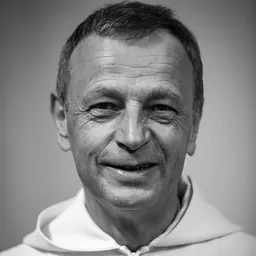
In 1998, Brother Roger had designated Brother Alois, a German Catholic who had originally come to Taizé as a youth and became one of the brothers, as his successor. This was confirmed by the community and in January 2005, it was announced that Alois would soon be taking Roger's place as Prior of Taizé, but this had not yet occurred at the time of Roger's death, when Alois was attending the World Youth Day 2005 celebration in Cologne, Germany. He was installed as prior shortly thereafter.
Publications 1944, Introduction a la Vie Communautaire 1953, La Regle de Taizé 1958, Vivre l’Aujourd’hui de Dieu / Living Today for God 1962, L'unité, espérance de vie / Unity, Life's Hope 1965, Dynamique du provisoire / The Power of the Provisional 1968, Violence des pacifiques / Violent for Peace 1971, Ta fête soit sans fin / Festival Without End, diary February 1969 – May 1970 1973, Lutte et contemplation / Struggle and Contemplation, diary May 1970 – April 1972 1976, Vivre l’inespéré / A Life We Never Dared Hope For, diary May 1972 – September 1974 1979, Etonnement d’un amour / The Wonder of a Love, diary September 1974 – December 1976 1980, Les Sources de Taizé / The Sources of Taizé 1982, Fleurissent tes déserts / And Your Deserts Shall Flower 1985, Passion d’une attente / A Heart that Trusts 1988, Son amour est un feu / His Love Is a Fire 1989, Marie, Mère des Réconciliations / Mary, Mother of Reconciliations (written together with Mother Teresa) 1992, La prière, fraîcheur d’une source / Prayer: Seeking the Heart of God (written together with Mother Teresa) 1995, En tout la paix du cœur / Peace of Heart in All Things 2001, Dieu ne peut qu’aimer / God Is Love Alone 2005, Pressens-tu un bonheur ? / Do You Expect happiness?
Editions, listed alphabetically, as found in the Library of Congress Catalog shortly after his death: Afire with love : meditations on peace and unity. Amour de tout amour : les sources de Taizé. (1990) Awakened from within : meditations on the Christian life. (1987) Brother Roger of Taizé: Essential Writings (Modern Spiritual Masters Series) (2006) Dynamik des Vorläufigen. (1967) Translation of Dynamique du provisoire Dynamique du proviso ire. (1965) En tout la paix du Coeur (1995) Essential Writings. (2006) Étonnement d'un amour : journal. (1979- ) Festival (1973) a translation of Ta fête soit sans fin. Fleurissent les déserts du coeur : journal, 5e volume, 1977–1979. (1982) Life from within : prayers. (1990) a Translation of: Aus dem Innern leben. and Living today for God. (1962) Originally published under the title Vivre l'Aujourd'hui de dieu. Lutte et contemplation; journal 1970–1972. (1973) No greater love : sources of Taizé. (1991) and Parable of community : the rule and other basic texts of Taizé. (1980) Passion d'une attente : journal, 6e volume, 1979–1981. (1985) Peace of heart in all things : meditations for each day of the year. (1996) The power of the provisional. (1969) Originally published as Dynamique du provisoire. Le Règle de Taizé. (1966) Revelation, a Protestant view; the Dogmatic Constitution on divine revelation, a commentary / by Roger Schutz and Max Thurian. (1968) The Rule of Taizé in French and in English. (1968) Translation of Le Règle de Taizé The Rule of Taizé in French and in English. (1967) French title: Le Règle de Taizé Struggle and contemplation; journal, 1970–2. (1974) Translation of Lutte et contemplation. Struggle and contemplation : journal 1970–2. (1974) Translation of Lutte et contemplation. Ta fête soit sans fin. (1971) Ta fête soit sans fin : journal 1969–1970. (1971) Unanimité dans le pluralisme. (1966) Unanimité dans le pluralisme. (1972) Unanimity in pluralism. (1967) Unity: man's tomorrow / by Roger Schutz (1962) Translation of L'unité, espérance de vie. Violence des pacifiques. (1968) Violent for peace. (1970) Translation of Violence des pacifiques. Violent for peace (1970) Translation of Violence des pacifiques. Vivre l'inespéré : journal 1972–1974. (1976) Taizé: lieu de communion. (1972) Mary, Mother of Reconciliations / by Mother Teresa of Calcutta, Brother Roger of Taizé (1989) Meditations on the way of the cross / by Mother Teresa of Calcutta and Brother Roger of Taizé (1987) Translation of: Kreuzweg Seeking the heart of God : reflections on prayer / Mother Teresa and Brother Roger (1993) Translated from the French.
Distinctions John Templeton Foundation: Templeton Prize (1974) Börsenverein des Deutschen Buchhandels: Friedenspreis des Deutschen Buchhandels (1974) University of Warsaw: Honorary doctorate (1986) UNESCO: UNESCO Prize for Peace Education (1988) City of Aachen: Charlemagne Prize (1989) Catholic University of Leuven: Honorary doctorate (1990) Alfred Toepfer Stiftung: Robert Schuman Prize (1992) Notre Dame University: Notre Dame Award (1996) Saint John’s University: (2003) Archbishop Rowan Williams: Lambeth Cross for Ecumenism (2004)
Don’t just read it —
keep it.
Full-length biographies made to live with: read them, listen on the way to work, watch them tonight.
- E-book
- Audio
- Video
Instant download · yours to keep · every purchase keeps this site free
Important facts
People in Frère Roger's life
Named in this biography and alive at the same time







Related people
Same field, nearest in time



Contemporaries
People whose lives overlapped Frère Roger's





Frequently asked questions
Who was Frère Roger?
Swiss monk (1915–2005)
When was Frère Roger born?
Frère Roger was born on 12 May 1915 in Provence.
When did Frère Roger die?
Frère Roger died on 16 August 2005 in Taizé.
What was Frère Roger's occupation?
Frère Roger was a theologian, prior and catholic priest.
What nationality was Frère Roger?
Frère Roger was Swiss and French.
Sources & further reading
Cite this page
APA: Biography.guide. (2026). Frère Roger. https://biography.guide/frere-roger/
MLA: "Frère Roger." Biography.guide, https://biography.guide/frere-roger/.
Chicago: "Frère Roger." Biography.guide. https://biography.guide/frere-roger/.
Data last updated: 2026-09-20 · Spot an error? Report a correction.
Page generated 2026-09-27 05:21 UTC