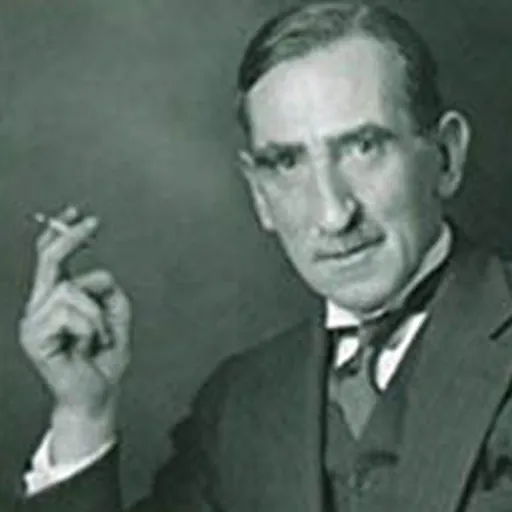
About Frederick Niven
Lived 1878 – 1944 (aged 65). Frederick Niven was a Chilean writer.
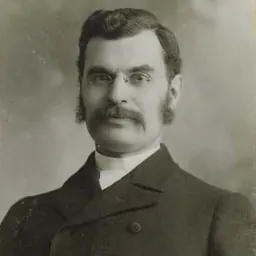
Frederick John Niven (March 31, 1878 – January 30, 1944) was a Canadian novelist of Scottish heritage. A prolific author, he produced over thirty works of fiction, an autobiography, poetry, essays, and pieces of journalism.
Biography Early life Niven was born in Valparaíso, Chile, on 31 March 1878, the youngest of three children. His father manufactured sewed muslin, while his mother was a Calvinist born in Calcutta. When he reached school age, he accompanied his mother to Scotland. He was educated at Hutcheson's Grammar School, Glasgow, First employed in his father's factory, he later worked as a librarian in Glasgow and Edinburgh, and also had employment in a jewelry shop. He worked on a railroad near Savona and dug ditches in Vancouver. When he was twenty years old, he spent a summer tramping in southern British Columbia, later portrayed in Wild Honey. His return to Scotland was aboard a cattleboat from Montreal, a setting recreated in S. S. Glory (1915). His first novel, Lost Cabin Mine (1908), was a Western published serially in The Popular Magazine. His second, The Island of Providence (1910), a historical romance of 17th century Devon, contained scenes replete with pirates and buccaneers. His first foray into realistically depicting Scottish life was A Wilderness of Monkeys (1911).
In 1911, Niven married Mary Pauline Thorne-Quelch, a journalist fifteen years his junior. In 1912 and 1913 the couple spent several months travelling in Western Canada prior to returning to London before WWI. Niven was rejected for military service due to his heart condition. He spent the war working for the Ministry of Food and the War Office. His first volume of poetry, Maple Leaf Songs, appeared in 1917. Starting in this decade, Niven traveled extensively, learning sign language from the Blackfoot people at Calgary, and also went farther abroad, to South America, The year 1923 saw the publication of the Western The Wolfer, a novel Niven described as written partly for fun and partly for money. He produced articles for Canadian Magazine, The Dalhousie Review, and Saturday Night. He now solely lived by his writing. In 1927, he published Wild Honey (UK Queer Fellowes), an account of hobo life, which the writer Charles Lillard later described as one of three best early novels of British Columbia. Two years later, he put forth a pair of non-fiction books, The Story of Alexander Selkirk, and Canada West, a historical account of western Canada.
The 1930s witnessed some of Niven's best Scottish novels, including The Three Marys (1930), The Paisley Shawl (1931), and the Staff at Simson's (1937). The first novel in his Canadian historical trilogy, The Flying Years, appeared in 1935. Niven published in 1938 a series of autobiographical essays entitled Coloured Spectacles. His trilogy continued with Mine Inheritance (1940), and the posthumously published The Transplanted (1944). He is buried in Nelson, British Columbia. In 1946 his headstone was provided by the City of Glasgow, and the memorial tablet by the Canadian Authors Association. The Frederick Niven Literary Award, given for outstanding contribution to literature by a Scot, is named after him.
Criticism The Canadian literary critic Northrop Frye considered Niven to be a "writer of brilliant promise". He was reviewed favourably by Hugh Walpole, Christopher Morley, Rebecca West, and Katherine Mansfield. His first novels were influenced by Robert Louis Stevenson and the hero of penny dreadfuls, Deadwood Dick. His Scottish novels are thought to be superior to his Canadian ones. The critic Edward McCourt ascribed this to Niven's emigration to Canada in middle age, and imperfect assimilation of the mores of his new home.
Niven was a careful stylist, and his writing showed qualities of wit, humanity, and intelligence. His ability to write memorable poetic descriptions has been remarked upon. The plots in his Scottish novels are not well developed, relying rather on an evocation of character and atmosphere. Despite the diligent sourcing of historical data, Niven's Canadian trilogy is marred by frequently wooden characters. One noted structural defect in The Flying Years is the too rapid passage of time, making it seem episodic. The latter novel is the only one of Niven's works to be included in the New Canadian Library series.
List of works
The Lost Cabin Mine (1908) - novel set in British Columbia The Island Providence (1910) - historical novel set partly in Caribbean A Wilderness Of Monkeys (1911) - Scottish novel Dead Men's Bells (1912) - Scottish & pirate novel set in 18th century Above Your Heads (1912) - short stories Hands Up! (1913) - novel set in United States Ellen Adair (1913) - Scottish novel The Porcelain Lady (1913) - Scottish novel Justice Of The Peace (1914 & 1923) - Scottish novel The SS Glory (1915) - novel set on a cattleboat from Montreal to Liverpool Cinderella Of Skookum Creek (1916) - novel set in western North America Two Generations (1916) - Scottish novel Sage Brush Stories (1917) - short stories Maple Leaf Songs (1917) - poetry Penny Scot's Treasure (1918) - novel set in western Canada The Lady Of The Crossing (1919) - novel set in British Columbia A Tale That Is Told (1920) - Scottish novel The Wolfer (1923) - novel set in western United States Treasure Trail (1923) - novel set in British Columbia and Washington State A Lover Of The Land, And Other Poems (1925) - poetry Queer Fellows (title in US: Wild Honey) (1927) - autobiographical account set in British Columbia Canada West (1929 & 1930) - non-fiction account of western Canada The Story Of Alexander Selkirk (1929) - non-fiction The Three Marys (1930) - principally Scottish novel The Paisley Shawl (1931) - Scottish novel The Rich Wife (1932) - Scottish novel Mrs Barry (1933) - Scottish novel Triumph, (1934) - novel set in South America and Scotland The Flying Years (1935) - historical novel set in Manitoba Old Soldier (1936) - Scottish novel The Staff At Simson's (1937) - Scottish novel Colour In The Canadian Rockies [with Walter J. Phillips] (1937) - non-fiction Coloured Spectacles (1938) - autobiographical essays The Story Of Their Days (1939) - Scottish novel Mine Inheritance (1940) - historical novel set in Manitoba Brothers In Arms (1942) - historical novel set in 18th century Glasgow and Virginia Under Which King (1943) - historical novel with a Jacobite setting The Transplanted (1944) - historical novel set in British Columbia
Source:
Don’t just read it —
keep it.
Full-length biographies made to live with: read them, listen on the way to work, watch them tonight.
- E-book
- Audio
- Video
Instant download · yours to keep · every purchase keeps this site free
Important facts
People in Frederick Niven's life
Named in this biography and alive at the same time




Related people
Same field, nearest in time


Contemporaries
People whose lives overlapped Frederick Niven's




Frequently asked questions
Who was Frederick Niven?
Scottish journalist and novelist
When was Frederick Niven born?
Frederick Niven was born on 3 March 1878 in Valparaíso.
When did Frederick Niven die?
Frederick Niven died on 30 January 1944 in Vancouver.
What was Frederick Niven's occupation?
Frederick Niven was a writer.
What nationality was Frederick Niven?
Frederick Niven was Chilean.
Sources & further reading
Cite this page
APA: Biography.guide. (2026). Frederick Niven. https://biography.guide/frederick-niven/
MLA: "Frederick Niven." Biography.guide, https://biography.guide/frederick-niven/.
Chicago: "Frederick Niven." Biography.guide. https://biography.guide/frederick-niven/.
Data last updated: 2026-09-20 · Spot an error? Report a correction.
Portrait: Wikimedia Commons · author & licence
Page generated 2026-09-27 04:58 UTC