
About Frederick E. Olmsted
Lived 1911 – 1990 (aged 78). Frederick E. Olmsted was an American painter.
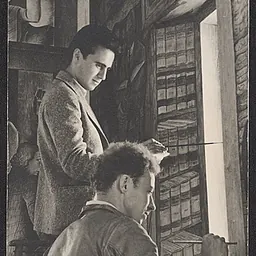
George Albert Harris and Olmsted (front) working on Coit Tower mural, 1934. Photo by Peter Stackpole Detail of "Theory and Science", City College of San FranciscoFrederick "Fred" Olmsted Jr. (April 10, 1911 – February 14, 1990) was an American artist and biophysicist. He created social realism themed murals and sculptures for the Federal Art Project, and the Public Works of Art Project.
Later, he became a scientist and biophysicist at Yale University, the Cleveland Clinic, and Woods Hole Oceanographic Institution.
Early life Olmsted was born in San Francisco, California on April 10, 1911. He was a great-nephew of the landscape architect Frederick Law Olmsted. They also spent summers in New Hampshire. He was studied art under of Ralph Stackpole at the California School of Fine Arts (now the San Francisco Art Institute).
Career
Art During the Great Depression, Olmsted worked for the Works Progress Administration, assisting John Langley Howard and George Albert Harris in their Coit Tower murals in San Francisco.
In 1935 while still an art student, he painted a fresco mural at the SFAI named "Marble Workers" which depicted tradesmen at work at a Fisherman's Wharf tile shop. In 2013, the "Marble Workers" was rediscovered and a Save America's Treasures grant was awarded to offset the cost of its restoration in September 2019. He carved the stone sculptures during the WPA's Art in Action, an exhibition of artists working live for audiences in the summer of 1940. When the Golden Gate International Exposition was over, the sculptures were donated to City College of San Francisco (CCSF) and are currently on display at the CCSF Ocean Campus. He worked on his sculptures at the Junior College of San Francisco (now City College of San Francisco). He served on the committee that organized the first annual open air art show in San Francisco in 1941.
In 1941, Olmsted painted two foot tempera fresco murals at the City College of San Francisco for the Federal Arts Project (FAP) of the Works Progress Administration. In December 1942, he was featured in another exhibit at the museum that included the curator's favorites works from the permanent collection. Olmsted taught art for a few years at California College of Arts and Crafts in Oakland (now called California College of Art).
Biophysics In the early 1940s, Olmsted abandoned his art career and became a scientist at Yale University. He developed a machine to shock the diseased hearts of dogs, a prototype for today's pacemaker.
Personal life While at the California School of Fine Arts Olmsted met fellow student Barbara Leslie Greene who was a native of Williams, Arizona. They married in Reno, Nevada on December 8, 1933.
In 1990, Olmsted died in Falmouth, Massachusetts at the age of 78.
Selected publications
Frederick Olmsted and A.C. Corcoran. "Systolic Pressure in the Intact, Unanesthetized Rat." Federal Proceedings, vol. 7, pt. 1 (March 1948): 88. Frederick Olmsted, A.C. Corcoran, and Irvine H. Page. "Blood Pressure in the Unanesthetized Rat. I" Circulation, vol. 3, no. 3 (May 1, 1951): 722–726. Frederick Olmsted, A.C. Corcoran, and Irvine H. Page. "Blood Pressure in the Unanesthetized Rat. II. Spontaneous Variations and Effect of Heat." Circulation, vol. 3, no. 5 (May 1, 1951): 727–729. DOI: 10.1161/01.cir.3.5.727 Irvine H. Page and Frederick Olmsted. "The Influence of Respiratory Gas Mixtures on Arterial Pressure and Vascular Reactivity in 'Normal' and Hypertensive Dogs." Circulation, vol. 3 (June 1, 1951): 801–819. Frederick Olmsted, Irvine H. Page, and A.C. Corcoran. "A Device for Objective Clinical Measurement of Cutaneous Elasticity: a 'Pinchmeter'." The American Journal of the Medical Sciences, vol. 222, no. 1 (July 1951): 73–75. doi: 10.1097/00000441-195107000-00014. Frederick Olmsted. "Recording of Indirect Blood Pressure in the Unanesthetized Rat." Methods in Medical Research, vo. 5 (1952): 253–257. H H Fertig, Frederick Olmsted, and A.C. Corcoran. "The Fusion Frequency of Flicker in Hypertension; A Study of its Application the Estimation of Hypertensive Cardiovascular Disease." American Heart Journal, vol 44, no. 2 (August 1952): 261–267. doi: 10.1016/0002-8703(52)90151-8. F. Del Greco, Frederick Olmsted, G. M. Masson, and A.C. Corcoran. "Graphic Measurement of Arterial Pressure in the Unanesthetized Rat; an Improved Method." Journal of Laboratory and Clinical Medicine, vol. 41, no. 5 (May 1953): 729–37. L. A. Lewis, Frederick Olmsted, Irvine H. Page et al. "Serum Lipid Levels in Normal Persons; Findings of a Cooperative Study of Lipoproteins and Atherosclerosis." Circulation, vol. 16, no. 2 (August 1957): 227–245. DOI: 10.1161/01.cir.16.2.227 Frederick Olmsted, Willem J. Kolff, and Donald B. Effler. "Electronic Cardiac Pacemaker After Open-Heart Operations: Report of a Case of Tetralogy of Fallot with Atrioventricular Block That Reverted to Sinus Rhythm." .Cleveland Clinic Journal of Medicine.vol. 25, no. 2 (April 1958): 84–91. Frederick Olmsted, Willem J. Kolffan, and Donald B. Effler. "Three Safety Devices for the Heart-Lung Machine." Cleveland Clinic Journal of Medicine, vol. 25, no. 3 (July 1958): 169–176. Frederick Olmsted. "Measurement of Cardiac Output in Unrestrained Dogs by an Implanted Electromagnetic Meter." IRE Transactions on Medical Electronics vol: ME-6, no. 4 (December 1959): 210–213. DOI: 10.1109/IRET-ME.1959.5007967 Frederick Olmsted and Franklin D. Aldrich. "Improved Electromagnetic Flowmeter; Phase Detection, A New Principle." .Journal of Applied Physiology, vol. 16, no. 1 (January 1961): 197–201. .Irvine H. Page and Frederick Olmsted. "Hemodynamic Effects of Angiotensin, Norepinephrine, and Bradykinin Continuously Measured in Unanesthetized Dogs." American Journal of Physiology, vol. 201, no. 1 (July 1961): 92–96. Frederick Olmsted. "New Techniques for Continuous Recording of Cardiovascular Functions in Urestrained Dogs." Journal of Applied Physiology, vol. 17, no. 1 (January 1, 1962): 152–156. Frederick Olmsted. "Biophysics in Cardiovascular Dynamics." Cleveland Clinic Journal of Medicine, vol. 29, no. 2 (April 1962): 90–95. Frederick Olmsted. "Phase Detection Electromagnetic Flowmeter-Design and Use." IRE Transactions on Bio-Medical Electronics, vol. 9, no. 2 (April 1962): 88–92. DOI 10.1109/TBMEL.1962.4322969. Frederick Olmsted and Irvine H. Page. "Hemodynamic Effects of Eledoisin, Kallidin II, and Bradykinin in Unanesthetized Dogs." American Journal of Physiology, vol. 203, no. 5 (November 1962): 951–954. Irvine H. Page and Frederick Olmsted. "Hemodynamic Mechanisms of Increased Cardiovascular Response Resulting from Ganglioplegics and Atropine." American Journal of Physiology, vol. 204, no. 4 (April 1963): 582–590. Frederick Olmsted and Irvine H. Page. "Hemodynamic Changes in Trained Dogs During Experimental Renal Hypertension." Circulation Research, vol. 16, no. 2 (February 1965): 134–139. Frederick Olmsted and Irvine H. Page."Hemodynamic Aspects of Prolonged Infusion of Angiotensin into Unanesthetized Dogs." Circulation Research, vol. 16, no. 2 (February 1965): 140–149. J. W. McCubbin, R. S. De Moura, Irvine H. Page, and Frederick Olmsted. "Arterial Hypertension Elicited by Subpressor Amounts of Angiotensin." Science, vol 149, no. 3690 (September 17, 1965): 1394–1395. doi: 10.1126/science.149.3690.1394. Frederick Olmsted and Irvine H. Page. "Hemodynamic Changes in Dogs Caused by Sodium Pentobarbital Anesthesia." American Journal of Physiology, vol. 210, no. 4 (April 1966): 817–820. doi: 10.1152/ajplegacy.1966.210.4.817 Frederick Olmsted, J. W. McCubbin, and Irvine H. Page. "Hemodynamic Cause of the Pressor Response to Carotid Occlusion." American Journal of Physiology, vol. 210, no. 6 (June 1966): 1342–1346. DOI: 10.1152/ajplegacy.1966.210.6.1342
Don’t just read it —
keep it.
Full-length biographies made to live with: read them, listen on the way to work, watch them tonight.
- E-book
- Audio
- Video
Instant download · yours to keep · every purchase keeps this site free
Important facts
People in Frederick E. Olmsted's life
Named in this biography and alive at the same time





Related people
Same field, nearest in time

Contemporaries
People whose lives overlapped Frederick E. Olmsted's






Frequently asked questions
Who was Frederick E. Olmsted?
American artist and biophysicist (1911–1990)
When was Frederick E. Olmsted born?
Frederick E. Olmsted was born on 10 April 1911 in San Francisco.
When did Frederick E. Olmsted die?
Frederick E. Olmsted died on 14 February 1990.
What was Frederick E. Olmsted's occupation?
Frederick E. Olmsted was a painter.
What nationality was Frederick E. Olmsted?
Frederick E. Olmsted was American.
Sources & further reading
· Wikipedia: Frederick E. Olmsted
· DBpedia: Frederick Olmsted Jr.
Cite this page
APA: Biography.guide. (2026). Frederick E. Olmsted. https://biography.guide/frederick-e-olmsted/
MLA: "Frederick E. Olmsted." Biography.guide, https://biography.guide/frederick-e-olmsted/.
Chicago: "Frederick E. Olmsted." Biography.guide. https://biography.guide/frederick-e-olmsted/.
Data last updated: 2026-09-20 · Spot an error? Report a correction.
Page generated 2026-09-27 05:28 UTC