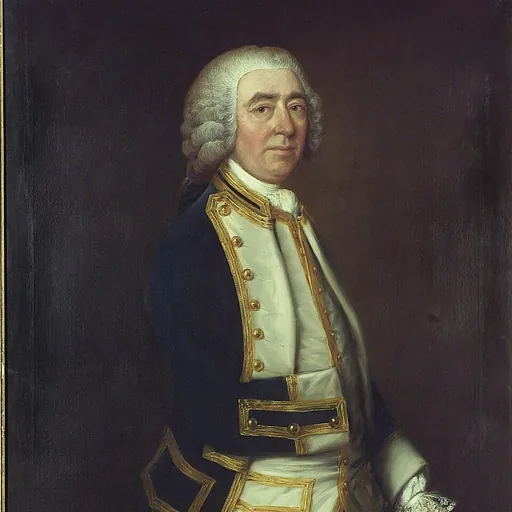
About Frederick Cornewall
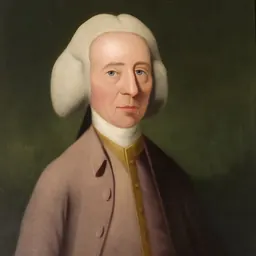
Lived 1706 – 1788 (aged 81–82). Frederick Cornewall was a British politician.
Captain Frederick Cornewall (1706 – 4 August 1788) was an officer in the British Royal Navy.
Early life He was born in 1706, the third son of Rev. Frederick Cornewall (1677-1748), Vicar of Bromfield, Shropshire, and his first wife Elizabeth Trice (d. 1730). He was baptised in his father's church on 3 August 1706.
Career Following the example of his uncle, Admiral Charles Cornewall, he embarked on a naval career, being promoted to the rank of Lieutenant on 13 March 1734. By February 1744, he was First Lieutenant aboard under the command of his cousin James Cornewall. On 11 February 1744, in the Battle of Toulon, Marlborough was immediately astern of Admiral Thomas Mathews' Flagship and the only ship to follow the Admiral into the midst of the Franco-Spanish fleet. Outgunned by the enemy, she came under a heavy bombardment during which James Cornewall was mortally wounded when a Chain-shot carried away both his legs. Frederick took command of the ship, but he too was soon incapacitated when he lost his right arm. When Cornewall was promoted to the rank of Captain soon after, his commission was dated from the date of the battle.
Cornewall's career as an independent commander did not begin auspiciously. Given command of the newly built in 1744, he was sailing the ship under the guidance of a pilot out of the Nore anchorage and on to the Downs on 21 October when it ran aground between Long Sand and the Kentish Knock. The ship could not be freed, and as her situation worsened the following day, Cornewall ordered her scuttled. It was not until 23 October that a rescue was completed and the Captain and 365 of the crew were taken off. A Lieutenant and 40 men were drowned. The subsequent Court-martial sentenced the pilot to 12 months in the Marshalsea prison.
In February 1745 he was given command of , followed by in 1747. Frederick's final command was , shortly after it was launched in 1761 and named in honour of his late cousin.
In 1752 he purchased Delbury Hall, near to Diddlebury in Shropshire, from the Bawdewin family.
Marriage and children
He married Mary (1719-1766), the daughter of Francis Herbert MP, at Bromfield on 2 May 1746. The couple had three sons:
Henry James Cornewall (b. & d. 1747) Frederick Cornewall (1752-1783), MP for Leominster and Ludlow. Folliott Cornewall (1753-1831), Bishop of Bristol, Hereford and Worcester.
He died at Delbury Hall on 4 August 1788, and is buried at Diddlebury.
Don’t just read it —
keep it.
Full-length biographies made to live with: read them, listen on the way to work, watch them tonight.
- E-book
- Audio
- Video
Instant download · yours to keep · every purchase keeps this site free
Important facts
People in Frederick Cornewall's life
Named in this biography and alive at the same time

Related people
Same field, nearest in time



Contemporaries
People whose lives overlapped Frederick Cornewall's





Frequently asked questions
Who was Frederick Cornewall?
British naval officer and politician, 1706-1788
When was Frederick Cornewall born?
Frederick Cornewall was born in 1706 in Bromfield.
When did Frederick Cornewall die?
Frederick Cornewall died on 4 August 1788 in Diddlebury.
What was Frederick Cornewall's occupation?
Frederick Cornewall was a politician.
What nationality was Frederick Cornewall?
Frederick Cornewall was British.
Sources & further reading
· Wikipedia: Frederick Cornewall
· DBpedia: Frederick Cornewall
Cite this page
APA: Biography.guide. (2026). Frederick Cornewall. https://biography.guide/frederick-cornewall/
MLA: "Frederick Cornewall." Biography.guide, https://biography.guide/frederick-cornewall/.
Chicago: "Frederick Cornewall." Biography.guide. https://biography.guide/frederick-cornewall/.
Data last updated: 2026-09-22 · Spot an error? Report a correction.
Portrait: Wikimedia Commons · author & licence
Page generated 2026-09-27 05:02 UTC