
About Frederick Beever
Lived 1830 – 1863 (aged 32–33). Frederick Beever was a military personnel.
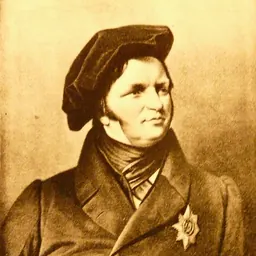
Frederick John Holt Beever ( – July 29, 1863), sometimes written as F. J. Holt Beever or Frederick Beaver, was a Welsh clergyman, nobleman, soldier, Freemason, and adventurer. Beever was the aide-de-camp of General Henry Hastings Sibley while serving in Union Army during Sibley's 1863 Campaign where he was killed in action. Beever is noted as being the first Freemason to be buried in North Dakota, his remains were later exhumed and reinterred at Oakland Cemetery in Saint Paul, Minnesota.
Early life Beever was born in Llanfoist in Wales around 1830, not much is known about his upbringing. Beever attended university at Jesus College, Oxford which he temporarily resigned from in 1852. Beever used his probationary period from Jesus College to travel to the Russian Empire. Beever returned to his studies at Jesus College in 1859. Harriet Bishop states in her 1864 book Dakota War Whoop that Beever traveled westward for his health and was seeking adventure and opportunity on the Great Plains. Bishop describes Beever as a "jovial, social man, brave energetic and reliable, and after "life's fitful fever'". Beever was present at the Battle of Big Mound and the Battle of Stony Lake in Dakota Territory.
On July 29, 1863, following the Battle of Stoney Lake Sibley gave Beever the verbal orders to "go ride to Col. McPhail - tell him not to pursue the enemy after dark, but to act discretionary as to a bivouac on the prairie". Beever was also ordered to retrieve Colonel William Crooks of the 6th Minnesota Infantry Regiment who was performing reconnaissance near the Apple Creek and have his regiment return to camp. Beever successfully relayed Sibley's orders to McPhail and Crooks, however, he did not return to Sibley's headquarters where his absence was noted by Sibley.
On July 30, 1863, Sibley ordered eleven companies under the command of Crooks to search for the body of Beever and another missing soldier, Private Nicholas Miller of Company K of the 6th Minnesota. A report by Harper's Weekly states that a portion of Beever's face was cut off with a tomahawk or knife. Clement Lounsberry notes in two separate sources that all three of Beever's revolvers were exhausted of ammunition signifying that Beaver attempted to fight back when ambushed by the Dakota.
Beaver was originally buried in a temporary grave on a nearby ridge near the Missouri River which was used as a rifle pit for soldiers. Several years later in the 1870s Beever's body was exhumed and reinterred at Fort Snelling National Cemetery before being reinterred at Oakland Cemetery in Saint Paul, Minnesota where it still rests today.
Legacy One of the arrows which killed Beever is held within the collection of the Minnesota Historical Society.
Don’t just read it —
keep it.
Full-length biographies made to live with: read them, listen on the way to work, watch them tonight.
- E-book
- Audio
- Video
Instant download · yours to keep · every purchase keeps this site free
Important facts
People in Frederick Beever's life
Named in this biography and alive at the same time

Related people
Same field, nearest in time


Contemporaries
People whose lives overlapped Frederick Beever's




Frequently asked questions
Who was Frederick Beever?
British soldier
When was Frederick Beever born?
Frederick Beever was born in 1830.
When did Frederick Beever die?
Frederick Beever died on 29 July 1863.
What was Frederick Beever's occupation?
Frederick Beever was a military personnel.
Sources & further reading
Cite this page
APA: Biography.guide. (2026). Frederick Beever. https://biography.guide/frederick-beever/
MLA: "Frederick Beever." Biography.guide, https://biography.guide/frederick-beever/.
Chicago: "Frederick Beever." Biography.guide. https://biography.guide/frederick-beever/.
Data last updated: 2026-09-20 · Spot an error? Report a correction.
Page generated 2026-09-27 05:08 UTC