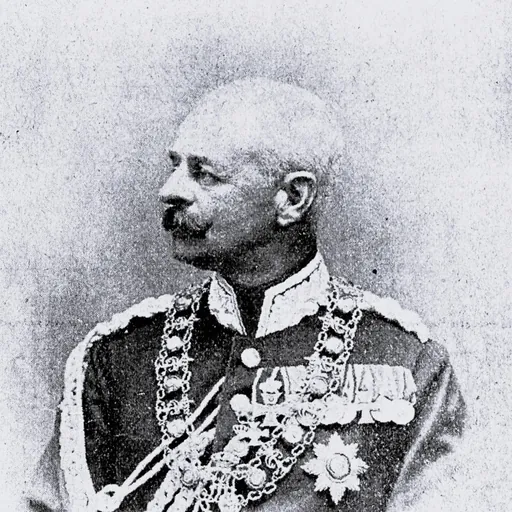
Frederick Augustus II, Grand Duke of Oldenburg
German noble (1852-1931); Grand Duke from 1900 until 1918
About Frederick Augustus II, Grand Duke of Oldenburg
Lived 1852 – 1931 (aged 78). Frederick Augustus II, Grand Duke of Oldenburg was a German sovereign.
Frederick Augustus II (16 November 1852 in Oldenburg – 24 February 1931 in Rastede) was the last ruling Grand Duke of Oldenburg.
Frederick Augustus was the eldest son of Peter II, Grand Duke of Oldenburg. He grew up with an interest in the navy and studied at multiple German universities, before serving in the navy. In 1878, he married Princess Elisabeth Anna of Prussia, daughter of Princess Maria Anna of Anhalt-Dessau and Prince Frederick Charles of Prussia. After her death in 1895, he married Elisabeth Alexandrine of Mecklenburg-Schwerin in 1896.
He ascended to the Oldenburg throne in 1900 as Frederick Augustus II and funded multiple infrastructure projects, including the development of ports and waterways. The First World War broke out during his reign which saw the Grand Duchy of Oldenburg fight with the German Empire under Kaiser Wilhelm II on the side of the Central Powers. The German Revolution at the end of the war forced Frederick Augustus to abdicate and led to the collapse of all German monarchies. After living in exile for two decades, Frederick Augustus died at the age of 78 years old.
Early life Frederick Augustus was born on 16 November 1852 in the Grand Duchy of Oldenburg as the eldest son of Peter II, the reigning Grand Duke of Oldenburg, and Princess Elisabeth of Saxe-Altenburg. From 1861, Frederick Augustus and his younger brother, Georg Ludwig, were tutored by Bavarian general Otto von Parseval, the son-in-law of former Oldenburg court marshal Alexander von Rennenkampff. Frederick Augustus studied at the University of Bonn, University of Strasbourg and University of Leipzig. His education was completed following a seven-month-long exchange to Asia Minor, Palestine, Egypt and Italy. Following this, he joined the military and achieved the rank of lieutenant.
Frederick Augustus acquired a captain's licence at a nautical school in Elsfleth and began to regularly skipper yachts. In 1888, he rescued a shipwrecked Danish sailor on Heligoland and was awarded with the Golden Rescue Medal by the Italian government for his actions. For this, he was the only German monarch appointed Admiral of the German Imperial Navy, which was ordered by Kaiser Wilhelm II. Frederick Augustus personally captained the luxury yacht Lensahn on family trips through the Baltic and Mediterranean Seas.
In 1899, the Shipbuilding Technical Society was founded and Frederick Augustus served as its honorary chairman until 1930. Additionally, he was one of the founders of the German School Ship Association, which campaigned for the expansion of seamanship training capacities for the German merchant navy, in January 1900.
In 1904, Frederick Augustus designed the "Niki Propeller", a ship propeller which he asked to be built by a Hamburg manufacturing company, however they refused as they believed it would produce a financial loss. Nonetheless, for his nautical achievements, Frederick Augustus was awarded a Doctorate at the Leibniz University Hannover in 1910. During his reign, Frederick Augustus also ordered the building of the Elisabeth-Anna-Palais, named after his first wife, who died during its construction. On 1 December 1906, a law introducing administrative jurisdiction came into effect per a decree signed by Frederick Augustus. The law had previously been drafted by lawyer Karl Dugend, but was defeated in the legislature. Moreover, on 14 January 1914, the construction of a training ship was completed by Joh. C. Tecklenborg. It was christened in 1918 in Frederick Augustus' name, and the ship is still in use today by Norway, which uses the name Statsraad Lehmkuhl for the vessel.
Being a state of the German Empire, the Grand Duchy of Oldenburg took part in World War I, under Frederick Augustus' rule. He personally commanded the Grand Ducal Oldenburg Cavalry Regiment during the war, in which he adhered to a group of annexationists, who wanted to secure Germany's position of power by acquiring foreign territories. He supported the invasion of Belgium and believed that France should be made a vassal state of Germany and be divided into a northern republic and southern Bourbon Kingdom. According to Geerkens, Frederick Augustus was pushed by Grand Admiral Alfred von Tirpitz to approach the King of Bavaria, Ludwig III, and suggest that the German monarchs demand that Wilhelm dismiss the Chancellor of Germany, Theobald von Bethmann Hollweg, who was accused of acting too weak and slowing German victory. Many German monarchs, including Frederick Augustus, were also disappointed with Bethmann Hollweg's rejection of the Reichstag Peace Resolution in 1917.
Life in exile Frederick Augustus and his family took up residence at Rastede Castle, where he took up farming and local industrial interests. Philosopher Karl Jaspers, who grew up in Oldenburg, wrote in his memoirs of this endeavour: "The Grand Duke used some of the money from the sale of the pictures to help found a sausage factory, which subsequently collapsed." Frederick Augustus' sale of arts helped to later influence the Cultural Property Protection Act 2019.
Death Frederick Augustus died on 24 February 1931 in Rastede. He was subsequently buried in the Grand Ducal Mausoleum of the Gertrudenfriedhof cemetery in Oldenburg. The marriages were the first such occasions performed since Prussia had become the German Empire in 1870. Due to this increased status, the weddings were attended by many important personages, including Leopold II of Belgium and his wife, Queen Marie Henriette. The Prince of Wales also attended, as Charlotte, one of the brides, was his niece.
They had two daughters:
married Prince Eitel Friedrich of Prussia, younger son of Wilhelm II of Germany. Before her death, her husband had been building a new residential palace; once she died, Frederick named the new building the Elisabeth-Anna-Palais in her honor.
On 24 October 1896, Frederick Augustus married Duchess Elisabeth Alexandrine of Mecklenburg-Schwerin, daughter of Frederick Francis II, Grand Duke of Mecklenburg. He succeeded as Grand Duke of Oldenburg in 1900.
They had five children:
NameBirthDeathNotes Nicolas Frederick William, Hereditary Grand Duke of Oldenburg 10 August 1897 3 April 1970 Married Princess Helena of Waldeck and Pyrmont. Duke Frederick Augustus 25 March 1900 26 March 1900 Twin with Alexandrine, died in infancy. Duchess Alexandrine 25 March 1900 26 March 1900 Twin with Frederick Augustus, died in infancy. Duchess Ingeborg Alix 20 July 1901 10 January 1996 Married Prince Stephan Alexander of Schaumburg-Lippe, younger son of Georg, Prince of Schaumburg-Lippe. Their children included Princess Marie Alix of Schaumburg-Lippe. Duchess Altburg Marie Mathilde Olga 19 May 1903 16 June 2001 Married Josias, Hereditary Prince of Waldeck and Pyrmont.
Honours
Ancestry
Don’t just read it —
keep it.
Full-length biographies made to live with: read them, listen on the way to work, watch them tonight.
- E-book
- Audio
- Video
Instant download · yours to keep · every purchase keeps this site free
Important facts
People in Frederick Augustus II, Grand Duke of Oldenburg's life
Named in this biography and alive at the same time



Related people
Same field, nearest in time

Contemporaries
People whose lives overlapped Frederick Augustus II, Grand Duke of Oldenburg's


Frequently asked questions
Who was Frederick Augustus II, Grand Duke of Oldenburg?
German noble (1852-1931); Grand Duke from 1900 until 1918
When was Frederick Augustus II, Grand Duke of Oldenburg born?
Frederick Augustus II, Grand Duke of Oldenburg was born on 16 November 1852 in Oldenburg.
When did Frederick Augustus II, Grand Duke of Oldenburg die?
Frederick Augustus II, Grand Duke of Oldenburg died on 24 February 1931 in Rastede.
What was Frederick Augustus II, Grand Duke of Oldenburg's occupation?
Frederick Augustus II, Grand Duke of Oldenburg was a sovereign.
What nationality was Frederick Augustus II, Grand Duke of Oldenburg?
Frederick Augustus II, Grand Duke of Oldenburg was German.
Sources & further reading
· Wikipedia: Frederick Augustus II, Grand Duke of Oldenburg
· DBpedia: Frederick Augustus II of Oldenburg
Cite this page
APA: Biography.guide. (2026). Frederick Augustus II, Grand Duke of Oldenburg. https://biography.guide/frederick-augustus-ii-grand-duke-of-oldenburg/
MLA: "Frederick Augustus II, Grand Duke of Oldenburg." Biography.guide, https://biography.guide/frederick-augustus-ii-grand-duke-of-oldenburg/.
Chicago: "Frederick Augustus II, Grand Duke of Oldenburg." Biography.guide. https://biography.guide/frederick-augustus-ii-grand-duke-of-oldenburg/.
Data last updated: 2026-09-21 · Spot an error? Report a correction.
Portrait: Wikimedia Commons · author & licence
Page generated 2026-09-27 05:00 UTC