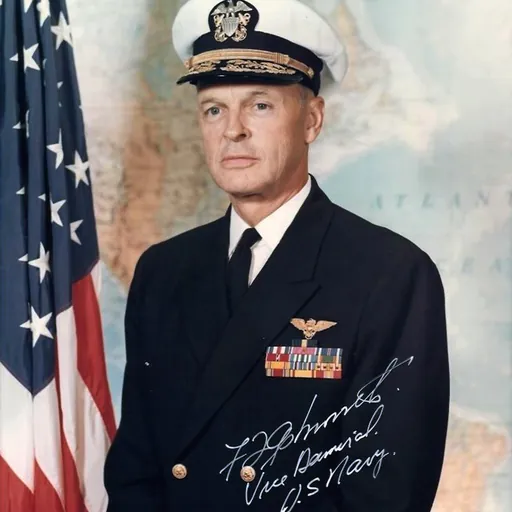
About Frederick Ashworth
Lived 1912 – 2005 (aged 93). Frederick Ashworth was an American naval officer.
Frederick Lincoln "Dick" Ashworth (24 January 1912 – 3 December 2005) was a United States Navy officer who served as the weaponeer on the B-29 Bockscar that dropped a Fat Man atomic bomb on Nagasaki, Japan on 9 August 1945 during World War II.
A 1933 graduate of the United States Naval Academy at Annapolis, Maryland, Ashworth commanded Torpedo Squadron Eleven (VT-11), a Grumman TBF Avenger unit based on Guadalcanal that flew patrol, search, spotting, strike, and night mine-laying missions in support of the New Georgia Campaign in the Solomon Islands. He was awarded the Distinguished Flying Cross for heroism while carrying out these missions. He then participated in the Gilbert and Marshall Islands campaign as aviation officer on the staff of Vice Admiral Richmond K. Turner's V Amphibious Force.
Rotated back to the United States in June 1944, Ashworth became senior naval aviator at the Naval Proving Ground in Dahlgren, Virginia. In November 1944 he was assigned to the Manhattan Project, and supervised the testing of atomic bomb components at Wendover. In February 1945, he travelled to Guam, where he met Fleet Admiral Chester Nimitz, and selected Tinian as a base of operations for the 509th Composite Group. After the war he selected Bikini Atoll as the site for Operation Crossroads.
Remaining in the navy after the war, Ashworth rose to the rank of vice admiral in May 1966. He was Commandant of Midshipmen at the United States Naval Academy in 1958, and served as commander of the United States Sixth Fleet from September 1966 to April 1967. He retired from the navy in 1968, and died in 2005.
Early life Frederick Lincoln "Dick" Ashworth was born in Beverly, Massachusetts on 24 January 1912, the third child of Fred Ashworth, who worked as a draughtsman and tool designer for the United Shoe Machinery Corporation, and his wife Minnie. He had two older brothers, Phil and Bentley. Phil graduated from the United States Naval Academy at Annapolis, Maryland, in 1931, but died in a 1938 seaplane crash off Pearl Harbor.
The family moved to a farmhouse in Wenham, Massachusetts, in 1918. Ashworth attended Center School in Wenham, and then, as Wenham had no high school of its own, Beverly High School, where he was president of the Student Council. Too young and small for football, he participated in track and cross country running. He graduated in 1928, and then entered Dartmouth College.
Ashworth decided that he wanted to go to Annapolis like his brother. He sat and passed the examinations for an appointment from his local Congressman, but did not secure one of the Congressman's two appointments. However, in August 1929, he was informed that one of the Congressman's appointments had been rejected for defective teeth. Ashworth then entered Annapolis. He graduated 134th in the class of 1933, and was commissioned as an ensign. His Distinguished Flying Cross citation read:
In September 1943, Ashworth was posted to the staff of Vice Admiral Richmond K. Turner's V Amphibious Force as aviation officer. In this capacity he served in the Gilbert and Marshall Islands campaign.
Project Alberta
In June 1944, Ashworth was rotated back to the United States, where he became senior naval aviator at the Naval Proving Ground in Dahlgren, Virginia. In November he was assigned to the Manhattan Project.
Holding the rank of commander, he became Director of Operations for Project Alberta, the portion of the Manhattan Project tasked with dropping of the weapons on Japan. In February 1945, Ashworth was sent to Guam to deliver a letter to Fleet Admiral Chester Nimitz from Fleet Admiral Ernest King ordering him to provide whatever support the Manhattan Project required. Ashworth's first task was to select a suitable base area for the 509th Composite Group. After looking at Guam and Saipan, he decided that Tinian would be more suitable, as it was closer to Japan than Guam, and had better facilities than Saipan. At the suggestion of island commander, Brigadier General Frederick V. H. Kimble, Ashworth selected an area at the northern end of the island.
Decorations
Don’t just read it —
keep it.
Full-length biographies made to live with: read them, listen on the way to work, watch them tonight.
- E-book
- Audio
- Video
Instant download · yours to keep · every purchase keeps this site free
Important facts
People in Frederick Ashworth's life
Named in this biography and alive at the same time

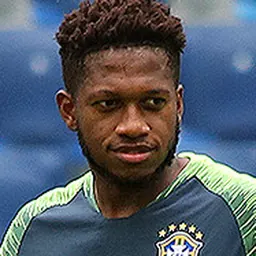

Related people
Same field, nearest in time
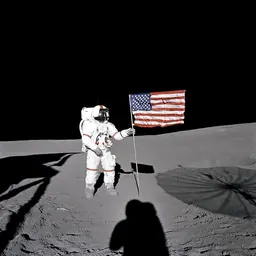
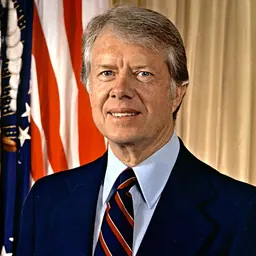
Contemporaries
People whose lives overlapped Frederick Ashworth's





Frequently asked questions
Who was Frederick Ashworth?
United States Navy admiral
When was Frederick Ashworth born?
Frederick Ashworth was born on 24 January 1912 in Beverly.
When did Frederick Ashworth die?
Frederick Ashworth died on 3 December 2005 in Phoenix.
What was Frederick Ashworth's occupation?
Frederick Ashworth was a naval officer.
What nationality was Frederick Ashworth?
Frederick Ashworth was American.
Sources & further reading
· Wikipedia: Frederick Ashworth
Cite this page
APA: Biography.guide. (2026). Frederick Ashworth. https://biography.guide/frederick-ashworth/
MLA: "Frederick Ashworth." Biography.guide, https://biography.guide/frederick-ashworth/.
Chicago: "Frederick Ashworth." Biography.guide. https://biography.guide/frederick-ashworth/.
Data last updated: 2026-09-21 · Spot an error? Report a correction.
Portrait: Wikimedia Commons · author & licence
Page generated 2026-09-27 05:00 UTC