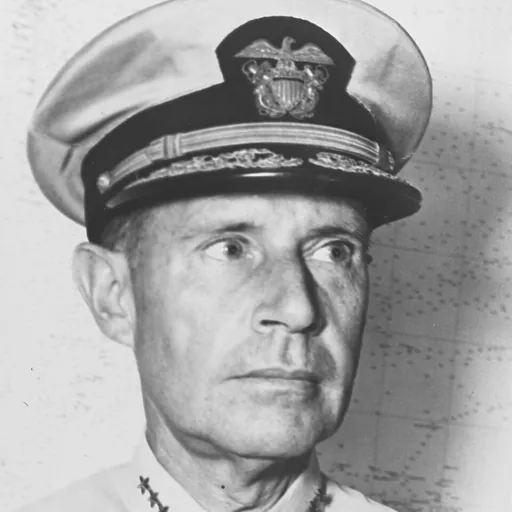
About Raymond A. Spruance
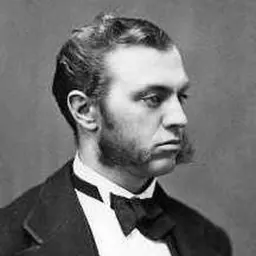
Lived 1886 – 1969 (aged 83). Raymond A. Spruance was an American naval officer, diplomat and philippines.
Raymond Ames Spruance (July 3, 1886 – December 13, 1969) was a United States Navy admiral during World War II. He commanded U.S. naval forces during the Battle of the Philippine Sea, one of the most significant naval battles of the Pacific Theatre. He also commanded Task Force 16 at the Battle of Midway, comprising the carriers and . At Midway, dive bombers from American carriers sank four fleet carriers of the Imperial Japanese Navy. Most historians consider Midway the turning point of the Pacific War.
Official Navy historian Samuel Eliot Morison characterized Spruance's performance as "superb", and he was nicknamed "electric brain" for his calmness, even in moments of supreme crisis, a reputation enhanced by his successful tactics. He emerged from the war as one of the greater admirals in American history. After the war, Spruance was appointed President of the Naval War College, and later served as American ambassador to the Philippines.
Early life Spruance was born in Baltimore, Maryland, on July 3, 1886, to Alexander and Annie Hiss Spruance. He was raised in Indianapolis, Indiana. Spruance attended Indianapolis public schools and graduated from Shortridge High School. From there he graduated from the U.S. Naval Academy class of 1907 early on September 12, 1906, and received further, hands-on education in electrical engineering a few years later.
Career prior to World War II Spruance's first duty assignment was aboard the battleship , an 11,400-ton veteran of the Spanish–American War. In July 1907 he transferred to the battleship and was aboard her during the historic around-the-world cruise of the Great White Fleet from 1907 to 1909.
Spruance's seagoing career included command of the destroyers from March 1913 to May 1914, , three other destroyers, and the battleship .
In 1916 he aided in the fitting out of the battleship and he served on board her from her commissioning in June 1916 until November 1917. During the last year of World War I he was assigned as Assistant Engineer Officer of the New York Naval Shipyard, and carried out temporary duty in London, England, and Edinburgh, Scotland.
Following his return to the United States, Spruance served aboard transport ship , before he was ordered to Bath Iron Works in Bath, Maine, for duty in connection with fitting out of destroyer in March 1919. He commanded that vessel during the patrols with the Atlantic Fleet until January 1920, when he assumed command of newly commissioned destroyer in San Francisco, California.
He commanded the Percival during the sea trials off the California coast and during the patrol cruises with the Destroyer Force, Pacific Fleet until May 1922, when he was ordered to Washington, D.C., for duty in the Bureau of Engineering under Rear Admiral John K. Robison. While in that capacity he assumed additional duty as a member of the board on doctrine of aircraft in connection with fleet fire control.
He began attendance at the Naval War College in 1926, and graduated in 1927. Spruance served as executive officer of USS Mississippi from October 1929 to June 1931. He also held several engineering, intelligence, staff and Naval War College positions up to the 1940s. He served as an instructor at the Naval War College from 1935 to 1938. He commanded the battleship USS Mississippi from April 1938 to December 1939, when he was promoted to rear admiral. On February 26, 1940, Spruance reported as commandant of the 10th Naval District with headquarters at Naval Station Isla Grande in San Juan, Puerto Rico. On August 1, 1941, he finished his tour in Puerto Rico.
World War II Before Midway In the first months of World War II in the Pacific, Spruance commanded the four heavy cruisers and support ships of Cruiser Division Five from his flagship, the heavy cruiser . His division was an element of the task force built around the aircraft carrier and commanded by Vice Admiral William F. Halsey Jr. Early on, Halsey had led his task force on hit-and-run raids against the Japanese in the western Pacific: striking the Gilbert and Marshall islands in February 1942, Wake Island in March, and projecting the air power of the Doolittle Raid against the Japanese homeland in April. These raids were critical to morale — setting a new tone of aggressiveness by U.S. commanders while providing invaluable battle experience for the commanders and sailors of the U.S. Navy. On the other hand, commander-in-chief of the U.S. Pacific Fleet, Admiral Chester Nimitz knew he must intercept the Japanese invasion fleet, and that he must give battle to the enemy aircraft carriers before they could project their overwhelming power against the naval air station at Midway.
Fewer than two days before launch from Pearl Harbor, Nimitz's commander of the fleet carrier force, Admiral Halsey, was hospitalized with severe shingles; Halsey immediately recommended Admiral Spruance to Nimitz as his replacement with Admiral Frank Jack Fletcher receiving overall command. Although Spruance was proven as a cruiser division commander, he had no experience handling carrier-air combat; Halsey reassured Nimitz, and he told Spruance and Fletcher to rely on their newly inherited staff, particularly Captain Miles Browning, a battle-proven expert in carrier warfare. Spruance assumed command of Task Force 16 with its two carriers, and , under battle command of Admiral Fletcher. Fletcher would command Task Force 17, but the task force flagship, , had been badly damaged at the Battle of the Coral Sea and the formation's other carrier, , had been sunk, but at Nimitz's behest Yorktown was patched-repaired in "rush" time purposefully to join the Midway operation. But in summing up Spruance's performance in the battle, Morison wrote: "Fletcher did well, but Spruance's performance was superb. Calm, collected, decisive, yet receptive to advice; keeping in his mind the picture of widely disparate forces, yet boldly seizing every opening. Raymond A. Spruance emerged from the battle one of the greatest admirals in American naval history". For his actions at the battle of Midway, Rear Admiral Spruance was awarded the Navy Distinguished Service Medal and cited as follows: "For exceptionally meritorious service ... as Task Force Commander, United States Pacific Fleet. During the Midway engagement which resulted in the defeat of and heavy losses to the enemy fleet, his seamanship, endurance, and tenacity in handling his task force were of the highest quality." Both Fletcher and Nimitz recommended Spruance for the Distinguished Service Medal for his role in the battle.
The Battle of Midway is considered by many to be a turning point of the war in the Pacific, along with the Guadalcanal campaign. Before Midway, a small and fractional U.S. Navy faced an overwhelmingly larger and battle-hardened Japanese Combined Fleet. After Midway, although the Japanese still held a temporary advantage in vessels and planes, the U.S. Navy and the nation gained confidence and, most critically, time. The setback in the Japanese timetable to encircle the Pacific gave the U.S. industrial machine time to accelerate war production, and ultimately, turn the advantage on Japan in the production of ships, planes, guns, and all the other matériel of war.
Commanding the Fifth Fleet Kwajalein Invasion, February 1944. From left to right: Spruance, RADM Richard L. Conolly, Assistant Secretary of the Navy James Forrestal, MG Harry Schmidt, MG Holland M. Smith, VADM Ben Moreell, LTC Evans Carlson, and RADM Charles A. Pownall. Shortly after the Midway battle, Spruance became chief of staff to Admiral Nimitz, and in September 1942 was appointed as Deputy Commander in Chief of the Pacific Fleet.
On August 5, 1943, Spruance was placed in command of the Central Pacific Force, which, on April 29, 1944, was redesignated as the Fifth Fleet. At that time, Admiral Nimitz instituted a unique arrangement in which the command of the vessels which made up the "Big Blue Fleet" alternated between Admiral William Halsey Jr., at which time it was identified as the Third Fleet and Task Force 38, and Admiral Spruance, when it became the Fifth Fleet and Task Force 58. When not in command of the fleet the admirals and their staffs were based at Pearl Harbor and planned future operations.
The two admirals were a contrast in styles. Halsey was aggressive and a risk taker. Spruance was calculating and cautious. Notwithstanding their different personalities, Spruance and Halsey were close friends. In fact, Spruance had a knack for getting along with difficult people, including his friend Admiral Kelly Turner, the hotheaded commander of 5th Fleet's amphibious force. One exception was Admiral John Towers, a constant critic of Spruance, whom Spruance came to despise for his naked ambition.
Most common sailors were proud to serve under Halsey; most higher-ranking officers preferred to serve under Spruance. Captain George C. Dyer of the light cruiser , who served under both Spruance and Halsey, summed up the view of many ship captains:
This gave rise to the description of Spruance as "an Admiral's admiral".
Spruance directed Operation Hailstone against the Japanese naval base Truk in February 1944 in which twelve Japanese warships, thirty-two merchant ships and 249 aircraft were destroyed. This occurred at the same time that Admiral Turner's forces were attacking Eniwetok Atoll in the Marshalls, about 700 miles to the east. Spruance himself directed a task group of battleships, cruisers and destroyers that left the main body to go after Japanese ships that were fleeing Truk, sinking the light cruiser and destroyer . This was said to be the first time that a four-star admiral took part in a sea action aboard one of the ships engaged. Admiral Spruance commanded with deadly precision, reported an observer.
Battle of the Philippine Sea Spruance (left) with Marine generals following the recapture of Guam on August 1, 1944. Others are LTG Holland M. Smith (FMFPac), MG Henry L. Larsen, Island Commander, MG Roy S. Geiger, (III Amphibious Corps).
While screening the American invasion of Saipan in June 1944, Spruance defeated the Japanese fleet in the Battle of the Philippine Sea. Although he broke the back of the Japanese naval air force by sinking three carriers, two oilers and destroying about 600 enemy airplanes (so many that the remaining Japanese carriers were used solely as decoys in the Battle of Leyte Gulf a few months later due to the lack of aircraft and aircrews to fly them) Spruance has been criticized for not being aggressive enough in exploiting his success in the Philippine Sea. Buell quotes Spruance speaking with Morison:
However, his actions were both praised and understood by the main persons ordering and directly involved in the battle. Admiral Ernest J. King, the Chief of Naval Operations, said to him "Spruance, you did a damn fine job there. No matter what other people tell you, your decision was correct." Spruance's fast carrier commander, Marc Mitscher, told his chief of staff Arleigh Burke:
You and I have been in many battles, and we know there are always some mistakes. This time we were right because the enemy did what we expected him to do. Admiral Spruance could have been right. He's one of the finest officers I know of. It was his job to protect the landing force.... Spruance later chose the battleship as his flagship, as the huge had both room for his staff and the speed to keep up with the fast carrier task forces.
Spruance received the Navy Cross for his actions at Iwo Jima and Okinawa.
Spruance succeeded Fleet Admiral Chester Nimitz as Commander in Chief, U.S. Pacific Fleet and Pacific Ocean Areas in November 1945, a few months after the end of the war.
On October 16, 1946, the former Secretary of War, Robert P. Patterson, presented the Army Distinguished Service Medal to Admiral Spruance, with citation as follows:
Post-war Retirement
Toward the end of the Second World War Congress created a limited number of five-star ranks for the Army and the Navy, designated General of the Army and Fleet Admiral. The Navy, by law, was limited to four fleet admirals; three of these appointments were obvious: Ernest King, Chester Nimitz and William Leahy. The fourth was a choice between Halsey and Spruance, and after much deliberation, eventually Halsey was appointed in December 1945. Spruance's achievements were acknowledged by the unique distinction of a special act of Congress awarding him Admiral's full pay for life. Spruance expressed his personal feelings on this matter as follows:
Spruance was President of the Naval War College from February 1946 until he retired from the Navy in July 1948. He was decorated with Order of Leopold and Croix de guerre with Palm by the Government of Belgium for his service for the Allied cause.
Shortly before his retirement, Spruance received the following Letter of Commendation from the Secretary of the Navy:
Your brilliant record of achievement in World War II played a decisive part in our victory in the Pacific. At the crucial Battle of Midway your daring and skilled leadership routed the enemy in the full tide of his advance and established the pattern of air-sea warfare which was to lead to his eventual capitulation...
Personality Spruance was an active man who thought nothing of walking eight or 10 miles a day. He was fond of symphonic music, and his tastes were generally simple. He never smoked, and drank little. He enjoyed hot chocolate and would make it for himself every morning. Besides his family, he loved the companionship of his pet schnauzer, Peter. Fit into his 70s, Spruance spent most of his retirement days wearing old khakis and work shoes and working in his garden and greenhouse; he loved to show them to visitors.
His achievements in the navy were well known, but himself much less. He did not discuss his private life, feelings, prejudices, hopes or fears, except with his family and his closest friends. He was modest and candid about himself. "When I look at myself objectively," he wrote in retirement, "I think that what success I may have achieved through life is largely due to the fact that I am a good judge of men. I am lazy, and I never have done things myself that I could get someone to do for me. I can thank heredity for a sound constitution, and myself for taking care of that constitution." About his intellect he was equally unpretentious: "Some people believe that when I am quiet that I am thinking some deep and important thoughts, when the fact is that I am thinking of nothing at all. My mind is blank."
The main auditorium of the U.S. Naval War College, Newport, Rhode Island, is named Spruance Hall. A bust of Spruance is in the lobby.
Cultural depictions Spruance was portrayed by Glenn Ford (a US Naval Reserve officer himself) in the 1976 film Midway, Madison Mason in the 2001 film Pearl Harbor and Jake Weber in the 2019 film Midway.
Spruance is depicted as the controversial victor of Midway by G. D. Spradlin in the 1988 TV miniseries War and Remembrance. He is shown to be at loggerheads with his staff on numerous occasions and corrected by them once. The series, based on Herman Wouk's book of the same name, shows Spruance's decision to end the battle and retreat rather than confront the rest of the Japanese fleet as having been opposed by his subordinates, and he was mocked behind his back as "lacking the stomach." Yet the decision is hailed by the series's narrator as instrumental in sealing the American victory. Wouk writes in his book that "Spruance escaped [the Japanese fleet admiral] Yamamoto's terrible trap by acting on perfect military instinct. Not till many months later did American intelligence ferret out the facts."
Awards Bust of Admiral Spruance, located in Spruance Hall at the U.S. Naval War College
Dates of rank
Don’t just read it —
keep it.
Full-length biographies made to live with: read them, listen on the way to work, watch them tonight.
- E-book
- Audio
- Video
Instant download · yours to keep · every purchase keeps this site free
Important facts
People in Raymond A. Spruance's life
Named in this biography and alive at the same time






Related people
Same field, nearest in time

Contemporaries
People whose lives overlapped Raymond A. Spruance's



Frequently asked questions
Who was Raymond A. Spruance?
United States admiral (1886-1969)
When was Raymond A. Spruance born?
Raymond A. Spruance was born on 3 July 1886 in Baltimore.
When did Raymond A. Spruance die?
Raymond A. Spruance died on 13 December 1969 in Monterey.
What was Raymond A. Spruance's occupation?
Raymond A. Spruance was a naval officer, diplomat and philippines.
What nationality was Raymond A. Spruance?
Raymond A. Spruance was American.
Sources & further reading
· Wikipedia: Raymond A. Spruance
· DBpedia: Raymond A. Spruance
Cite this page
APA: Biography.guide. (2026). Raymond A. Spruance. https://biography.guide/raymond-a-spruance/
MLA: "Raymond A. Spruance." Biography.guide, https://biography.guide/raymond-a-spruance/.
Chicago: "Raymond A. Spruance." Biography.guide. https://biography.guide/raymond-a-spruance/.
Data last updated: 2026-09-23 · Spot an error? Report a correction.
Portrait: Wikimedia Commons · author & licence
Page generated 2026-09-27 05:05 UTC