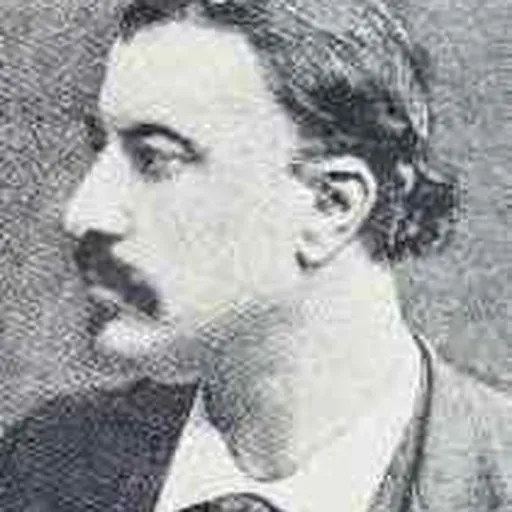
About Frederic Clay
Lived 1838 – 1889 (aged 51). Frederic Clay was a British composer.
Frederic Emes Clay (3 August 1838 – 24 November 1889) was an English composer known principally for songs and his music written for the stage. Although from a musical family, for 16 years Clay made his living as a civil servant in HM Treasury, composing in his spare time, until a legacy in 1873 enabled him to become a full-time composer. He had his first big stage success with Ages Ago (1869), a short comic opera with a libretto by W. S. Gilbert, for the small Gallery of Illustration; it ran well and was repeatedly revived. Clay, a great friend of his fellow composer Arthur Sullivan, introduced the latter to Gilbert, leading to the Gilbert and Sullivan partnership.
In addition to Gilbert, Clay's librettists during his 24-year career included B. C. Stephenson, Tom Taylor, T. W. Robertson, Robert Reece and G. R. Sims. The last of his four pieces with Gilbert was Princess Toto (1875), which had short runs in the West End and in New York. Clay's other compositions include cantatas and numerous individual songs. His last two works were both successful operas composed in 1883, The Merry Duchess and The Golden Ring. He then suffered a stroke that paralysed him at the age of 44 and ended his career.
The historian Kurt Gänzl has called Clay "the first significant composer of the modern era of British musical theatre", but even his most successful stage works were soon eclipsed by those of Gilbert and Sullivan. During his lifetime he was best known for his parlour songs, which were familiar throughout Britain. Clay's music was widely regarded as not particularly original or memorable, but musicianly and pleasing.
Life and career Early years
Clay was born in Paris, the fourth of six children of James Clay (1804–1873) and his wife, Eliza Camilla, née Woolrych. Clay was educated at home in London by private tutors, and studied piano and violin, and later composition under Bernhard Molique. Through the influence of Lord Palmerston, Clay secured a post in HM Treasury, Under a later administration Clay undertook confidential missions on behalf of W.E.Gladstone.
At the age of 20 Clay experienced what he called the "opening up" of his musical senses: hearing Verdi's Il trovatore at Covent Garden and Auber's Les diamants de la couronne at the Opéra-Comique in Paris, he was enthused by "the strength of vocal declamation in the one work and the delight of musical comedy in the other".
Clay had a modest operatic success with a one-act operetta, Court and Cottage, to a libretto by Tom Taylor, produced at Covent Garden in 1862 as an after-piece to Meyerbeer's Dinorah. A second one-act piece for Covent Garden followed in 1865: Constance, a curtain-raiser for the annual pantomime, had a libretto by T. W. Robertson. Like Court and Cottage, it was favourably reviewed in the press, but did not remain in the theatrical repertoire.
In the mid-1860s, Clay and his close friend and fellow musician Arthur Sullivan were frequent guests at the home of John Scott Russell. By about 1865 Clay became engaged to Scott Russell's youngest daughter, Alice May, and Sullivan wooed the middle daughter, Rachel.
1866 to 1873
In 1866 Clay's first cantata, The Knights of the Cross was performed in London, conducted by Sullivan. It was politely received, but the composer's "talent and good taste" did not, in the opinion of one reviewer, result in "much originality of character". In 1869 came Clay's first substantial theatrical success, the "operatic entertainment" Ages Ago, written for the German Reeds at the Royal Gallery of Illustration, with a libretto by W. S. Gilbert. and the "fantastic music drama" Babil and Bijou, or The Lost Regalia (1872).
Full-time composer
Foreseeing, and not relishing, a long period of Conservative government after the party's election victory in February 1874, Clay resigned from the Treasury.
Clay's cantata Lalla Rookh (containing his best-known song, "I'll sing thee songs of Araby" and also "Still this golden lull"), was given successfully at the Brighton Festival in 1877, and was later performed elsewhere in Britain and the US. and The Golden Ring starring Marion Hood (1883). The latter was written for the reopening of the Alhambra Theatre, which had been burned to the ground the year before. These shows were both successful and, in Gänzl's view, showed an artistic advance on Clay's earlier work.
Clay had been in precarious health during the year, and had been obliged to abandon work on a third cantata, Sardanapalus, commissioned for the Leeds Festival. After conducting the second performance of The Golden Ring in December 1883 he suffered a stroke that paralysed him and cut short his productive life. | In the article in the 2001 edition of Grove, Christopher Knowles sums up Clay's music: His melodies are always fresh and graceful; his harmonic treatment, though sometimes strikingly original, owes much to Rossini and Auber. Successful though he was, he never really broke away from the drawing-room ballad and, lacking Sullivan’s sense of fun and powers of invention, remained largely in his shadow. and The Encyclopedia of the Musical Theatre. The Squire (1881) Twelfth Night
Choral The Knights of the Cross (cantata, 1866) The Red Cross Knight (London, 1871, revision of the 1866 work, above) Lalla Rookh (cantata, Brighton Festival, 1877)
Songs Numerous, including "She Wandered Down the Mountainside", "The Sands of Dee", and "'Tis Better Not to Know".
Notes, references and sources
Don’t just read it —
keep it.
Full-length biographies made to live with: read them, listen on the way to work, watch them tonight.
- E-book
- Audio
- Video
Instant download · yours to keep · every purchase keeps this site free
Important facts
People in Frederic Clay's life
Named in this biography and alive at the same time






Related people
Same field, nearest in time


Contemporaries
People whose lives overlapped Frederic Clay's
Frequently asked questions
Who was Frederic Clay?
English composer
When was Frederic Clay born?
Frederic Clay was born on 3 August 1838 in Paris.
When did Frederic Clay die?
Frederic Clay died on 24 November 1889 in Buckinghamshire.
What was Frederic Clay's occupation?
Frederic Clay was a composer.
What nationality was Frederic Clay?
Frederic Clay was British.
Sources & further reading
Cite this page
APA: Biography.guide. (2026). Frederic Clay. https://biography.guide/frederic-clay/
MLA: "Frederic Clay." Biography.guide, https://biography.guide/frederic-clay/.
Chicago: "Frederic Clay." Biography.guide. https://biography.guide/frederic-clay/.
Data last updated: 2026-09-23 · Spot an error? Report a correction.
Portrait: Wikimedia Commons · author & licence
Page generated 2026-09-27 05:06 UTC