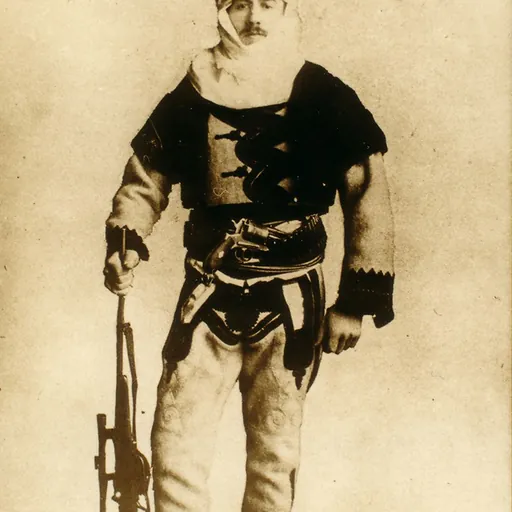
Franz Nopcsa von Felső-Szilvás
Hungarian noble and academic
About Franz Nopcsa von Felső-Szilvás
Lived 1877 – 1933 (aged 55). Franz Nopcsa von Felső-Szilvás was a Hungarian paleontologist, ethnologist, albanologist, writer, zoologist and geologist, known for Albanology, Ethnology and Geology.
Baron Franz Nopcsa von Felső-Szilvás (also Baron Nopcsa von Felső-Szilvás, Baron Nopcsa, Ferenc Nopcsa, báró felsőszilvási Nopcsa Ferenc, Baron Franz Nopcsa, and Franz Baron Nopcsa; May 3, 1877 – April 25, 1933) was a Hungarian aristocrat, adventurer, scholar, geologist, paleontologist and albanologist. He is widely regarded as one of the founders of paleobiology, and first described the theory of insular dwarfism. He was also a specialist on Albanian studies and completed the first geological map of northern Albania.
Life
Nopcsa was born in 1877 in Déva, Transylvania, Kingdom of Hungary (today Deva, Romania), to the Hungarian Nopcsa aristocratic family. He was the son of (1848-1918), a member of the Hungarian Parliament and his wife, Matylda Henrietta Żeleński z Żelanki (1852-1938). In 1895 Nopcsa's younger sister Ilona discovered dinosaur bones at the family estate at Szacsal (today part of Sânpetru, Sântămăria-Orlea, Romania). He shared the bones with Professor Eduard Suess, who encouraged him to study them. Following the professor's advice, he started studying geology at the University of Vienna in 1897, He acquired a PhD in geology in 1903 from the university; his doctorate focused on geologically mapping the area surrounding the family estate.
On 20 November 1906 Nopcsa met the then eighteen-year-old Bajazid Doda in Bucharest and hired him as his secretary. Nopcsa later recounted this meeting in his memoir:
Nopcsa had a close relationship with Doda for over 30 years. It is widely suspected that Nopcsa was gay and was in a homosexual relationship with Doda. He soon learned the Albanian dialects and customs. Eventually, he got on good terms with the leaders of the Albanian nationalist resistance who fought against the Turks in the region. Nopcsa gave passionate speeches and smuggled in weapons.
In 1907, on one of his expeditions into the Albanian mountains, he and Bajazid Doda were taken hostage by the bandit Mustafa Lita. Lita demanded ten thousand Turkish pounds for his release. He was eventually rescued by Doda's father, who had brought 'ten armed retainers'. Out of these conflicts, Albania arose as an independent state, which needed a king. Nopcsa volunteered, suggesting he would use money he would gain from marrying a rich American girl to fund the war efforts, however, to no avail.
Nopcsa Ferenc in Shqiptar warrior costume with Yataghan & Tançica, cca 1913 Later, during the First World War, Nopcsa was on another mission as a spy for Austria-Hungary, working undercover as a shepherd in Transylvania. With the defeat of Austria-Hungary at the end of the war, Nopcsa's native Transylvania was ceded to Romania. As a consequence, the Baron of Felső-Szilvás lost his estates and other possessions in 1920. Compelled to find paid employment, he landed a job as the head of the Hungarian Geological Institute in 1925.
But Nopcsa's tenure in the Geological Institute was short-lived, he soon became bored of the sedentary job. He went to Europe on a motorcycle journey together with his long-standing Albanian secretary Bajazid Elmaz Doda to study fossils. He later returned to Vienna where he ran into financial difficulties again and was distracted in his work. To cover his debts, he sold his fossil collection to the Natural History Museum in London. Nopcsa struggled with illness, to the extent that he had to give a lecture in a wheelchair in 1928.
During his lifetime Nopcsa wrote a memoir based on diaries and notes from 1897 to 1917. Even though he finished the memoir around 1929, it was never published during his lifetime.
Contributions to paleobiology and geology
Nopcsa's main contribution to paleontology – and hence "paleobiology" – was that he was one of the first researchers who tried to "put flesh onto bones." At a time when paleontologists were mainly interested in assembling bones, he tried to deduce the physiology and living behavior of the dinosaurs he was studying. Nopcsa was the first to suggest that these archosaurs cared for their young and exhibited complex social behavior, an idea that did not take off until the 1980s. Because he was one of the first people to study the biology of dinosaurs, he is known as the 'father of paleobiology', Some of his works in this field exploited paleohistological data.
Another of Nopcsa's theories that was ahead of its time was that birds evolved from ground-dwelling dinosaurs, which is the theory of cursorial origin of flight. He theorized that the Proavis, a theorized predecessor of birds, was running animal with forearms lifted off the ground, which they would flap as they made a jump. The scales on its forearms would develop into feathers to aid this, and eventually allowing for flight. He theorized that "limited resources" found on islands commonly have an effect of "reducing the size of animals" over the generations, producing a localized form of dwarfism. Nopcsa's theory of insular dwarfism—also known as the island rule—is today widely accepted. Additional pygmy sauropods, named Europasaurus, were recently discovered in northern Germany.
Nopcsa also created a theory about the dinosaurs' sexual dimorphism, which he published in 1926. Among others, he thought that hadrosaurid species with the cranial crests were males and those without them were females. He paired Kritosaurus with Parasaurolophus, Prosaurolophus with Saurolophus and others. His examples were not proved to be true, but his opinion that sexual dimorphism was present among hadrosaurid dinosaurs has gained acceptance, see for example Lambeosaurus.
Nopcsa discovered and named several species in his lifetime. In 1899 he named the species Mochlodon robustus, which he later renamed to Rhabdodon robustum in 1915. He also named Struthiosaurus transylvanicus, which he described in 1915. In 1928 he named the Teinurosaurus (meaning "extended tail lizard"). He named the turtle species Kallokibotion bajazidi, which literally means 'beautiful box of Bajazid '. Nopcsa chose the name because, in the words of British palaeontologist Gareth Dyke, "the shape of the shell reminded him of Bajazid's arse". especially on macroevolution, on which the fossil record can yield relevant data.
Nopcsa was also an important geologist.
After Nopcsa's death, several of his important manuscripts were left unpublished. He participated in the work of the Albanian Congress of Trieste, published his notes on the congress that became of particular historical interest. He left the Albanological part of his estate along with a letter of manuscripts to be published to Norbert Jokl, a renowned specialist in Albanian studies and Nopcsa's former colleague.
Media about Nopcsa In 2016, the English language documentary film "Doda-The life and adventures of Franz Baron Nopcsa", directed by North Macedonian director Visar Vishka, was released. The Hungarian language documentary Magyarosaurus – Báró Nopcsa Ferenc nyomában [Magyarosaurus – In the Footsteps of Baron Ferenc Nopcsa] directed by Áron Mátyássy starring geologist Árpád Juhász and aircraft aerobatic performer Péter Besenyei was released in 2019.
Don’t just read it —
keep it.
Full-length biographies made to live with: read them, listen on the way to work, watch them tonight.
- E-book
- Audio
- Video
Instant download · yours to keep · every purchase keeps this site free
Important facts
more
Baron Franz NopcsaPeople in Franz Nopcsa von Felső-Szilvás's life
Named in this biography and alive at the same time


Related people
Same field, nearest in time

Contemporaries
People whose lives overlapped Franz Nopcsa von Felső-Szilvás's


Frequently asked questions
Who was Franz Nopcsa von Felső-Szilvás?
Hungarian noble and academic (1877-1933)
When was Franz Nopcsa von Felső-Szilvás born?
Franz Nopcsa von Felső-Szilvás was born on 3 May 1877 in Deva.
When did Franz Nopcsa von Felső-Szilvás die?
Franz Nopcsa von Felső-Szilvás died on 25 April 1933 in Vienna.
What was Franz Nopcsa von Felső-Szilvás's occupation?
Franz Nopcsa von Felső-Szilvás was a paleontologist, ethnologist, albanologist, writer, zoologist and geologist.
What was Franz Nopcsa von Felső-Szilvás known for?
Franz Nopcsa von Felső-Szilvás was known for Albanology, Ethnology, Geology and Paleobiology.
What nationality was Franz Nopcsa von Felső-Szilvás?
Franz Nopcsa von Felső-Szilvás was Hungarian.
Sources & further reading
· Wikipedia: Franz Nopcsa von Felső-Szilvás
· DBpedia: Franz Nopcsa von Felső-Szilvás
Cite this page
APA: Biography.guide. (2026). Franz Nopcsa von Felső-Szilvás. https://biography.guide/franz-nopcsa-von-felso-szilvas/
MLA: "Franz Nopcsa von Felső-Szilvás." Biography.guide, https://biography.guide/franz-nopcsa-von-felso-szilvas/.
Chicago: "Franz Nopcsa von Felső-Szilvás." Biography.guide. https://biography.guide/franz-nopcsa-von-felso-szilvas/.
Data last updated: 2026-09-21 · Spot an error? Report a correction.
Portrait: Wikimedia Commons · author & licence
Page generated 2026-09-27 04:59 UTC