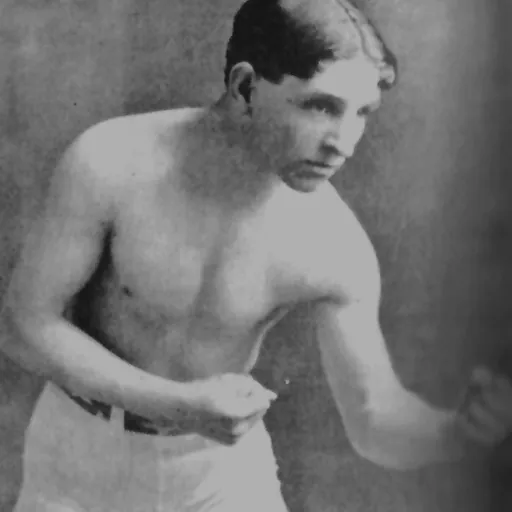
About Frankie Neil
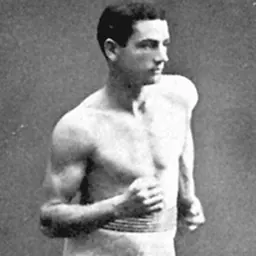
Lived 1883 – 1970 (aged 86). Frankie Neil was an American boxer.
Frankie Neil (July 25, 1883 – March 6, 1970) was a World Bantamweight champion. Fighting at 114 1/2 pounds, he took the world title from reigning champion Harry Forbes on August 13, 1903, at the Mechanics Pavilion in San Francisco in a second-round knockout of a match scheduled for twenty rounds. Eddie Graney was the referee. Neil held the title only a little over a year, losing it on October 17, 1904, to British boxing champion Joe Bowker.
Neil later was reputed to have lost much of his boxing fortune at the horse track and from investing in race horses. He worked for Standard Oil in his retirement from boxing.
Early career Not long before his first attempt at the bantamweight championship, on April 11, 1902, Neil fought a grueling fifteen-round draw against Eddie Hanlon, who was only seventeen at the time. The lengthy bout was considered an epic one, and both boxers later remarked to the Oakland Tribune that they were completely exhausted after the bout. Their close bout in Oakland, California, was marked by Neil's skills at fighting from a distance, as the Tribune noting Neil's defensive skills wrote, "At long range Neil was by far the cleverer of the two and he landed repeatedly on Hanlon...." Neil's scientific boxing skills were noted in the battle when the Tribune wrote, though Hanlon appeared the stronger, more aggressive boxer, "Neil had the cleaner punch and landed as often as Hanlon, but did not have the force to his blows."
Neil first tried for the bantamweight title against Harry Forbes on December 23, 1902, but lost in a seventh-round TKO in Oakland, California. In a wind up to the title between November 1900 and March 1902, Neal won an impressive seven of eight bouts in the San Francisco area by early knockout or technical knockout. During the two year windup, he fought against such competent boxers as George White, George Margarini, Tommy Dixon, and Kid Malone. Forbes had been a two to one betting favorite prior to the bout due to his standing as reigning champion, though many boxing fans still backed Neil to win. In the brief two rounds of boxing, Forbes had been down three times, probably surprising many in the audience.
According to at least the World Boxing Association, Neil lost the World Bantamweight title on October 17, 1904, to British boxer Joe Bowker at the National Sporting Club in London in an historic twenty round points decision. As globally recognized boxing associations with the ability to sanction titles were in their infancy in 1904, some dispute as to when Neil lost his title may exist in news articles of the period. Neil claimed years later in an interview that he was never able to hit with the same ferocity after hearing of the death of Tenny. Neil may have been considered a clever scientific boxer by some, but these skills, in the opinion of most boxing historians, were far surpassed by those of Attell. In December 1906, Neil wrote an article for the Oakland Tribune noting that he was robbed by the referee in the decision against him in his July 4 bout with Attell in Los Angeles, and that he had given Attell, the "worst licking of his career." It is questionable if most of the boxing fans present would have agreed with Neil.
Neil would lose to Attell again at Dreamland Rink in San Francisco on January 31, 1908, in a thirteenth of twenty-round TKO. Years later, in an interview in 1961, Attell claimed he had been motivated to beat Neil as a result of anti-semitic remarks he had heard Neil, whom he had known since childhood, make during the fight.
Boxing decline, 1907
In his ill-advised comeback to the ring on November 22, 1907, Neil lost badly to the accomplished boxer Owen Moran at the Dreamland Rink in San Francisco. As noted by The San Francisco Call, of his eight-month hiatus from boxing, "it is this letup which is the factor that is hard to estimate in figuring upon his chances." Though sometimes taking on top talent, such as Young Brit, and Monte Attell, Neil lost 13 of 21 of his better publicized bouts after his loss to Moran.
Later life and death Neil was working for Standard Oil in Richmond, California by June 1926, and had lived in Richmond since the early 1920s. In 1926, he would on occasion referee boxing matches at El Cerito, and Richmond, California. He had previously lost his boxing fortune from investing in a large stable of race horses and from his personal losses from betting on the races.
He died on March 6, 1970, at 86, in Richmond, California after an illness of several months, and was buried three days later at Mt. Olivet Cemetery in the South San Francisco suburb of Colma. Neil had been working as a janitor at a local Post Office in his later years, living at Point Richmond.
Professional boxing record All information in this section is derived from BoxRec, unless otherwise stated.
Official record
All newspaper decisions are officially regarded as “no decision” bouts and are not counted to the win/loss/draw column.
Don’t just read it —
keep it.
Full-length biographies made to live with: read them, listen on the way to work, watch them tonight.
- E-book
- Audio
- Video
Instant download · yours to keep · every purchase keeps this site free
Important facts
People in Frankie Neil's life
Named in this biography and alive at the same time



Related people
Same field, nearest in time


Contemporaries
People whose lives overlapped Frankie Neil's


Frequently asked questions
Who was Frankie Neil?
American boxer (1883-1970)
When was Frankie Neil born?
Frankie Neil was born on 25 July 1883 in San Francisco.
When did Frankie Neil die?
Frankie Neil died on 6 March 1970 in Point Richmond, California.
What was Frankie Neil's occupation?
Frankie Neil was a boxer.
What nationality was Frankie Neil?
Frankie Neil was American.
Sources & further reading
Cite this page
APA: Biography.guide. (2026). Frankie Neil. https://biography.guide/frankie-neil/
MLA: "Frankie Neil." Biography.guide, https://biography.guide/frankie-neil/.
Chicago: "Frankie Neil." Biography.guide. https://biography.guide/frankie-neil/.
Data last updated: 2026-09-24 · Spot an error? Report a correction.
Portrait: Wikimedia Commons · author & licence
Page generated 2026-09-27 05:08 UTC