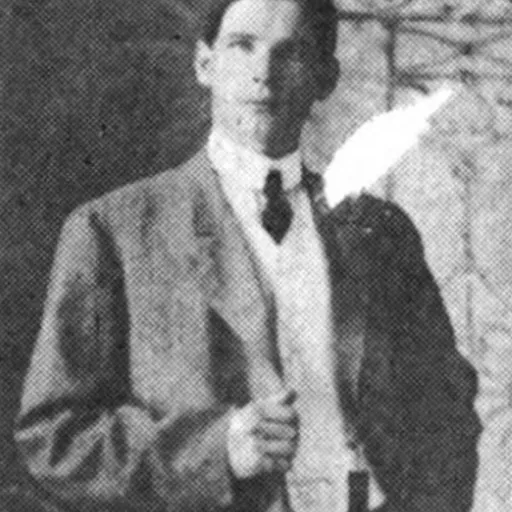
Frank Pease
American activist
About Frank Pease
Lived 1879 – 1959 (aged 79). Frank Pease was an American.
Major Frank Pease (September 22, 1879 - January 12, 1959) was president of the Hollywood Technical Directors Institute, an anti-communist activist organization during the 1920s and 1930s. His was best known for his opposition to Sergei Eisenstein's presence in the United States while the filmmaker was on contract with Paramount Studios. Due to Pease's campaign against the Russian filmmaker, the Fish Committee (predecessor to the House Un-American Activities Committee) investigated Eisenstein for contaminating American cinema with communist propaganda.
Family
Frank Chester Pease was born in 1879, although some sources say 1881 or 1883, in Boston, Massachusetts. He also used the middle name of Clymer. On December 13, 1907, he married Belle de Mille Norris, 26, in Chicago while he was an art student studying sculpture. The couple had a daughter, Elizabeth, who died at the age of 6 months on June 28, 1909. The tragedy put a strain on the marriage and the couple divorced by the end of 1915. Pease married Mabelle Abbie Rose Abbott.
Military career
Although Pease identified himself as a retired major in the United States Army, he held no such rank. He served as a private in 1902 and was attached to the Hospital Corps. He received a medical discharge in 1905 at the Presidio in San Francisco after serving at Cotabato, Philippines, where his right leg was amputated. He also suffered from bronchitis and hemorrhoids. He announced to the San Jose Mercury News in 1907 that he planned a world tour of foreign armies to learn their procedures and to help implement reforms in the U.S. Army, but his project never materialized.
Hollywood
Living a transient life for several years, he worked as a Red Cross field director in Fort Worden Point, Townsend, WA, during World War I. By the early 1920s, his writings of progressive politics had stopped, although he continued to write non-political articles for "The Smart Set" and art-related periodicals. It was during this period that his political ideology shifted from the progressive movement to the far right. He arrived in Hollywood on August 11, 1927, and began attending Actors' Equity meetings. He and his wife, Mabelle, lived on Sunset Boulevard in 1930 with their young daughter. He garnered a reputation among some actors for making wild accusations at Actors' Equity meetings that actors harbored communist sympathies. In 1930 he identified himself as a screenwriter, but there is no evidence that he wrote scripts or received screen credit. He also variously presented himself as a film director or agent, but there remains no evidence that he held any of these positions.
In November 1929, he founded the United Character Actors' Association that purported to represent day actors, such as bit players and extras. However, day actors only earned $15 a day and Pease could not earn a living operating the association. His next project was the Hollywood Technical Directors Institute, which he operated out of his residence at 6557 Sunset Boulevard. There is no evidence that the institute had any employees or represented any technical directors. Pease identified technical directors as experts in their field, such as military personnel, who monitored the accuracy of specific professions depicted in movies and provided technical advice to film directors. Yet no film director had ever heard of Pease or his organization until Pease began issuing press statements that director Lewis Milestone's "All Quiet on the Western Front" (1930) was anti-American and anti-military. Pease characterized the film as "filthy" because it undermined the beliefs in the army and its chief source of inspiration originated from the Soviet Union. Pease spent three unproductive years in Europe in his attempts to agitate against communism. He returned to the United States in 1934. The Jewish Telegraphic Agency tracked Pease's activities throughout the 1930s, documenting his work as a fascist and antisemitic pamphleteer. In August 1937 he moved from New York to live in Coral Gables, FL.
He served as the National Commander of the American Defenders, originally called the National Film Committee of American Defenders, an anti-Jewish fascist organization founded in 1929 by Pease. By the early 1930s, American Defenders became primarily a publisher for Pease's pamphlets. Although antisemitic, Pease opposed the policies of Germany's National Socialism. He also was an avid supporter of the American fascist H. Keith Thompson and the antisemite William Gregg Blanchard II, the leader of the Los Angeles-based The White Front in the late 1930s and publisher of "Nation and Race" and author the booklet "Racial Nationalism."
Among Pease's published writings were "What I Learned in Nazi Germany" (American Defender Press, 1934) in which he attempted to link communism to the Third Reich, and "Pole to Panama: An Appeal for American Imperialism and a Defense of American Capitalism" (American Defender Press, 1935), which advocated American imperialism by controlling all lands from the North Pole to Panama as a means to solve internal and foreign problems. He also published through American Defender "The Hole in The Hauptmann Case?" (1936), which alleged that Richard Hauptmann was framed for the Lindbergh kidnapping, and "Technicians and Revolution: An Expose of Communist Tactics For Overthrowing The State" (1939).
Death
Pease died in Dade County, FL, in 1959 and buried at Arlington National Cemetery. Mabelle died in 1966 and was buried alongside him.
Don’t just read it —
keep it.
Full-length biographies made to live with: read them, listen on the way to work, watch them tonight.
- E-book
- Audio
- Video
Instant download · yours to keep · every purchase keeps this site free
Important facts
People in Frank Pease's life
Named in this biography and alive at the same time





Contemporaries
People whose lives overlapped Frank Pease's






Frequently asked questions
Who was Frank Pease?
American activist
When was Frank Pease born?
Frank Pease was born on 22 September 1879 in Boston.
When did Frank Pease die?
Frank Pease died on 12 January 1959 in Miami-Dade County.
What nationality was Frank Pease?
Frank Pease was American.
Sources & further reading
Cite this page
APA: Biography.guide. (2026). Frank Pease. https://biography.guide/frank-pease-1879/
MLA: "Frank Pease." Biography.guide, https://biography.guide/frank-pease-1879/.
Chicago: "Frank Pease." Biography.guide. https://biography.guide/frank-pease-1879/.
Data last updated: 2026-09-20 · Spot an error? Report a correction.
Page generated 2026-09-27 05:10 UTC