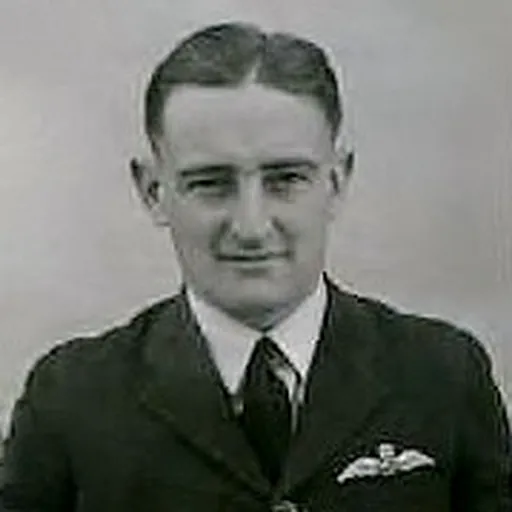
About Frank Headlam
Lived 1914 – 1976 (aged 62). Frank Headlam was an Australian aircraft pilot.
Air Vice Marshal Frank Headlam, (15 July 1914 – 23 December 1976) was a senior commander in the Royal Australian Air Force (RAAF). Born and educated in Tasmania, he joined the RAAF as an air cadet in January 1934. He specialised in flying instruction and navigation before the outbreak of World War II. In April 1941, he became commanding officer of No. 2 Squadron, which operated Lockheed Hudsons. The squadron was deployed to Dutch Timor in December, and saw action against Japanese forces in the South West Pacific. After returning to Australia in February 1942, Headlam held staff appointments and training commands, finishing the war a group captain.
Headlam served as Officer Commanding North-Western Area in 1946, and as Director of Training from 1947 to 1950. In 1950–51, during the Malayan Emergency, he was stationed at Singapore as commander of No. 90 (Composite) Wing and, later, RAF Tengah. He twice served as acting Air Member for Personnel, in 1957 and 1959–60, receiving appointment as a Commander of the Order of the British Empire in 1958. Promoted air vice marshal, he successively held the positions of Air Officer Commanding (AOC) Operational Command in 1961–62, AOC No. 224 Group RAF from 1962 to 1965 during the Indonesia–Malaysia Konfrontasi, Deputy Chief of the Air Staff in 1965–66, and AOC Support Command in 1966–67. He was appointed a Companion of the Order of the Bath in 1965. Following a posting to London as Head of the Australian Joint Services Staff from 1968 to 1971, he retired from the Air Force and died in Melbourne five years later.
Early career RAAF Avro Ansons in 1938; Flight Lieutenant Headlam flew a similar model around Australia on a long-distance navigation exercise in November that year. The son of farmers Malcolm and Hilda Headlam, Frank Headlam was born on 15 July 1914 in Launceston, Tasmania. He was schooled at Clemes College, Hobart, and matriculated in 1932. Against the wishes of his parents he joined the Royal Australian Air Force (RAAF) as an air cadet on 16 January 1934. He underwent flying instruction with No. 1 Flying Training School (FTS) at RAAF Point Cook, Victoria, and was commissioned as a pilot officer on 1 January 1935.
After completing a conversion course, Headlam was assigned to the Seaplane Squadron at Point Cook. No larger than a flight according to the official history of the pre-war RAAF, Seaplane Squadron was part of No. 1 FTS and operated Supermarine Southampton flying boats and de Havilland Gipsy Moth floatplanes, among other types. During this posting Headlam was promoted to flying officer, on 1 July 1935, and wrote a paper on national defence in which he suggested that with "strong air forces, naval forces (including submarines), and fixed defences, Australia may be made practically invulnerable". According to Air Force historian Alan Stephens, this paper "in effect, defined the 'anti-lodgment' concept which has been a persistent feature of RAAF strategic thinking". Commencing in July 1938, he was one of six students to take part in the RAAF's first Long Specialist Navigation Course, run by Flight Lieutenants Bill Garing and Alister Murdoch at Point Cook. The course involved several epic training flights that attracted considerable media attention, including a twelve-day, round-Australia trip by three Avro Ansons, one of which was piloted by Headlam, in November. The following month, Headlam led the three Ansons on a six-day journey back and forth over Central Australia. He subsequently passed the navigation course with a special distinction. On 27 January 1939 he was posted to RAAF Station Laverton, Victoria, as a flight commander.
World War II
Following the outbreak of World War II, No. 1 Squadron undertook convoy escort and maritime reconnaissance duties off south-eastern Australia. On 7 December, this detachment established itself at Penfui, near Koepang in Dutch Timor; No. 2 Squadron's eight remaining Hudsons were stationed at Darwin on standby. The following day, aware that Australia was now at war in the Pacific, one of the Penfui-based Hudsons attacked the Japanese pearler Nanyo Maru, which was suspected of being a radio ship, and forced it aground. Penfui was bombed by the Japanese for the first time on 26 January 1942, and attacked regularly thereafter, damaging some aircraft. The intact Hudsons were withdrawn to Darwin but Headlam and his staff remained at Penfui so the base could be used by aircraft during reconnaissance missions from Australia. On 18 February, Headlam was ordered to evacuate all his personnel except a small party to demolish the airfield with assistance from Sparrow Force. He returned to Darwin the next day, just as the city experienced its first raid by the Japanese. Four of No. 2 Squadron's Hudsons were destroyed in the attack; the remainder were relocated to Daly Waters, where they continued to carry out reconnaissance and bombing missions against Japanese targets in Timor. No. 97 (Reserve) Squadron was formed from the school's personnel in June. He was promoted to group captain on 1 December 1943, and was appointed the inaugural commanding officer of No. 3 AOS, operating Ansons and Fairey Battles out of Port Pirie, on 9 December. Headquartered at RAF Changi, Singapore, No. 90 Wing controlled RAAF units operating during the Malayan Emergency: No. 1 (Bomber) Squadron, flying Avro Lincolns, and No. 38 (Transport) Squadron, flying Douglas C-47 Dakotas. The Lincolns conducted area bombing missions over communist-held territory, as well as strikes against pinpoint targets. The Dakotas were tasked with courier flights, VIP transport and medical evacuations across South East Asia, and in Malaya with airlifting troops and cargo, dropping supplies to friendly forces and despatching propaganda leaflets. Headlam was slightly injured on 20 December, when a No. 38 Squadron Dakota he was co-piloting on a supply drop crash-landed at Kampong Aur in Pahang, following engine failure. In August 1951 he was named commander of RAF Tengah, Singapore, while retaining his post as commanding officer of No. 90 Wing. Headlam handed over command of No. 90 Wing in December 1951.
On 19 February 1952, Headlam became senior air staff officer (SASO) at Eastern Area Command in Penrith, New South Wales. During his term as SASO, the RAAF began re-equipping with English Electric Canberra jet bombers and CAC Sabre jet fighters. Headlam was appointed an Officer of the Order of the British Empire (OBE) in the 1954 New Year Honours for his "exceptional ability and devotion to duty". He was promoted to acting air commodore in May.
Headlam was promoted to substantive air commodore on 1 January 1955. In this role Headlam occupied a seat on the Air Board, the service's controlling body that comprised its senior officers and was chaired by the Chief of the Air Staff. He was also one of two RAAF representatives to serve on a committee, chaired by businessman William John Allison, examining conditions of defence service; the committee's recommendations led to a doubling of flight pay, among other improvements. Headlam's other positions at the Department of Air included Air Commodore Plans from October 1957 to January 1959, and Director General Plans and Policy from January to August 1959. Headlam was appointed a Commander of the Order of the British Empire (CBE) in the 1958 Queen's Birthday Honours, gazetted on 3 June. In May 1960 he became acting Deputy Chief of the Air Staff. Headlam was promoted to air vice marshal on 29 May. He was succeeded as AOC OPCOM by Air Vice Marshal Alister Murdoch. Divorced from his first wife in 1956, he married widowed social worker Vernon Spence at the Sydney registry office on 20 January 1964. He handed over No. 224 Group to Air Vice Marshal Christopher Foxley-Norris on 30 November.
Returning to Australia, Headlam became Deputy Chief of the Air Staff (DCAS) on 26 January 1965. His tenure as DCAS coincided with the most significant rearmament program the Air Force had undertaken since World War II, and with manpower shortages stemming from this expansion and from Australia's increasing involvement in the security of South East Asia. The first RAAF helicopters were committed to the Vietnam War towards the end of his term, and he travelled to Saigon with the Chief of the General Staff, Lieutenant General Sir John Wilton, in March 1966 to plan the deployment. The year before, Wilton had recommended to Air Marshal Murdoch, the Chief of the Air Staff, that two Iroquois be sent to Vietnam for familiarisation purposes; Murdoch had rebuffed Wilton, and the RAAF helicopter squadron was considered underprepared for its army co-operation role when it finally did deploy. Headlam succeeded Air Vice Marshal Douglas Candy as AOC Support Command, Melbourne, on 8 August 1966. Support Command had been formed in 1959, by merging the RAAF's former Training and Maintenance Commands.
Retirement Returning to Australia in June 1971, Headlam took resettlement leave before retiring from the Air Force on 3 August.
Don’t just read it —
keep it.
Full-length biographies made to live with: read them, listen on the way to work, watch them tonight.
- E-book
- Audio
- Video
Instant download · yours to keep · every purchase keeps this site free
Important facts
People in Frank Headlam's life
Named in this biography and alive at the same time






Related people
Same field, nearest in time

Contemporaries
People whose lives overlapped Frank Headlam's

Frequently asked questions
Who was Frank Headlam?
commander in the Royal Australian Air Force (1914-1976)
When was Frank Headlam born?
Frank Headlam was born on 15 July 1914 in Launceston.
When did Frank Headlam die?
Frank Headlam died on 23 December 1976 in Melbourne.
What was Frank Headlam's occupation?
Frank Headlam was an aircraft pilot.
What nationality was Frank Headlam?
Frank Headlam was Australian.
Sources & further reading
Cite this page
APA: Biography.guide. (2026). Frank Headlam. https://biography.guide/frank-headlam/
MLA: "Frank Headlam." Biography.guide, https://biography.guide/frank-headlam/.
Chicago: "Frank Headlam." Biography.guide. https://biography.guide/frank-headlam/.
Data last updated: 2026-09-23 · Spot an error? Report a correction.
Portrait: Wikimedia Commons · author & licence
Page generated 2026-09-27 05:06 UTC