
About Frank George Gibbons
Lived 1899 – 1932 (aged 32). Frank George Gibbons was a British military personnel.
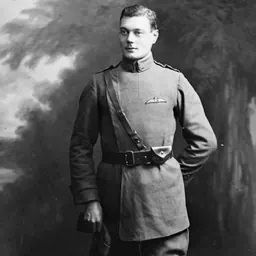
Flight Lieutenant Frank George Gibbons (13 June 1899 – 21 May 1932) was a British First World War flying ace credited with fourteen aerial victories. He served in the Royal Air Force post-war, until killed in a flying accident during an air race.
World War I service
Gibbons joined the Royal Flying Corps as an air mechanic (cadet) in June 1917, and was commissioned as a second lieutenant in November. After completing his flying training Gibbons was posted to No. 22 Squadron RFC to fly the Bristol F.2b two-seater fighter. He was promoted to lieutenant in April 1918, and gained his first aerial victory on 31 May. This was the first in a string of victories that made him an ace by 5 June, gaining the required five victories in less than a week. He gained another victory at the end of June, and single victories in July and August, before scoring another string of six between 2 and 27 September. Such aces as John Jones, John Umney, Ronald Fletcher, Valentine Collins, Christopher Shannon, and James McDonald manned the observer's guns while teamed with Gibbons. In his final tally, he had destroyed six German fighter aircraft and driven eight others down out of control, In July 1919 he was sent to the Middle East to serve in No. 111 Squadron based in Palestine, On 22 April, he was granted Royal Aero Club Aviators' Certificate No. 7860, and on 15 June he rejoined the Royal Air Force when granted a short service commission with the rank of flying officer with effect from 9 June 1920. Later that year he undertook the Instructor's Course at the Central Flying School.
Gibbons was granted a permanent commission in the RAF on 26 December 1922, and his short service commission was cancelled. On 16 May 1923 he was posted to No. 208 Squadron, then based at Constantinople, Turkey, flying Bristol F.2b fighters. On 14 August he was transferred to the Aden Flight, a detachment from No. 208 Squadron, based at RAF Khormaksar, Aden. On 15 April 1925 he returned to No. 208 Squadron, who were now based at RAF Ismailia, Egypt.
On 1 January 1926 Gibbons was promoted to flight lieutenant, and on 22 January he was transferred to RAF Heliopolis, Egypt. He was eventually transferred back to the Home Establishment, and posted to the RAF Depot at Uxbridge on 4 November 1926. On 16 April 1927 he was assigned to No. 19 Squadron, based at RAF Duxford, flying the Gloster Grebe, and then to the Home Aircraft Depot at RAF Henlow in 30 July, to attend an engineering course. On 1 August 1929 Gibbons was posted to No. 5 Flying Training School at RAF Sealand, serving on the staff for engineering duties. to complete a course in navigation,
Air racing Aside from his RAF career Gibbons also developed an interest in the popular air races of the day. He competed in the 1930 King's Cup Air Race flying the Cirrus Hermes-engined Simmonds Spartan G-AAMG, but failed to complete the course. He also flew as navigator to Mr. H. T. Andrews, flying a Spartan Arrow in the Circuit of Europe competition in mid-1930. The next day he attended the Yorkshire Aeroplane Club's event at Sherburn-in-Elmet, taking part in a 30-mile air race in his Spartan, and coming third. On 25 July 1931 Gibbons took part in the King's Cup Air Race for the second time, again flying Spartan G-AAHA. He led for much of the race, but was finally overtaken in the final leg by Flying Officer E. C. T. Edwards, flying the Blackburn Bluebird IV G-AACC belonging to Robert McAlpine, and came second by only three minutes. On 3 October 1931 he took part in a race between Heston Aerodrome, London, and Cardiff, to mark the opening of the Cardiff Municipal Aerodrome. Gibbons was flying the Gipsy II-engined Spartan Three Seater G-ABTT, and came third, despite carrying Louis Strange and his wife as passengers.
On 21 May 1932 Gibbons was again flying the Three Seater G-ABTT in a race sponsored by The Morning Post, when his aircraft crashed into a tree near Stanton, Suffolk, killing him instantly. It was believed he was looking at a map inside the cockpit at the moment of the accident. Gibbons' funeral took place at Ipswich on 25 May 1931. He was 32 years of age and unmarried.
Don’t just read it —
keep it.
Full-length biographies made to live with: read them, listen on the way to work, watch them tonight.
- E-book
- Audio
- Video
Instant download · yours to keep · every purchase keeps this site free
Important facts
People in Frank George Gibbons's life
Named in this biography and alive at the same time





Related people
Same field, nearest in time



Contemporaries
People whose lives overlapped Frank George Gibbons's


Frequently asked questions
Who was Frank George Gibbons?
British flying ace
When was Frank George Gibbons born?
Frank George Gibbons was born on 13 June 1899 in Peterborough.
When did Frank George Gibbons die?
Frank George Gibbons died on 21 May 1932 in Stanton.
What was Frank George Gibbons's occupation?
Frank George Gibbons was a military personnel.
What nationality was Frank George Gibbons?
Frank George Gibbons was British.
Sources & further reading
· Wikipedia: Frank George Gibbons
· DBpedia: Frank George Gibbons
Cite this page
APA: Biography.guide. (2026). Frank George Gibbons. https://biography.guide/frank-george-gibbons/
MLA: "Frank George Gibbons." Biography.guide, https://biography.guide/frank-george-gibbons/.
Chicago: "Frank George Gibbons." Biography.guide. https://biography.guide/frank-george-gibbons/.
Data last updated: 2026-09-20 · Spot an error? Report a correction.
Page generated 2026-09-27 05:24 UTC