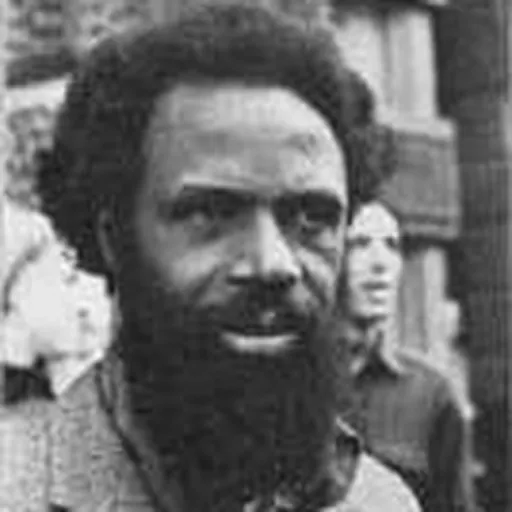
Frank Crichlow
British activist for Black rights
About Frank Crichlow
Lived 1932 – 2010 (aged 78). Frank Crichlow was a British civil rights advocate and community activist, known for The Mangrove.
Frank Gilbert Crichlow (13 July 1932 – 15 September 2010) was a British community activist and civil rights campaigner, who became known in 1960s London as a godfather of black power activism. He was a central figure in the Notting Hill Carnival. His restaurant, The Mangrove in All Saints Road, served for many years as the base from which activists, musicians, and artists organised the event.
Crichlow was one of the Black activists known as the Mangrove Nine, who were charged in 1970 with inciting a riot following a protest against repeated police raids of The Mangrove restaurant. The defendants were all acquitted of the most serious charges and the trial became the first judicial acknowledgement of behaviour (the repeated raids) motivated by racial hatred, rather than legitimate crime control, within the Metropolitan Police.
Early life and emigration to UK Originally from Woodbrook, Port of Spain, Trinidad, Frank Crichlow arrived in England in June 1953 on the SS Colombie, among the first wave of post-war immigrants from the Caribbean. He lived in Paddington at first, working for British Rail, then formed the Starlight Four band in 1956. Margaret Busby writes in The Guardian that the band had a few television and radio appearances, which, by 1959, gave Crichlow enough money to open the El Rio cafe in Notting Hill at 127 Westbourne Park Road. The cafe became a fashionable meeting place — with people such as model Christine Keeler and politician John Profumo as customers — and provided a safe place for black people to meet. Crichlow described it as a "school or university" for hustlers.
The Mangrove and civil rights activism In 1968, Crichlow opened The Mangrove restaurant at 8 All Saints Road, Notting Hill, attracting both unwelcome police attention and celebrity visitors such as Diana Ross and the Supremes, Vanessa Redgrave, and Sammy Davis Jr. The restaurant was raided six times in the first year, though nothing was found. Crichlow, Darcus Howe, and several others marched on the police station in 1970 in protest against the constant police attention. Crichlow called the trial "a turning point for black people".
Despite being well known locally for his anti-drug stance — Heather Mills writes in The Independent that the local joke about him was that "his education is lacking: he's the only Trinidadian who doesn't know what a great draw of ganja is" — Crichlow was charged with drug offences in 1979 but was subsequently cleared of the charges. In 1988, police used sledgehammers to break into The Mangrove, searching for drugs, after hiding in a freight container outside the restaurant, from where they launched the raid. Charged with possession of heroin and cannabis, which he said the police had planted, Crichlow was defended by Gareth Peirce, Michael Mansfield, and Courtenay Griffiths. Crichlow was again acquitted, receiving £50,000 damages from the Metropolitan Police in 1992 for false imprisonment, battery and malicious prosecution.
Personal life and death Crichlow and his partner, Lucy Addington, had a son and three daughters, including Lenora.
Crichlow died of prostate cancer in 2010, aged 78.
In popular media and legacy Crichlow appeared in the 1973 Franco Rosso and John La Rose documentary film The Mangrove Nine.
In 2011, a blue plaque for Crichlow organised by the Nubian Jak Community Trust was unveiled at the former site of The Mangrove in All Saints Road.
Actor Shaun Parkes portrays Crichlow in the Mangrove episode of Steve McQueen's 2020 film anthology/television miniseries Small Axe.
Don’t just read it —
keep it.
Full-length biographies made to live with: read them, listen on the way to work, watch them tonight.
- E-book
- Audio
- Video
Instant download · yours to keep · every purchase keeps this site free
Important facts
Family & relationships
People in Frank Crichlow's life
Named in this biography and alive at the same time



Related people
Same field, nearest in time



Contemporaries
People whose lives overlapped Frank Crichlow's

Frequently asked questions
Who was Frank Crichlow?
British activist for Black rights
When was Frank Crichlow born?
Frank Crichlow was born on 13 July 1932 in Port of Spain.
When did Frank Crichlow die?
Frank Crichlow died on 15 September 2010 in London.
What was Frank Crichlow's occupation?
Frank Crichlow was a civil rights advocate and community activist.
What was Frank Crichlow known for?
Frank Crichlow was known for The Mangrove.
What nationality was Frank Crichlow?
Frank Crichlow was British.
Sources & further reading
Cite this page
APA: Biography.guide. (2026). Frank Crichlow. https://biography.guide/frank-crichlow/
MLA: "Frank Crichlow." Biography.guide, https://biography.guide/frank-crichlow/.
Chicago: "Frank Crichlow." Biography.guide. https://biography.guide/frank-crichlow/.
Data last updated: 2026-09-22 · Spot an error? Report a correction.
Portrait: Wikimedia Commons · author & licence
Page generated 2026-09-27 04:59 UTC